





Related Content: Diesel Prices Soar Amid Oil Market Volatility
Fleet Advantage TLDI Highlights Rising Costs of Aging Fleet Equipment Amid Higher Diesel Prices
Fleet Advantage’s latest Truck Life Cycle Data Index shows fleets operating older Class 8 trucks could face significantly higher costs as diesel prices rise, while newer 2028 equipment may deliver savings of more than $12,000 per truck annually.
May 7, 2026
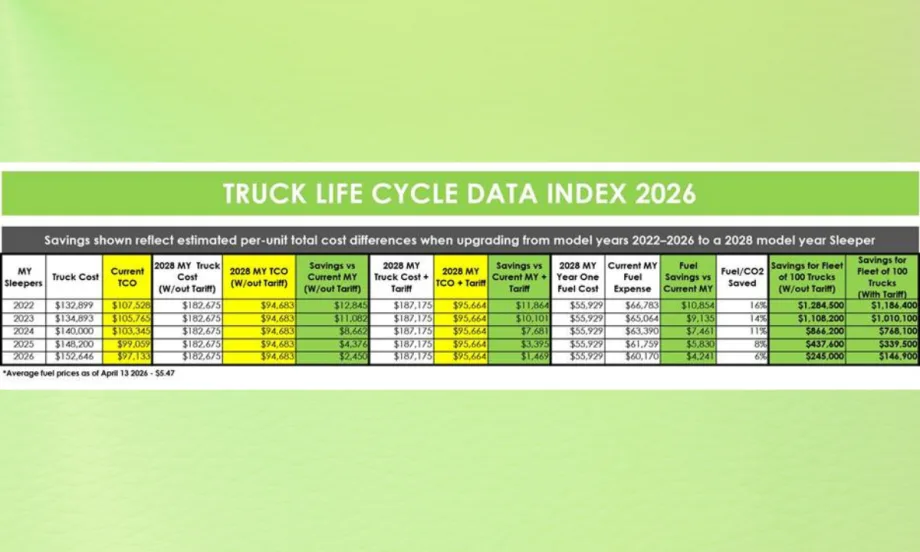
Fleet Advantage’s latest Truck Life Cycle Data Index highlights the operating cost benefits of upgrading to newer Class 8 truck models.
Credit:
Fleet Advantage
2 min to read
Fleet Advantage released updated findings from its Truck Life Cycle Data Index (TLDI), comparing all-in operating costs of Class 8 trucks across recent model years. The data comes as national diesel prices have surpassed $5.20 per gallon in some markets, highlighting the financial impact of operating older equipment.
TLDI Data Highlights Cost Gap Between Older and Newer Trucks
The latest TLDI compares 2022 through 2026 model-year trucks with new 2028 equipment using the April 2026 national average diesel price of $5.47 per gallon.
According to the data, replacing a 2022 sleeper truck with a 2028 model can reduce first-year operating costs by up to $12,845 per vehicle. For a 100-truck fleet, that equates to potential savings of $1.28 million, excluding tariff adjustments.
Fleet Advantage said diesel prices increased roughly 40% in one month, widening the cost gap between older, less fuel-efficient trucks and newer equipment. The company noted that many fleets are also evaluating alternative fuel options as part of their procurement strategies.
The TLDI data points to savings in fuel efficiency, maintenance and repair, and total cost of ownership when fleets upgrade equipment.
Fuel Efficiency Drives Savings
Fuel economy remains one of the largest contributors to cost savings from truck replacement. Fleet Advantage said fleets operating 2022 sleeper trucks can save approximately $10,854 per truck in fuel costs during the first year after replacing them with 2028 models — a 16% reduction in fuel expense along with lower CO2 emissions.
“In today’s elevated diesel price environment, even incremental improvements in fuel efficiency can translate into thousands of dollars in annual savings per truck,” said Brian Antonellis, senior vice president of fleet operations for Fleet Advantage.
Antonellis said older trucks create a compounding cost burden across fuel, maintenance and total cost of ownership, which becomes more significant as diesel prices rise.
Multi-Year Planning and Tariff Considerations
Fleet Advantage said a multi-year procurement strategy can help fleets optimize equipment acquisition and reduce total cost of ownership. The company cited rising material costs, changing emissions regulations, and evolving durability standards as factors contributing to higher vehicle prices.
The TLDI also factors in current tariff conditions. Fleet Advantage said that even with a $4,500 tariff added to 2028 model-year equipment, upgrading still delivers cost savings:
- Fleets upgrading from 2022 models can save $11,864 per truck, or $1.19 million across 100 trucks.
- Fleets upgrading from 2023 models can save $10,101 per truck, or $1.01 million across 100 trucks.
- Fleets upgrading from 2025 models can save $3,395 per truck, or $339,500 across 100 trucks.
“Even with rising component prices and tariff headwinds, the economics still strongly favor upgrading to newer equipment,” Antonellis said.
More Equipment
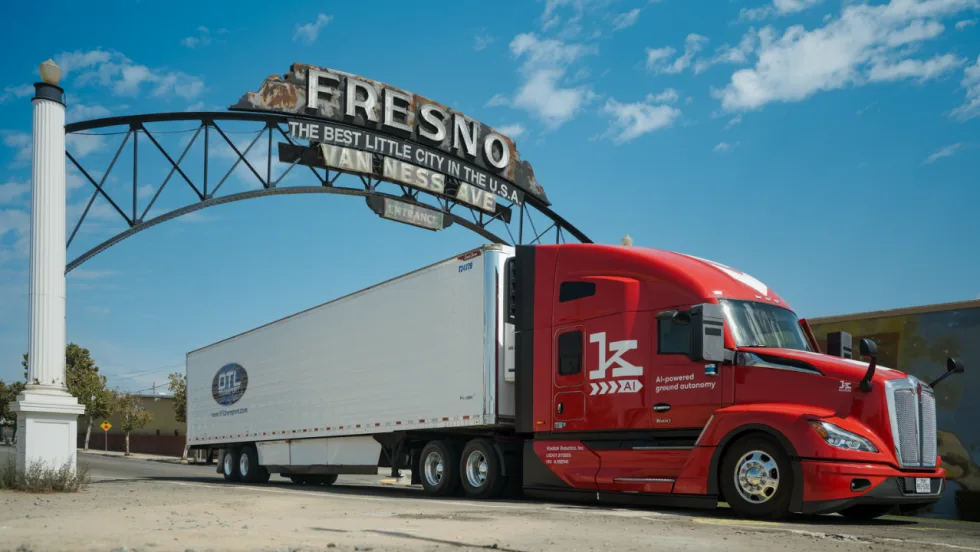
Kodiak Hauls Produce in California Autonomous Truck Pilot
Kodiak AI and DTL Transport have begun hauling produce between Fresno and Los Angeles under California’s new rules for testing heavy-duty autonomous trucks. A safety driver remains behind the wheel.
Read More →
Used-Truck Remarketing Math Is Changing
Used-truck value is no longer just a concern at trade-in. Decisions made throughout a truck’s first life can influence what it’s worth years later.
Read More →
How Volvo Updated Its D13 for EPA 2027 [Watch]
Volvo’s updated D13 promises lower emissions without sacrificing performance or fuel economy. Take a closer look at what changed inside the engine in this HDT Spotlight video.
Read More →
Michelin Tire Improves Efficiency and Durability for Regional Fleets
The Michelin X Multi Energy D2 is a regional haul drive tire engineered to help fleets improve fuel efficiency, durability and traction in demanding stop-and-go operations.
Read More →
ZF Expands Commercial Vehicle Push in North America
ZF is expanding its North American commercial-vehicle presence with new transmission applications, electrification, trailer technology and autonomous-driving systems.
Read More →
Tesla Wants a Self-Driving Semi. Are Cameras Enough?
Could Tesla’s camera-only autonomous driving technology work on an 80,000-pound Semi? In this commentary, HDT's Deborah Lockridge takes a look at Tesla, Cybercab, and how autonomous trucks see the road.
Read More →
Kodiak: Driverless Long-Haul Truck Launch on Track for 2026
Kodiak AI says its driverless long-haul safety case is 93% complete and it remains on track to begin commercial operations by year-end 2026.
Read More →
What DOT’s Automated Vehicle Strategy Means for Trucking
The U.S. Department of Transportation issued a new automated-vehicle strategy that outlines plans for driverless-truck regulations, cross-state freight corridors, and federal safety standards.
Read More →
East Coast Port Launches $45M Electric Truck Push
The Port Authority of New York and New Jersey announced millions in incentives for zero-emission drayage trucks, yard tractors, and new charging hubs near the port.
Read More →
PlusAI Going Public to Fund Autonomous Truck Launch
A SPAC deal could provide PlusAI with up to $300 million as it works toward a 2027 commercial launch of factory-built autonomous trucks.
Read More →