





FTR: Trucking Conditions Index Climbs to Highest Level Since 2022
ACT: Trucking Volumes Rise, Capacity Tightens as Fuel Prices Cloud Outlook
ACT Research data shows volumes hitting a four-year high and supply-demand balance strengthening, but higher oil prices are undercutting tariff relief and tempering optimism.
March 24, 2026

What do the latest numbers from ACT Research indicate about the state of for-hire trucking?
Credit:
HDT Graphic
2 min to read
- Trucking volumes have reached a four-year high, indicating a rise in transportation demand.
- The supply-demand balance in the trucking sector is becoming stronger, leading to tighter capacity.
- Higher oil prices are undermining tariff relief and impacting industry optimism.
*Summarized by AI
February data from ACT Research indicates improving conditions for trucking last month, as freight volumes increased while capacity continued to contract.
ACT’s For-Hire Trucking Volume Index rose to a four-year high, bolstered by January’s large winter storm that buffeted the Midwest, South, and East Coast and created a backlog of freight.
“For-hire volumes are benefitting from slowing/contracting private fleet growth, putting loads into the for-hire market, even with the current absence of a broader freight demand recovery,” said Carter Vieth, Research Analyst at ACT Research.
The ACT For-Hire Trucking Index is a monthly survey of for-hire trucking service providers. ACT Research converts responses into indexes, where the neutral or flat activity level is 50.
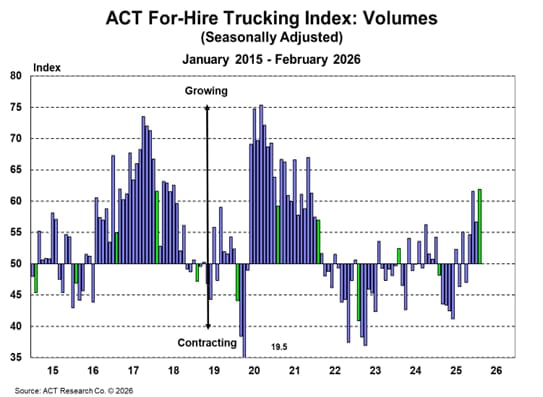
The ACT For-Hire Trucking Index is based on a survey of carriers measuring degree and directional changes. Readings above 50 show growth and readings under 50 show degradation.
Credit:
ACT Research
Tariff Relief vs. Higher Oil Prices
The repeal of IEEPA tariffs and the expiration of §122 tariffs in 150 days should lower the effective tariff rate by roughly 10% and may help to trigger a restock, he said. However, higher oil prices following the conflict with Iran have effectively negated any tariff benefit to consumers in the short term, potentially slowing economic (and freight volume) growth.
ACT’s Capacity Index ticked down slightly, marking the 11th month in a row in neutral/contraction territory.
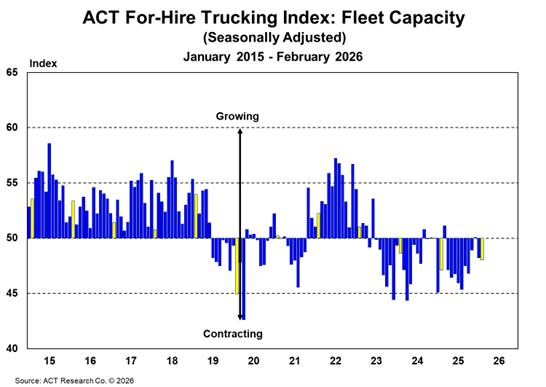
The overcapacity that has been keeping rates down is slowly improving. ACT’s Capacity Index ticked down 0.4 points m/m, to 48.0 in February from 48.4 in January.
Credit:
ACT Research
ACT’s Trucking Pricing Index rose 5.3 points month over month as winter storms tightened capacity and aided volumes, creating a backlog of loads.
Broadly speaking, ACT said, pricing has improved this year on sustained capacity exits and choppy, if gradually improving, volumes in the market.
“Capacity continues to exit as current levels of profitability, despite recent pricing improvements, remain a constraint on investment,” Vieth said.
“Weather also had an effect, allowing for some improvement in the coming months. Increased truck orders since the news that EPA’27 will still happen partially is driving some purchasing, but capacity additions will likely be modest until we get closer to 2027.”
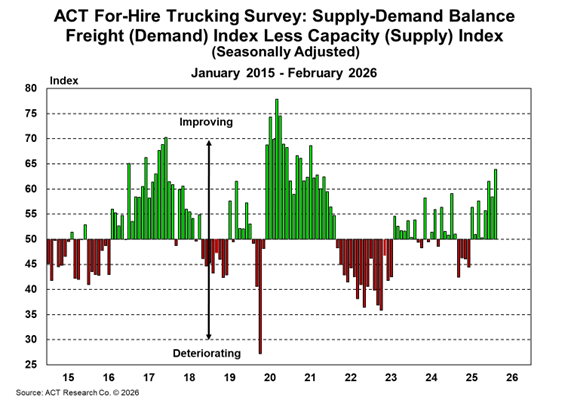
ACT’s Supply-Demand Balance increased in February to 63.9 (seasonally adjusted, from 58.4 in January, a 4.5-year high as volumes increased and capacity continued to contract.
Credit:
ACT Research
What's Next for Trucking?
ACT’s Supply-Demand Balance rose to a 4.5-year high as volumes increased and capacity continued to contract.
Though the freight cycle is beginning to kick into gear, ACT said, it will likely be hard for fleets to expand capacity amid FMCSA’s enforcement efforts targeting immigration and nondomiciled CDL drivers.
“While rate gains may ease as the weather improves, FMCSA nondomicile actions should tighten the driver supply further,” Vieth said. “And as private fleets contract, for-hire demand should improve solely on the return of market share that was ceded between 2022–2025.”
More Fleet Management

How MFA Helps Protect Trucking Fleets
Multi-factor authentication adds protection when passwords are stolen. Here’s how it works and where fleets should start.
Read More →
How Better Freight Data Helps Trucking Teams Get Ahead of Disruption
Trucking and logistics teams have plenty of data. The problem is getting the right information in front of the right people soon enough to act. Better-connected data can help teams spot trouble earlier and make smarter decisions before small problems become big ones.
Read More →
Trimble: Taking Artificial Intelligence in Trucking Beyond Faster Tasks
At Insight 2026, Trimble executives argued that fleets may need to redesign workflows to get more from AI as it introduced new products and enhancements. AI’s value will depend on how fleets combine automation with their people's knowledge.
Read More →

Nominations Open for HDT Emerging Leaders
Heavy Duty Trucking is looking for accomplished trucking fleet professionals under 40 who are making an impact and helping lead the industry forward.
Read More →
Why Private Fleets Are Taking More Freight
Private fleets are putting their own trucks on demanding customers and high-cost lanes as companies seek greater control over service, costs, and capacity.
Read More →
Sponsored•September 16, 2026
Color Match Smarter: Tools That Restore & Perform
For fleet managers and collision repair professionals keeping heavy-duty trucks on the road, getting the color right the first time isn't just about appearance — it's about efficiency, turnaround time, and bottom-line results. Discover how today's digital color tools are transforming the repair process from guesswork to precision.
Read More →
FMCSA Pauses Biennial-Update Enforcement Amid Motus Transition
Carriers whose updates were due on or after June 1 have more time, while FMCSA works to stabilize its new registration system and warns of phishing sites impersonating its new carrier registration system, Motus.
Read More →
Sponsored•September 14, 2026
2026 Blueprint for Countering Smarter Supply Chain Theft
Cargo theft is no longer just the cost of doing business. It's a multi-billion-dollar criminal enterprise exploiting vulnerabilities across your fleet, drivers, and supply chain.
Read More →
What the U.S.-Canada Trade War Means for Trucking
Escalating U.S.-Canada tariffs could disrupt cross-border freight, reduce truck volumes, raise costs, and create new uncertainty for carriers on both sides of the border.
Read More →
What Are Trucking’s Top Concerns for 2026?
The American Transportation Research Institute wants to know what's worrying trucking fleet managers, drivers, and other stakeholders in its annual Industry Issues survey.
Read More →