





Why the New VNL is a Cutting-Edge Technology Platform for Volvo
Volvo Sees Autonomous Trucks as an All-New Transportation Mode
At a press conference at its headquarters in Greensboro, North Carolina, Volvo Trucks North America said autonomous trucks should be considered a distinct mode of transportation going forward.
November 30, 2024
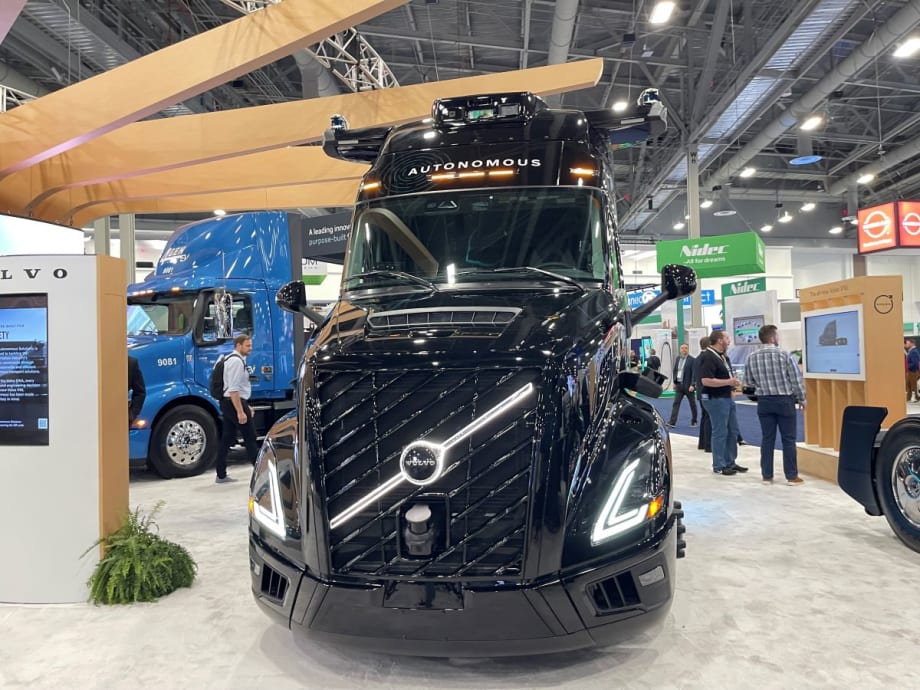
The new VNL tractor will be the technology platform for the first generation of Volvo autonomous trucks.
Photo: Jack Roberts
4 min to read
When are autonomous trucks coming to market?
It’s a question that been asked repeatedly since these advanced trucks first appeared almost a decade ago.
there are currently autonomous trucks available for sale. And many are running validation routes around North America. But to date, no truck OEM has yet entered into full scale production with this new technology.

Sasko Cuklev, head of on-road solutions for Volvo Autonomous Solutions speaks to journalists at the company's headquarters in Greensboro, North Carolina, on November 19.
Photo: Jack Roberts
But that might be about to change.
At a November 19 press briefing at Volvo Trucks North American headquarters in Greensboro, North Carolina, the global truck OEM hinted that its autonomous solution may not be far off at all.
Moreover, Sasko Cuklev, head of on-road solutions for Volvo Autonomous Solutions, said that autonomous trucks will be revolutionary when they come to market. So much so, he noted, that the industry should view them as a unique transportation mode.
In other words, as distinct a means of transporting goods as, say, air freight, maritime shipping, rail or human-driven trucks.
The Race for Long-Haul Solutions
Volvo has been making tremendous strides in developing safe, reliable, autonomous solutions according to Cuklev.
Mot of Volvo’s efforts have been focused in limestone quarry operations in Norway.
Cuklev noted that Volvo has been operating eight trucks without human drivers for over a year-and-half there. These daily operations include a five-kilometer haul road and brutal artic weather conditions.
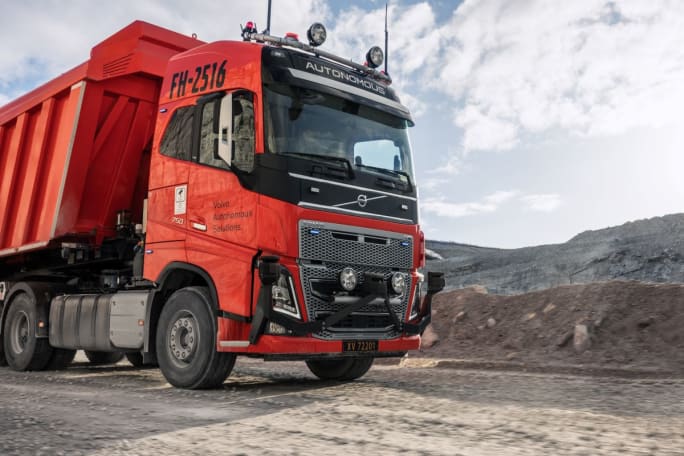
Volvo has been running eight autonomous trucks in mining operations in Norway to validate its self-driving technology.
Photo: Volvo Trucks
“And we’re backing those trucks up to crushers as well,” Cuklev explained. “A lot of developers say backing is especially difficult for autonomous trucks. But we’re doing it multiple times a day.”
Still, the “Holy Grail” for autonomous trucks are long-haul applications, Cuklev said.
And Volvo is making progress on that front too, according to Cuklev.
“Autonomous technology is not as simple as many people were led to believe it would be,” Cuklev explained. “Which is why today, at Volvo, we feel autonomous technology really needs to be looked at as an all-new way of transporting goods. Our society should view autonomous as a new mode of transportation. Just like you have air, rail, shipping and trucking. Soon we will also have autonomous transport. And that new transportation mode we’ll need an entirely new ecosystem to make that solution feasible.”
With those goals in mind, Volvo has been running two evaluation routes in Texas. One route is between Dallas and Houston. And the other is from Fort Worth to El Paso.
The routes are a bit short in terms of a solid business case for autonomous, Cuklev said.
But, he added, longer routes are coming as Volvo. And they will be part of building a network of service points that will be required to fully support autonomous trucks working in daily fleet operations.
“We are super confident in what we’re doing,” Cuklev said. “We have a very good plan on how to commercialize this technology. We have well defined steps going forward – always with an emphasis on safety.”
The VNL Technology Platform
Volvo unveiled its new VNL Class 8 tractor in May. And in a sign as to how fast its autonomous solutions are developing, a self-driving version of the new truck debuted a mere four months later.
“The new VNL is the vehicle platform we will utilize when we launch our autonomous solution in Texas moving freight,” Cuklev said. “We are already pioneering that approach with partners like DHL and Uber Freight. This is a process of many steps. We have already worked out middle mile solutions. And our next step – which will begin any week now – will be to introduce autonomous functionality to our solution.”

A critical aspect for Volvo Autonomous Solutions is to offer customers a completely integrated vehicle designed from the ground up for driverless operations.
Photo: Volvo Trucks North America
The next steps, Cuklev added, will focus on a fully mature Volvo autonomous system.
“The big questions are what happens after that achievement?” he said. “Because we would like to scale this technology fast. And we are preparing for that now. Because when we release our autonomous solution, we want to be able to bring it into scale production as quickly as possible.”
A key aspect of that goal will be to the Aurora Driver autonomous control system into Volvo’s production line in New River Valley, Virginia.
“Our goal is not to produce fully integrated autonomous trucks in double-digit numbers,” Cuklev added. “But much higher, with high-volume production our ultimate goal.”
For fleets, that will mean the production of a Volvo truck designed, developed and built from the ground up with Aurora Driver fully integrated into its design. And that will include full-service support for all autonomous systems from certified Volvo dealers all across North America.
“We have already built our first batch of 25 of these trucks,” Cuklev said. “And as we get closer to our launch date, we will get immediate scale. But more importantly, we will be building those autonomous trucks to the same quality standards that we do with our standard VNL and other vehicles.”
More Equipment

How Volvo Updated Its D13 for EPA 2027 [Watch]
Volvo’s updated D13 promises lower emissions without sacrificing performance or fuel economy. Take a closer look at what changed inside the engine in this HDT Spotlight video.
Read More →
Michelin Tire Improves Efficiency and Durability for Regional Fleets
The Michelin X Multi Energy D2 is a regional haul drive tire engineered to help fleets improve fuel efficiency, durability and traction in demanding stop-and-go operations.
Read More →
ZF Expands Commercial Vehicle Push in North America
ZF is expanding its North American commercial-vehicle presence with new transmission applications, electrification, trailer technology and autonomous-driving systems.
Read More →
Tesla Wants a Self-Driving Semi. Are Cameras Enough?
Could Tesla’s camera-only autonomous driving technology work on an 80,000-pound Semi? In this commentary, HDT's Deborah Lockridge takes a look at Tesla, Cybercab, and how autonomous trucks see the road.
Read More →
Kodiak: Driverless Long-Haul Truck Launch on Track for 2026
Kodiak AI says its driverless long-haul safety case is 93% complete and it remains on track to begin commercial operations by year-end 2026.
Read More →
What DOT’s Automated Vehicle Strategy Means for Trucking
The U.S. Department of Transportation issued a new automated-vehicle strategy that outlines plans for driverless-truck regulations, cross-state freight corridors, and federal safety standards.
Read More →
East Coast Port Launches $45M Electric Truck Push
The Port Authority of New York and New Jersey announced millions in incentives for zero-emission drayage trucks, yard tractors, and new charging hubs near the port.
Read More →
PlusAI Going Public to Fund Autonomous Truck Launch
A SPAC deal could provide PlusAI with up to $300 million as it works toward a 2027 commercial launch of factory-built autonomous trucks.
Read More →
NHTSA Moves to Rewrite Truck Fuel-Economy Rules
The National Highway Traffic Safety Administration says it lacks authority to regulate medium- and heavy-duty truck engines separately from complete vehicles, but the existing standards have not yet been eliminated.
Read More →
Detroit Opens Orders for EPA 2027 Engines
Detroit isn’t starting from scratch to meet EPA 2027 diesel emissions standards. Its Gen 6 DD13 and DD15 engines keep much of today’s platform while updating the fuel and aftertreatment systems.
Read More →