




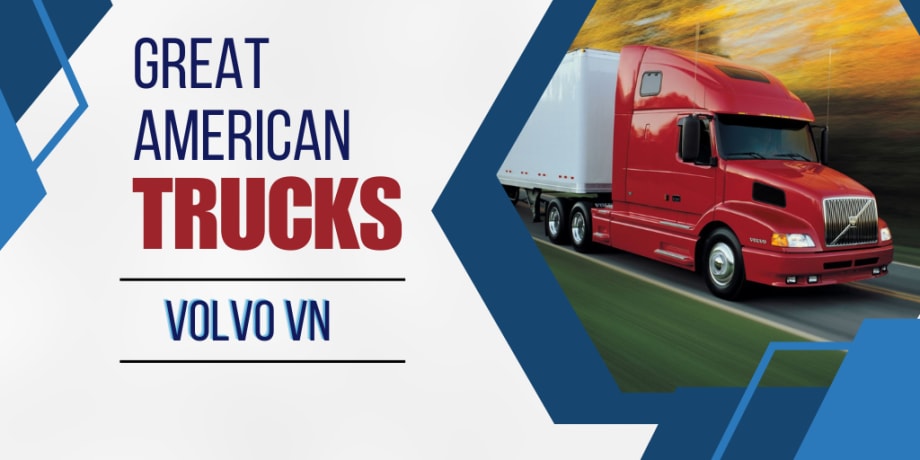
Great American Trucks: The Volvo VN
Volvo set out to design a truck that was a game-changer. It ended up with a truck that transformed an entire industry.

The VN featured a super-sleek aerodynamic profile that was unlike anything else offered at the time in the Class 8 market.
Photo: Volvo Trucks North America
I’ve been toying with the idea of writing a Great American Trucks installment on the Volvo VN for some time, now.
And I must admit to some hesitation on my part to do so.
It’s not because the Volvo VN wasn’t a hugely important North American truck. Because it was. In fact, it’s not hyperbole to call the VN a groundbreaking design that completely changed the game when it came to North American Class 8 truck design.
My hesitation to write about the history of the Volvo VN is more personal in nature.
Because Great American Trucks is about the history of trucking. And nearly 30 years ago, in 1996, as a newly minted, still wet-behind-the-ears trucking journalist, the very first truck launch I ever covered was the launch of the Volvo VN.
So, it’s odd – and admittedly a little depressing – for me to look back at a truck launch I attended in person as a “historical event.”
On the other hand, looking back at that launch today, it’s clear that the VN signified a major shift in North American truck design. Its launch was a sea change not in just how American trucks looked – but in how they performed and what fleets, owner-operators and drivers would come to expect from a Class 8 truck when it came to efficiency, fuel economy, aerodynamics, safety, productivity and comfort.
Volvo Comes to North America
Volvo was established in Gothenburg, Sweden in 1927, by Assar Gabrielsson and Gustav Larson. The two business partners initially wanted to establish a passenger car company that could build a Swedish passenger car capable of dealing with the country’s harsh winter weather and poor, often unpaved roads. The very first Volvo truck rolled off the assembly line the following year.
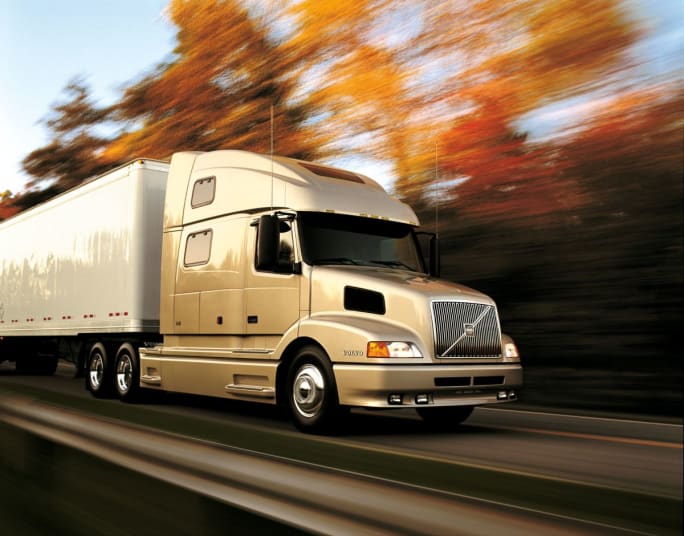
The VN also featured a fully integrated sleeper design with a host of new driver safety and comfort features.
Photo: Volvo Trucks North America
From its very beginning, Gabrielsson and Larson’s unwavering commitment to safety, efficiency durability and sustainability had been forged as essential, non-negotiable, guiding principles for their company. And ones that remain central to Volvo’s products to this very day.
By the 1970s, Volvo had grown to be a successful European manufacturer of passenger cars, trucks, heavy machinery and marine powertrains. But the company had global aspirations. And clearly, selling both cars and trucks in North America would be critical for achieving that goal.
Volvo had been a minor player in the U.S. medium-duty market since the 1960s. But to truly break into North America, the company knew it needed a presence in the Class 8 heavy truck market.
But Americans were still leery of foreign made vehicles. To date, only Volkswagen had managed to establish a major presence in the U.S., with the quirky, but widely popular Beetle compact car.
But that was it. And foreign truck manufacturers in the U.S. Class 8 market were virtually unheard of.
The best way to enter the North America market, Volvo executives decided, was to acquire a domestic manufacturer. This would give the company a legacy, domestic nameplate to soothe any misgivings among potential customers. It would also provide Volvo with an established dealer network and products to build upon with its own technology.
And luckily the North American truck market – much like the passenger car market – was undergoing considerable constriction and realignment at the time.
Many older truck OEMs were finding it harder and harder to compete on a national scale with larger, better financed competitors.
In many cases, these companies would often merge together, or be acquired, in hopes of gaining the scale and reach necessary to compete with OEMs that were quickly gaining national brand recognition and market share.
On such company was White Trucks. Over the past several years, White had acquired other legacy OEMs, including Autocar, Sterling and Western Star.
All for naught.
By 1980, White was in bankruptcy. And Volvo acquired most of the company’s North American assets – with Western Star being spun off as a separate brand.
A Tangled Web of OEMs
The new Volvo White Truck Corporation initially focused simply on staying competitive in the tough North American truck market.
These efforts largely focused on upgrading existing White and Autocar designs and bolstering its dealer network. Whenever possible, Volvo also took the opportunity to introduce its own technologies into designs, as well.
But there were some opportunities to innovate. In 1982, the White Integral Sleeper model was introduced. This groundbreaking truck featured integrated passenger and sleeper compartments.
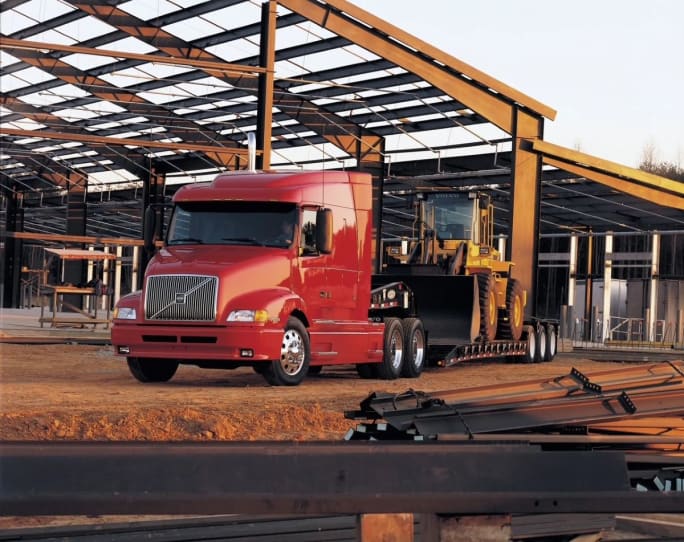
Volvo wanted to make a statement with its 1996 VN model. And it succeeded beyond its wildest expectations.
Photo: Volvo Trucks North America
And, in a foreshadowing of things to come, in 1987, the company launched the “White Aero” model. This truck featured a lowered hood and a flush-mounted grill to enable it to cut through the wind better at highway speeds.
By this point General Motors was looking to get out of the commercial truck business. Even mighty GM was having trouble competing with specialized commercial truck OEMs – which were rapidly consolidating their hold on the marketplace.
Volvo then became the dominant partner in the new Volvo GM Heavy Truck Corporation. On a positive note, this joint venture infused Volvo with more dealers and cash to strengthen its North American position.
Unfortunately, the Volvo nameplate became somewhat lost in the hazy “WhiteGMC” and “Volvo GM” branding debacle that followed the merger.
By the mid-1990s, however, Volvo felt it was now strong enough to compete on its own terms and under its own nameplate in North America.
The company began the process of winding down its associations with White and General Motors. It was clearly time to take on North America on its own terms.
But to do that, it would need a new truck. And not just any truck. It needed a new truck that would make a serious, uncompromising statement about who Volvo as a truck OEM was – and what it stood for as a global truck brand.
The VN is Born
Volvo’s first 15 years in North America had been tumultuous. But the company had learned a lot about the largest heavy truck market in the world. And its partnerships with White and GM had given it a great deal of insight into what American truckers wanted from a truck and expected it to perform.
But as it surveyed the North American heavy-duty truck landscape in the mid-1990s, Volvo saw an opportunity.
The industry was still very much emerging from a mindset that dated back to the 1950s. Only recently had the industry migrated away from cabover sleeper trucks, to larger, roomier, conventional models. But the designs were still very much rooted in a time of dirt-cheap fuel prices. Vehicle styling took precedent over aerodynamics. Driver comfort was – at best – a design afterthought. And driver safety was pretty much limited to seat belts.
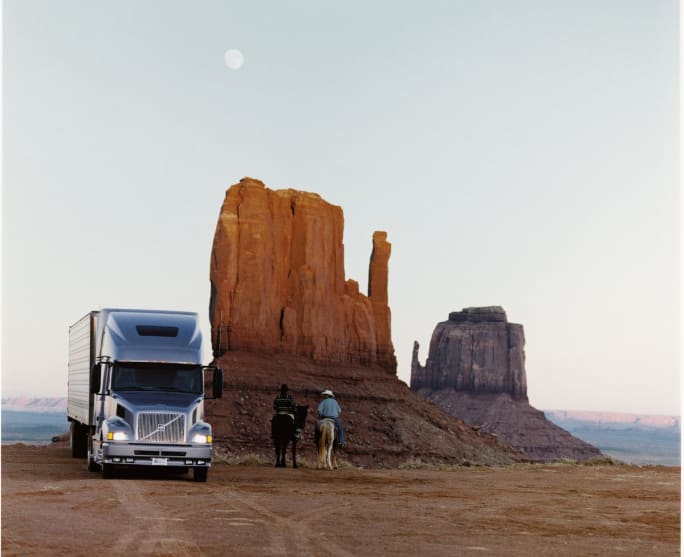
Volvo marketing made much of the fact that the VN was the OEM's first truck designed in and for the North American Class 8 market.
Photo: Volvo Trucks North America
From its customers in Europe and around the globe, Volvo knew that cheap fuel prices wouldn’t last forever. And it was just a matter of time before emissions regulations began to impact the trucking industry, the way they had with passenger car markets around the world.
Volvo’s new North American truck, dubbed the VN, would address all of those issues.
The design evoked popular North American Class 8 styling. But aerodynamic performance was clearly the primary design driver. The truck featured a lower, sloping hood, narrow front grill, sculpted fenders and a rearward-raked roofline. These design features gave the truck an exceptionally clean aerodynamic profile – particularly when compared to competitive trucks on the market at the time.
It was more than just a sleek, eye-catching cab, too. Volvo engineered the cab so that it could meet the stringent Swedish Cab Safety Test. This standard, substantially more robust than required for the North American truck market, gave drivers an extra measure of safety in collisions, from overhead impacts and truck rollover accidents.
Volvo carried over its integrated sleeper concept. But, for the first time, the rear compartment of the truck was more than simply a place for drivers to sleep. Volvo engineers designed the VN sleeper to include more base creature comforts than were standard at the time. And a fold-down desktop gave drivers an additional area to comfortably eat meals and handle paperwork.
Engine options included Volvo diesel power, as well as the standard set of options considered standard at the time: the Cummins M11, the Detroit Series 60 Diesel and Caterpillar’s 3406. To help deliver its focus on fuel efficiency, the new VN was also 1,100 lbs. lighter than the previous Volvo conventional model it was replacing.
An Industry-Changing Design
Volvo’s bold VN move caught the North American trucking industry by surprise. And the general responses to the new truck reflected both the audacity of the company, as well as the truck’s all-new design.
There were polite raised eyebrows in the industry. As well as outright sneers and mocking laughter.
The VN was proof the Volvo didn’t understand the North American trucking industry, naysayers said. The truck looked too “European,” they claimed. And lacked the tough, bold stance American truckers demanded.
As noted, I was a rookie editor at the time. And, admittedly, I still had a lot to learn about the industry. And I really didn’t appreciate what a departure the VN design was.
So, the VN’s detractors really didn’t make any sense to me. To my untrained eye, the VN was a decidedly modern design. The truck’s lines clearly drew on conventional designs prevalent at the time. But it was much sleeker, more refined, clearly aerodynamic profile.
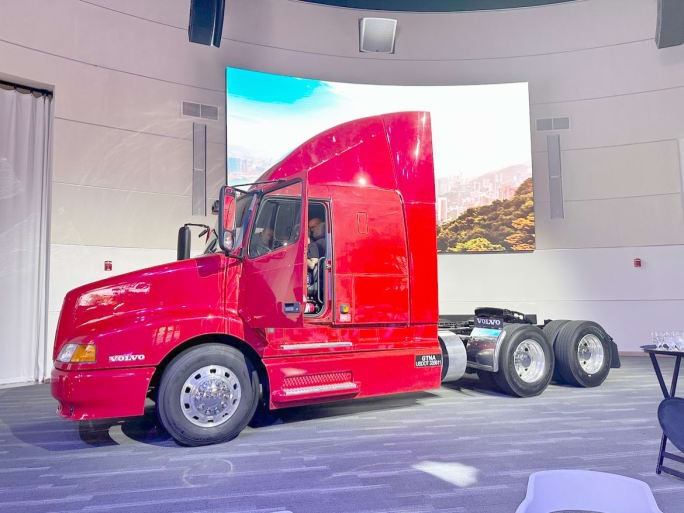
The VN is one of the most important trucks in Volvo's history and sits in a place of honor at the OEM's Customer Center in Dublin, Virginia today.
Photo: Kyle Zimmerman
But it turned out that Volvo knew what it was doing.
Just five years later, terrorists attacked the U.S. on September 11, 2001. And in the resulting global war on terror that ensued, fuel prices in North America skyrocketed. Many fleets, running older, inefficient trucks and on razor-thin profit margins couldn’t compete. Hundreds – perhaps thousands – of carriers went out of business.
Suddenly, fuel economy was of the utmost importance to long-haul carriers. And fleets appreciated the VN’s outstanding fuel economy performance, driver comfort and safety features.
And all the sneers and laughter aside, suddenly aerodynamic conventional trucks started debuting across the industry. And this is a trend that continues to this day. Advanced aerodynamics are a primary design priority for every new truck that enters the North American market.
Volvo set out to create a game-changing truck that would cement its position as a top-tier North American OEM. And it ended up designing a truck that fundamentally changed the entire North American trucking industry.
Which is why the Volvo VN will deservedly go down in history as a Great American Truck.
More Equipment

How Volvo Updated Its D13 for EPA 2027 [Watch]
Volvo’s updated D13 promises lower emissions without sacrificing performance or fuel economy. Take a closer look at what changed inside the engine in this HDT Spotlight video.
Read More →
Michelin Tire Improves Efficiency and Durability for Regional Fleets
The Michelin X Multi Energy D2 is a regional haul drive tire engineered to help fleets improve fuel efficiency, durability and traction in demanding stop-and-go operations.
Read More →
ZF Expands Commercial Vehicle Push in North America
ZF is expanding its North American commercial-vehicle presence with new transmission applications, electrification, trailer technology and autonomous-driving systems.
Read More →
Tesla Wants a Self-Driving Semi. Are Cameras Enough?
Could Tesla’s camera-only autonomous driving technology work on an 80,000-pound Semi? In this commentary, HDT's Deborah Lockridge takes a look at Tesla, Cybercab, and how autonomous trucks see the road.
Read More →
Kodiak: Driverless Long-Haul Truck Launch on Track for 2026
Kodiak AI says its driverless long-haul safety case is 93% complete and it remains on track to begin commercial operations by year-end 2026.
Read More →
What DOT’s Automated Vehicle Strategy Means for Trucking
The U.S. Department of Transportation issued a new automated-vehicle strategy that outlines plans for driverless-truck regulations, cross-state freight corridors, and federal safety standards.
Read More →
East Coast Port Launches $45M Electric Truck Push
The Port Authority of New York and New Jersey announced millions in incentives for zero-emission drayage trucks, yard tractors, and new charging hubs near the port.
Read More →
PlusAI Going Public to Fund Autonomous Truck Launch
A SPAC deal could provide PlusAI with up to $300 million as it works toward a 2027 commercial launch of factory-built autonomous trucks.
Read More →
NHTSA Moves to Rewrite Truck Fuel-Economy Rules
The National Highway Traffic Safety Administration says it lacks authority to regulate medium- and heavy-duty truck engines separately from complete vehicles, but the existing standards have not yet been eliminated.
Read More →
Detroit Opens Orders for EPA 2027 Engines
Detroit isn’t starting from scratch to meet EPA 2027 diesel emissions standards. Its Gen 6 DD13 and DD15 engines keep much of today’s platform while updating the fuel and aftertreatment systems.
Read More →