





Related: What Will 2018 Bring to Trucking?
Truck Technology Takes the Stage at the Consumer Electronics Show
For the first time, truck manufacturers are showing off their latest technological advancements at one of the most influential technology shows on the planet in Las Vegas this week.
January 10, 2018
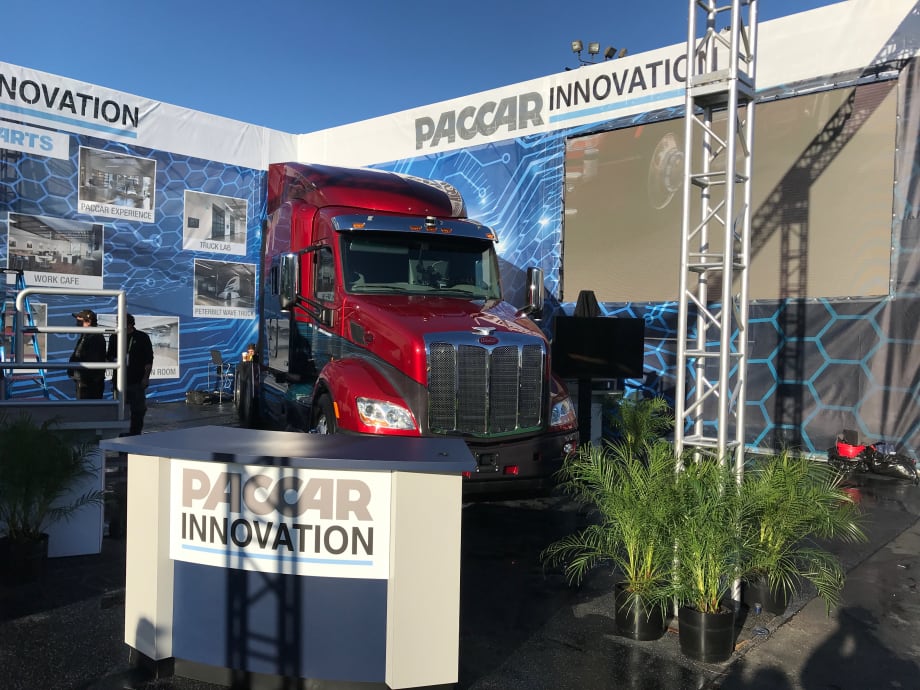
Paccar's Innovation Booth at CES. Photo: Peterbilt
3 min to read
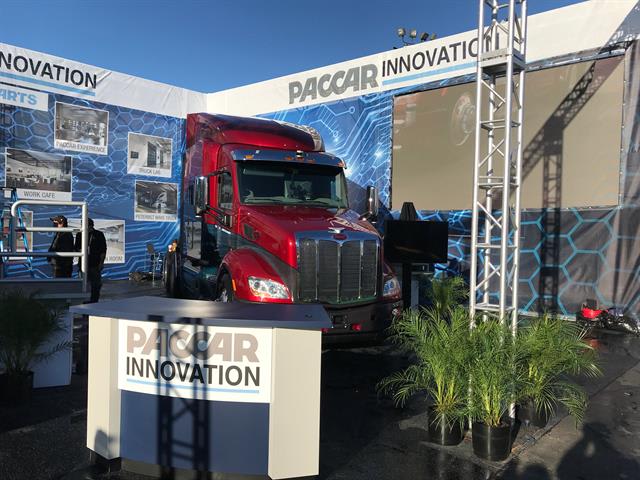
Paccar's Innovation Booth at CES. Photo: Peterbilt
If you need any more evidence that technology is moving into commercial vehicles at astonishing speed, look no further than the CES consumer electronics show this week in Las Vegas.
Once the domain of geeks and gamers, CES has evolved to become one of the most important venues for showcasing new and emerging technology, attracting over 20,000 attendees annually.
Increasingly, automotive companies have been using the show to reveal high-tech upcoming features and concepts. But now, commercial vehicles are getting their due.
The biggest splash so far is arguably Toyota’s new e-Palette concept vehicle, which the company describes as a sort of highly adaptable, multi-use urban car, van or truck, depending on the owner’s preference.
Toyota is developing the e-Palette in partnership with Amazon, Uber and Pizza Hut, which says a lot about the vehicle’s potential uses. The design shown at CES has no windshield or set passenger seating arrangement. But, Toyota says, the vehicle can be configured for multiple applications, including delivery or passenger-van, a parcel delivery truck, a mobile office or even a hotel room.
Called e-Palette, the concept vehicle is larger than the self-driving taxis being tested by Alphabet spin-off Waymo but smaller than the driverless semi-trucks that Uber is working on – a multipurpose urban runabout.
A further hint as to what the future of transportation and trucking is going to look like was revealed in comments made by Toyota President Akio Toyoda, who told reporters at CES, “My aim is to change Toyota from an automobile company to a mobility company. Our competitors are no longer those just making cars. Companies like Google, Apple and Facebook are what I think about at night.”
TuSimple, a startup company developing autonomous trucking technology, is showcasing its Level 4 autonomous truck at CES. The China-based company says this is the debut in the United States of its latest L4 trucks, which are slated to hit the roads for testing in Arizona this year. TuSimple is also discussing its new collaboration with Nvidia. This year, TuSimple will scale its efforts to commercialize self-driving trucks in the United States by deploying additional Peterbilts.
Paccar is also using CES to show off some of its cutting-edge technology. Peterbilt is showcasing its own Level 4 autonomous Model 579 tractor, which was developed in partnership with Waymo.
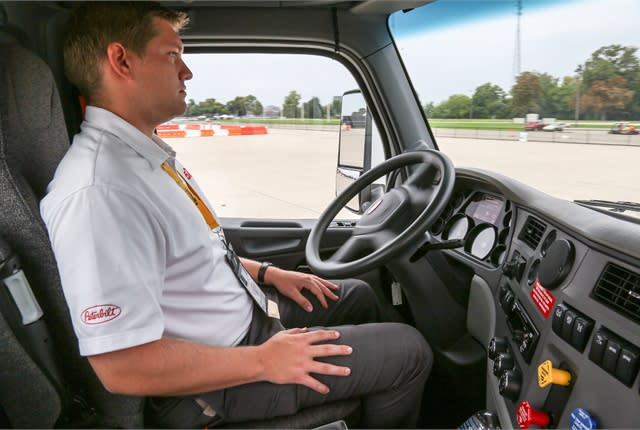
Paccar is using the Consumer Electronics Show in Las Vegas to show off new technology, including Peterbilt's Level 4 autonomous Model 579 tractor. Photo: Peterbilt
Peterbilt’s sister company, Kenworth, is also using CES to show off its hydrogen-fuel-cell-powered T680 day cab tractor, which uses compressed hydrogen gas and air to produce electricity that is then used to drive the vehicle. The fuel cell emits only water vapor emitted at the tailpipe. This electricity can power the dual-rotor electric motor to move the truck, or it can recharge the lithium-ion batteries for use later. The hybrid drive system manages the power from the fuel cell to and from the batteries, as well as the traction motors and other components, such as the electrified power steering and brake air compressor.
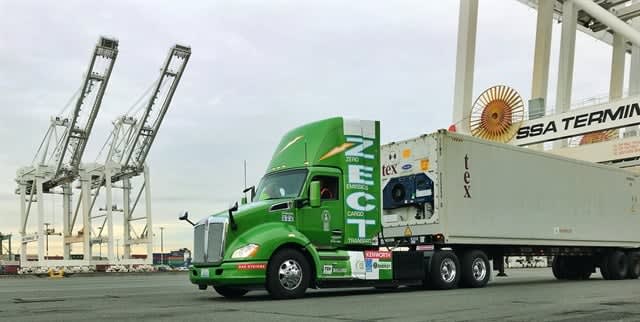
Kenworth used CES to show off Kenworth, is also using CES to show off its hydrogen-fuel-cell-powered T680 day cab tractor, which is shown here during trials in the Seattle area.Photo: Kenworth
Kenworth says the truck will initially have a range of 150 miles and is designed for short haul and port operations. The truck's electric motor can output 565 horsepower and is capable of carrying Class 8 loads.
The presence of commercial vehicles at such a high-profile consumer electronics show is a clear sign that the industry is rapidly moving toward a more tech-driven future. And it will be interesting to see if additional truck OEMs choose to use the show next year to demonstrate even more advanced vehicle concepts.
More Fleet Management

Sponsored•September 16, 2026
Color Match Smarter: Tools That Restore & Perform
For fleet managers and collision repair professionals keeping heavy-duty trucks on the road, getting the color right the first time isn't just about appearance — it's about efficiency, turnaround time, and bottom-line results. Discover how today's digital color tools are transforming the repair process from guesswork to precision.
Read More →
FMCSA Pauses Biennial-Update Enforcement Amid Motus Transition
Carriers whose updates were due on or after June 1 have more time, while FMCSA works to stabilize its new registration system and warns of phishing sites impersonating its new carrier registration system, Motus.
Read More →
Sponsored•September 14, 2026
2026 Blueprint for Countering Smarter Supply Chain Theft
Cargo theft is no longer just the cost of doing business. It's a multi-billion-dollar criminal enterprise exploiting vulnerabilities across your fleet, drivers, and supply chain.
Read More →


Sponsored•September 1, 2026
How Telematics Improves Visibility, Control, and Performance in Refrigerated Fleets
Explore how telematics help refrigerated fleets improve visibility, uptime, efficiency, compliance, and cargo protection across connected cold chain operations.
Read More →
What the U.S.-Canada Trade War Means for Trucking
Escalating U.S.-Canada tariffs could disrupt cross-border freight, reduce truck volumes, raise costs, and create new uncertainty for carriers on both sides of the border.
Read More →
What Are Trucking’s Top Concerns for 2026?
The American Transportation Research Institute wants to know what's worrying trucking fleet managers, drivers, and other stakeholders in its annual Industry Issues survey.
Read More →
American Trucking Associations Looks for a New Leader
ATA President and CEO Chris Spear abruptly left his job at the association on August 21, at a pivotal time for the trucking industry.
Read More →
Public Wi-Fi Cybersecurity Risks: How Truck Drivers and Fleets Can Protect Their Data
Public Wi-Fi can expose truck drivers and fleets to credential theft, malware, and other cyber threats. Here’s how to reduce the risk on the road.
Read More →
For Nicky Cupp, Fleet Innovation Starts With Frustration
HDT Truck Fleet Innovator Nicky Cupp turns everyday pain points at Fraley & Schilling into opportunities for better technology and smarter processes.
Read More →
Adam Buttgenbach’s Approach to Electric Trucks: Start With Where They Fit
HDT Truck Fleet Innovator Adam Buttgenbach helped PepsiCo build one of North America’s largest EV fleets by focusing on where electric trucks make operational sense.
Read More →