





You also may like: In Pursuit of Green Hydrogen for Trucking
Hino Hydrogen-Fuel-Cell Heavy-Duty Truck Debuts at ACT Expo
Hino unveiled a hydrogen fuel-cell-electric prototype version of its Class 8 XL8 truck at the 2021 ACT Expo in Long Beach, California.
August 31, 2021
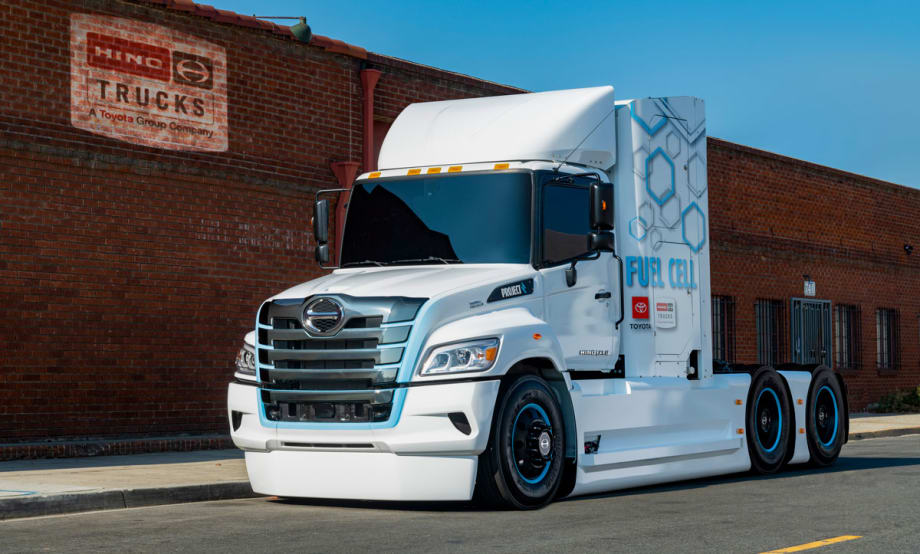
Hino collaborated with Toyota to develop this hydrogen fuel-cell-electric version of its Class 8 truck.
Photo: Hino
2 min to read
Hino unveiled a hydrogen fuel-cell-electric prototype version of its Class 8 XL8 truck at the 2021 ACT Expo in Long Beach, California, Aug. 31.
In a pre-show video on Aug. 27 at its Michigan headquarters, company officials explained that the truck is powered by two Toyota fuel cells designed for commercial vehicles, a top unit and a bottom unit, which are under the hood in the traditional engine well. Toyota recently announced that starting in 2023, a dedicated line at Toyota Motor Manufacturing Kentucky in Georgetown, Kentucky, will begin assembling these fuel cell modules for use in heavy-duty commercial trucks.
The Hino prototype has a 12-volt battery system plus a high-voltage battery that works with the fuel cells to provide power and torque that the company says are equal to or better than diesel. The hydrogen tanks are located in a cabinet behind the cab. Behind that there’s a two-motor system and transmission, and a prop shaft leading to the rear differential.
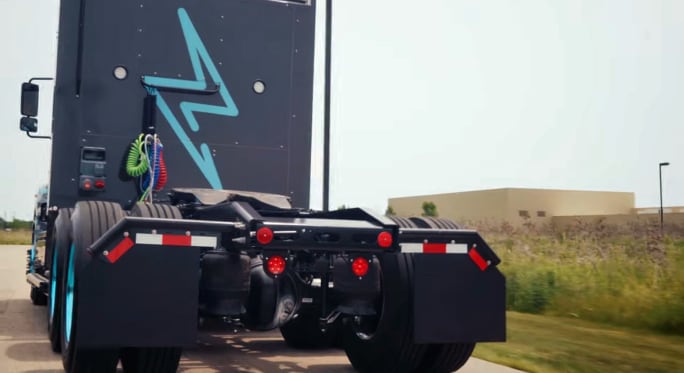
The hydrogen tanks on Hino's fuel-cell-electric prototype are located in a cabinet behind the cab.
Photo: Screen capture from Hino video
Company officials noted that they announced their FCEV plans less than a year ago.
“It’s amazing what our team has been able to accomplish in a relative short period of time,” said Glenn Ellis, Hino's senior vice president of customer experience, in a news release. “We are looking forward to validating the performance, reliability and efficiency of our hydrogen fuel cell electric system in the XL Series chassis.”
Since the announcement last October, the company has “received significant interest from customers, and now we have something tangible to show them in our prototype FCEV,” said Bob Petz, Hino’s senior vice president of vehicle and part sales.
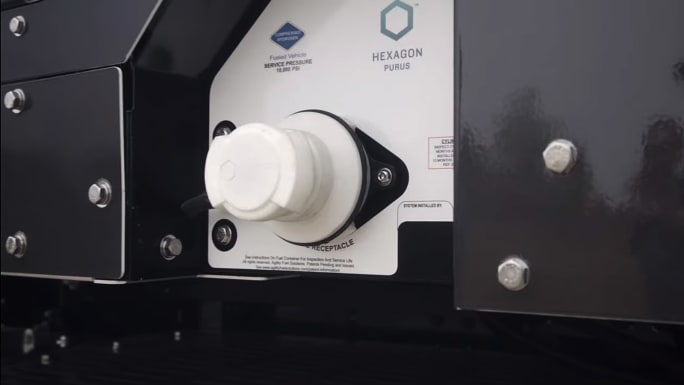
One of Hino's development partners is Hexagon Purus.
Photo: Screen capture from Hino video
It’s part of Hino’s Project Z, the company’s development path to zero-emissions vehicles, ranging from Class 4 to Class 8. The zero-emission products announced in Project Z, in addition to the Class 8 FCEV, included a Class 5 Hino M5 chassis equipped with an Sea Electric Sea-Drive 120a, a Class 8 XL8 box truck powered by XOs Trucks’ X-Pack battery and electric drive system, and a Class 7 4x2 XL7 tractor powered by Hexagon Purus’ full electric drive system.
More Fuel Smarts

How Volvo Updated Its D13 for EPA 2027 [Watch]
Volvo’s updated D13 promises lower emissions without sacrificing performance or fuel economy. Take a closer look at what changed inside the engine in this HDT Spotlight video.
Read More →
Diesel Price Spike Shortens Payback for Natural Gas Trucks, Report Says
Energy Vision estimates fleets could recover the higher purchase price of an RNG-fueled Class 8 tractor in 1.3 to 2.8 years under current fuel-price scenarios.
Read More →
Calstart Becomes Catalyst Mobility, Reflecting Broader Focus
Calstart is now Catalyst Mobility, reflecting the nonprofit’s growing national role in clean transportation, including zero-emission trucks, infrastructure and incentive programs.
Read More →

Record Diesel Prices Squeeze Trucking Fleets
Average U.S. diesel prices have climbed to nearly $6 a gallon, surpassing the 2022 record as tight refinery capacity and Middle East disruptions keep fuel costs elevated.
Read More →
Sponsored•September 9, 2026
How Fuel Delivery Shapes Engine Performance
Fuel delivery depends on more than what happens at the injector. For fleet, maintenance and technical professionals, looking at the full path from pump to injector can provide useful context for understanding engine performance.
Read More →
East Coast Port Launches $45M Electric Truck Push
The Port Authority of New York and New Jersey announced millions in incentives for zero-emission drayage trucks, yard tractors, and new charging hubs near the port.
Read More →
California Bill Could Shed Light on Electric Truck Prices
Why do battery-electric Class 8 trucks remain so expensive? A California bill headed to Gov. Gavin Newsom would give fleets and state agencies more visibility into what manufacturers charge.
Read More →
Detroit Opens Orders for EPA 2027 Engines
Detroit isn’t starting from scratch to meet EPA 2027 diesel emissions standards. Its Gen 6 DD13 and DD15 engines keep much of today’s platform while updating the fuel and aftertreatment systems.
Read More →
Zero-Emission Truck Corridor Planned for West Coast
California, Oregon, Washington, British Columbia and Baja California are coordinating plans for truck charging and hydrogen fueling from Canada to Mexico.
Read More →
A Closer Look at Kenworth’s Electric T880E Vocational Truck [Video]
Learn more about Kenworth's T880E battery-electric vocational truck at the Paccar Technical Center, including its range, applications, upfitting considerations, and PTO options, in this HDT Spotlight video.
Read More →