




Project Z: Hino Unveils Zero-Emissions Truck Lineup
Hino is working with technology leaders such as Toyota, Hexagon Purus, and Xos to produce a low-cost product line up as the industry moves forward to zero-emission trucks.

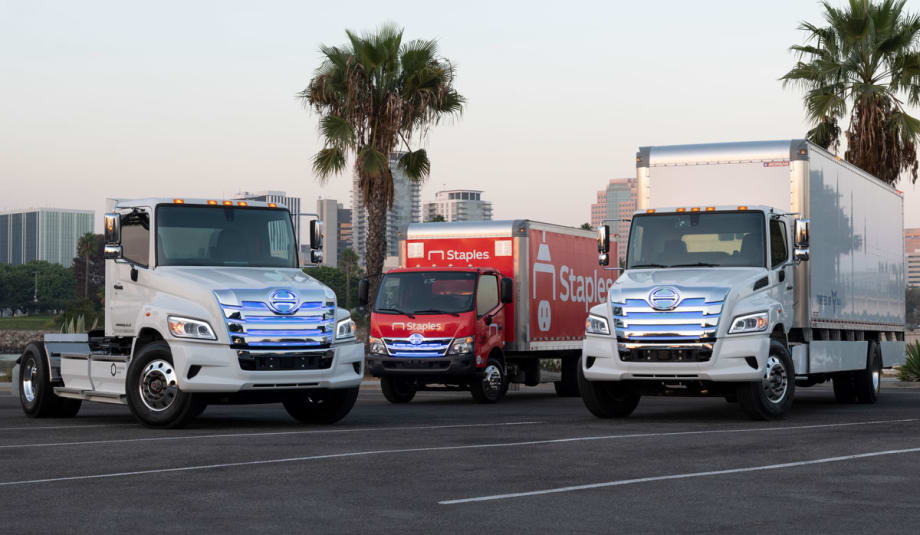
Hino’s Project Z drives toward zero-emission medium- and heavy-duty trucks.
Photo: Hino
Hino Motors stepped up onto the zero-emissions stage earlier this week announcing Project Z, the company’s development path to zero-emissions commercial vehicles. In a live virtual event broadcast on Facebook and YouTube, Hino introduced a line-up of zero-emissions trucks ranging from Class 4 to Class 8, as well as its partners in advanced electric drive systems.
The ZEV products included a Class 5 Hino M5 chassis equipped with an Sea Electric Sea-Drive 120a, a Class 8 XL8 box truck powered by XOs Trucks’ X-Pack battery and electric drive system, and a Class 7 4x2 XL7 tractor powered by Hexagon Purus’ full electric drive system.
In a special announcement, Hino also Hino XL8 6x4 tractor powered by a Toyota Mirai Fuel Cell system. (Read full coverage here.)
"Our holistic approach to working with technology leaders like Toyota, Hexagon Purus and Xos will result in a sustainable, low-cost product line up that will meet the needs of our customers as our industry moves forward to zero emission vehicles," said Hino Motors' Senior VP of Customer Experience Glenn Ellis.
Project Z will consist of demonstration vehicles in the first half of 2021, customer demonstrations in 2022, and production prior to 2024, according to the company.
The 19,500-lb GVW M5 model displayed in Staples livery works everyday for the office supply company in southern California in real-world service. It's also in testing and trials in several east coast venues.
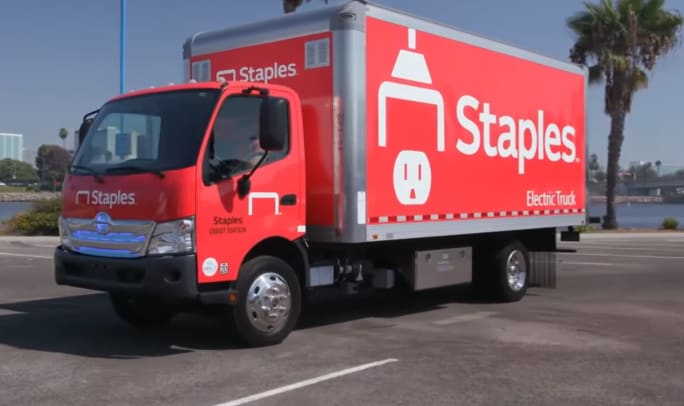
The Hino battery-electric M5 is equipped with Sea Electric's Sea-Drive 120A electric powertrain with a real-world working range of about 150 miles. It's available to purchase now in parts of the country.
Photo: HIno
Class 5 M5 Box Truck
The M5 equipped with Sea Electric Sea-Drive 120A electric powertrain. It's 138 kWh batteries and JJE high-voltage electric motor deliver the equivalent of 170 hp and 1100 lb-ft of torque. The drivetrain requires no transmission, and the battery system requires no additional thermal management system. The battery packs are located where the engine and transmission once sat.
Tony Fairweather, president of Australia-based Sea Electric, says the battery pack can deliver 240 miles of range on a single charge with no load in the box, "But with a 5,000- to 6,000-pound payload and the air conditioning operating normally, it will travel about 150 miles," he said.
"We have been operating this power system in Australia, New Zealand, South East Asia and other countries in the region for three or four years now, and we have over a million miles of in-service testing in five countries," Fairweather said.
"For customers ready to move in that direction now, the Sea Electric SEA-Drive 120A paired with a Hino M Series chassis is commercially available today," noted Ellis.
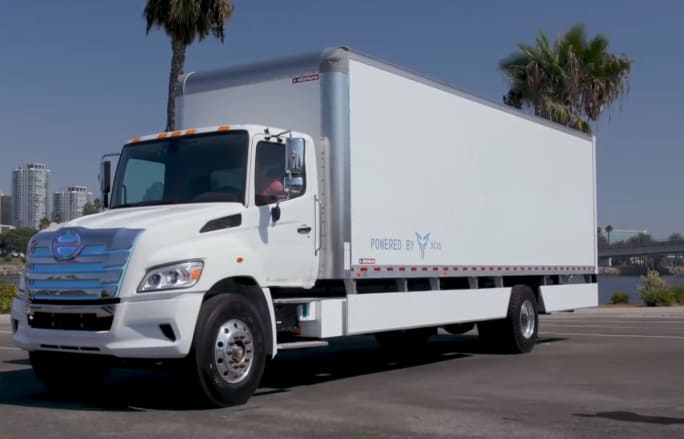
This Hino Class 8 straight truck is powered by XOs Trucks’ X-Pack modular battery and electric drive system. Its expected range is about 250 miles.
Photo: HIno
XL8 Box Truck
Moving up a couple of classes to the XL Series, Hino showed a Class 8 straight truck with a whopping 30-foot cargo box powered by XOs Trucks’ X-Pack modular battery and electric drive system. Jose Castaneda, vice-president of business development with XOs Truck said the truck shown has a 10-battery system capable of about 250 miles.
"The battery system is modular, so customers can scale up or down depending on their needs," he said. "That's typically determined by wheelbase or the range they need."
Castaneda didn't disclose the actual battery capacity or the ratings and output of the motor.
With the X-Pack system, each battery module is air-cooled (which helps keep the weight down) and contains its own charging electronics. "If a battery change is needed, the defective module can be removed quickly rather than replacing the entire pack," Castaneda added.
XOs claims the truck can be charged in about an hour with a Level 3 DC charger.
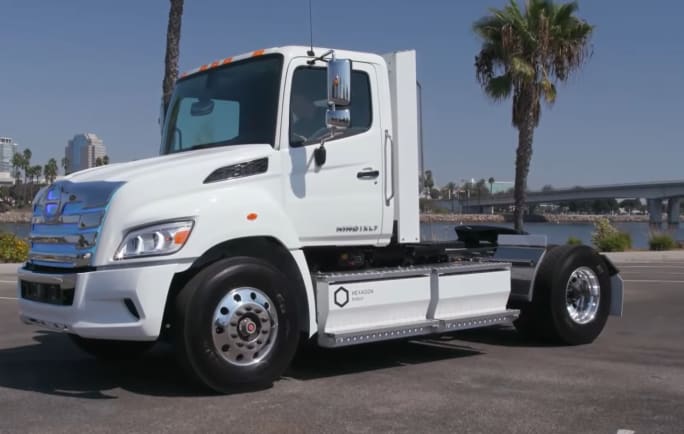
Hino partnered with Hexagon Purus Systems for its battery-electric Class 7 XL7 4x2 tractor. It uses two saddle-mounted 220 kWh battery packs for a range of about 200 miles.
Photo: HIno
4x2 XL7 Tractor
Hino partnered with Hexagon Purus Systems, known for its Agility-brand compressed natural gas storage tanks, on its battery-electric Class 7 XL7 4x2 tractor. As shown, the truck uses two saddle-mounted 220 kWh battery packs mounted in vibration-minimizing racks for improved durability.
All the high-voltage power distribution and fusing, as well as the power electronics for the drivetrain are located in the cabinet behind the cab. It's tall and slim to maintain the space needed for the trailer swing with various king-pin depths. Range for the truck is about 200 miles.
"We can configure the batteries in 110-kWh increments to allow customers to optimize the packs for their operation," said Eric Coupal-Sikes, vice-president of e-mobility engineering at Hexagon Purus. "These batteries are liquid cooled, and we are able to offer the package in the same wheelbase as a diesel configuration."
The truck shown was equipped with Allison Transmission's new Gen Power 100D e-axle, with two traction motors capable of producing 400 kW (equal to about 500 hp) continuously, with 600 kW at peak output, and 33,000 lb-ft of tire-chewing torque. Coupal-Sikes noted the power electronics can also be mated to a single center-drive motor with a conventional differential and axle.
"Our supervisory control system and power electronics are agnostic as to which drivetrain goes into the truck," he said. "We can have multiple suppliers with their motors, center drive, or an e-axle."
Hino did not say what the standard offering would be when the truck becomes available. Coupal-Sikes said the company has done a million miles equivalent validation testing.
Hino Trucks' Project Z will consist of demonstration vehicles in the first half of 2021, customer demonstrations in 2022, and production prior to 2024, and the project doesn't end there. Over the coming months, Hino Trucks said it will unveil more granular details about the technologies and vehicles to come out of Project Z.
More Fuel Smarts

How Volvo Updated Its D13 for EPA 2027 [Watch]
Volvo’s updated D13 promises lower emissions without sacrificing performance or fuel economy. Take a closer look at what changed inside the engine in this HDT Spotlight video.
Read More →
Diesel Price Spike Shortens Payback for Natural Gas Trucks, Report Says
Energy Vision estimates fleets could recover the higher purchase price of an RNG-fueled Class 8 tractor in 1.3 to 2.8 years under current fuel-price scenarios.
Read More →
Calstart Becomes Catalyst Mobility, Reflecting Broader Focus
Calstart is now Catalyst Mobility, reflecting the nonprofit’s growing national role in clean transportation, including zero-emission trucks, infrastructure and incentive programs.
Read More →

Record Diesel Prices Squeeze Trucking Fleets
Average U.S. diesel prices have climbed to nearly $6 a gallon, surpassing the 2022 record as tight refinery capacity and Middle East disruptions keep fuel costs elevated.
Read More →
How Fuel Delivery Shapes Engine Performance
Fuel delivery depends on more than what happens at the injector. For fleet, maintenance and technical professionals, looking at the full path from pump to injector can provide useful context for understanding engine performance.
Read More →
East Coast Port Launches $45M Electric Truck Push
The Port Authority of New York and New Jersey announced millions in incentives for zero-emission drayage trucks, yard tractors, and new charging hubs near the port.
Read More →
California Bill Could Shed Light on Electric Truck Prices
Why do battery-electric Class 8 trucks remain so expensive? A California bill headed to Gov. Gavin Newsom would give fleets and state agencies more visibility into what manufacturers charge.
Read More →
Detroit Opens Orders for EPA 2027 Engines
Detroit isn’t starting from scratch to meet EPA 2027 diesel emissions standards. Its Gen 6 DD13 and DD15 engines keep much of today’s platform while updating the fuel and aftertreatment systems.
Read More →
Zero-Emission Truck Corridor Planned for West Coast
California, Oregon, Washington, British Columbia and Baja California are coordinating plans for truck charging and hydrogen fueling from Canada to Mexico.
Read More →
A Closer Look at Kenworth’s Electric T880E Vocational Truck [Video]
Learn more about Kenworth's T880E battery-electric vocational truck at the Paccar Technical Center, including its range, applications, upfitting considerations, and PTO options, in this HDT Spotlight video.
Read More →