





“Far too many politicians are trigger-happy. They want to ban technologies instead of telling us what they want us to achieve.”
— Lars Svenqvist, Volvo Group
Volvo: Truck Engines Have a Zero-Emissions Future
Volvo's chief technology officer, Lars Stenqvist, is adamant that internal combustion truck engines will power heavy trucks long into the future.
April 12, 2024
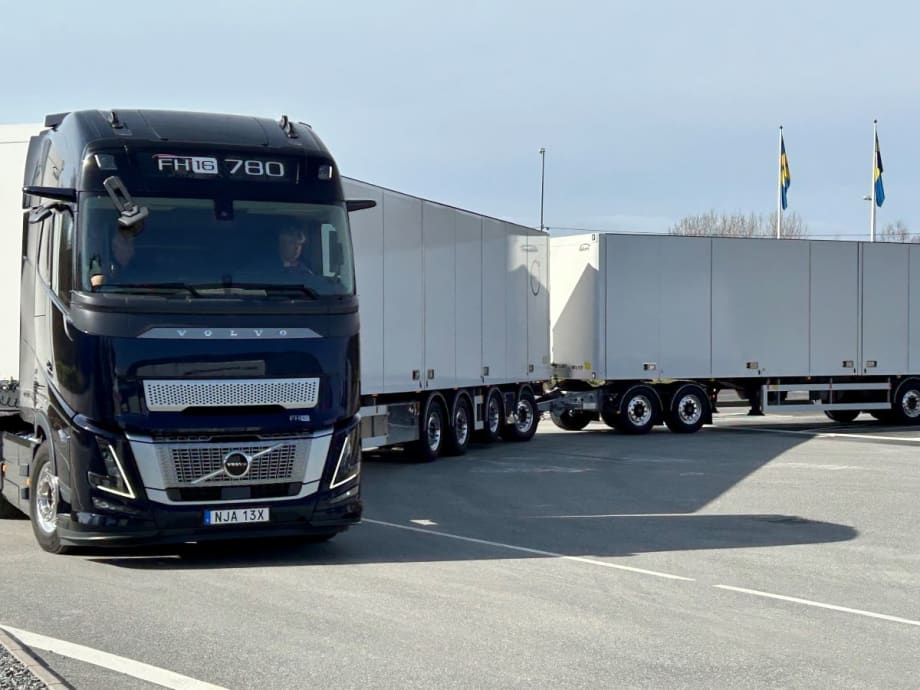
High-horsepower engines burning synthetic diesel fuel will have definite role in future zero-emission trucking solutions, according to Lars Stenqvist, chief technology officer for the Volvo Group.
Photo: Jack Roberts
5 min to read
Volvo has a long history of environmental awareness. That history fits in well with its current determination to drive the global trucking industry to a net zero future by 2050. So it might surprise you to learn that the Swedish truck maker's chief technology officer is not only a fan of the internal combustion engine, but also is convinced that ICE technology will remain an integral propulsion technology for fleets for many decades to come.
Lars Stenqvist is in charge of 10,000 Volvo Group engineers worldwide. His team develops new trucks and technology for Volvo, Mack and Renault trucks. All told, Stenqvist is in charge of 15,000 Volvo employees and a $2.7 billion research and development budget.
And Stenqvist is big on the internal combustion engine.
'Technology the Planet Can Cope With'
From his headquarters on the Volvo campus in Gothenburg, Sweden, Stenqvist oversees Volvo’s massive investments in a high-tech future — everything from new propulsion systems to software. His team uses something Volvo calls CAST — common architecture and shared technology — to create new products, components and systems that will go into service worldwide.
“I want my solutions to be used across the Volvo Group,” Stenqvist said. “New technology that can be used in yellow construction machines, buses and all three truck brands. That is the mindset I want all my engineers to have. This is the recipe we have used for decades and it has served us very well.”
The key, Stenqvist said, is that Volvo engineers develop components that easily integrate into other platforms. Several years ago, Volvo began to electrify buses. Under the CAST mindset, engineers made sure those components could easily be integrated into construction machines or trucks.
“A few years later, we saw the business opportunity to reuse those BEV components from buses on trucks and construction machines,” he notes. “And that is why we are pioneers in battery-electric trucks today.”
Future Trucks Should be Safe, Fossil-Free, and Productive
The trucking industry is going through a massive transformation, and Stenqvist believes that virtually everything on the planet is connected to that change.
“At Volvo, we firmly believe the world needs more transportation,” he said. “But we cannot just use the solutions we build today. We need technology the planet can cope with.”
For Stenqvist, that vision of future trucks means ones that are 100% safe, 100% fossil free, and 100% more productive for their users.
He understands the popularity of internal combustion engines. The technology is over a century old and very familiar to fleets worldwide. But Volvo did a global study of ICE technology in 2020 and concluded that there are just not enough biofuel and renewable fuel options available to decarbonize trucking today.
As a result, his team turned to a strategy of making the majority of trucks on the road either battery-electric or hydrogen fuel cell vehicles by 2040.
"But I want to be super clear: We believe in a long life and a long future for ICEs," he added. "And we believe that all three of those technologies will be developed and used in parallel by fleets in the future.”
That means Stenqvist’s engineering team must now master three different propulsion technologies. Two of those are brand-new that “came out of the blue” without any prior experience for his team to learn from.
But at the same time, this year, Volvo will invest more money than ever before in ICE technology connected to meeting the just-finalized U.S. EPA 2027 emissions regulations.
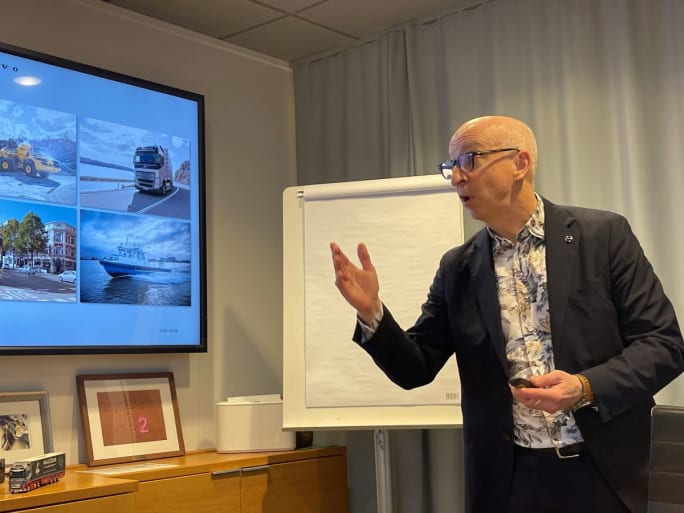
Lars Stenqvist, chief technolgy officer, the Volvo Group, details the company's multi-pronged approach to zero-emission transport during a press briefing in Lundby, Sweden, on April 9, 2024.
Photo: Jack Roberts
Trucking's Road to Net-Zero Emissions: Many Societies, Many Solutions
Five years down trucking’s road to net zero, Stenquist said that Volvo engineers are “less sure and more humble” about the way the technologies they’ve developed will be employed.
“How and where these zero-emission powertrains are used will not be decided by engineers,” he said. “Those issues will be decided by society. And there will be different solutions in different applications and in different countries.”
Stenqvist noted that many countries and regions are currently struggling with electric infrastructure. Green hydrogen infrastructure is even farther behind.
“That is why we think we need to develop all of these technologies in parallel,” he explained. “Because in one region, hydrogen fuel cell vehicles might work best. And in another region, battery-electric trucks may provide the best solution.”
And, he added, diesel will still play an important role in heavy-haul applications that are not as price-sensitive as others.
“In those situations, our new 17-liter engine running on synthetic diesel will be a very attractive option,” he said.
Working With Regulators and Politicians on Truck Emissions Regulations
Of course, the drawbacks to any use of diesel fuel in the future — even synthetic diesel fuel — is that combustion creates NOx emissions.
“That is why we must have a good dialogue with politicians and educate them on the drawbacks and benefits of these technologies,” Stenqvist said. “Far too many politicians are trigger-happy. They want to ban technologies instead of telling us what they want us to achieve.”
While California gets all the headlines in the U.S., in Europe it is the U.K. that is talking about banning ICEs, thanks to well-meaning, but overzealous and ill-informed politicians, Stendqvist said.
“I don’t think that will stand,” he said. “ICEs running on hydrogen can be a very good solution for future trucking applications. We need to have broader technology palettes to explore all of these solutions and offer our customers the best solutions for the jobs they need to do.”
Investing in Sustainability Beyond Truck Manufacturing
And Volvo is already doing those things.
“We need to take control of different parts of the value chain,” he said. “We need to understand that while battery-electric trucks are great, producing batteries today is far from a ‘green’ activity.”
That is why Volvo has been so proactive in stepping into what called "vertical" businesses to round out and complement the powertrain technologies the OEM is developing. Prime examples include:
Volvo’s acquisition of battery developer and producer Proterra.
A massive new battery plant in Mariestad, Sweden.
Volvo’s new joint venture with Westport to develop new ICE technologies for heavy trucks.
There is still a long way to go on the road to net zero. But, according to Lars Stenqvist, all options are on the table at Volvo. And new solutions are constantly being worked on and developed for fleets all over the globe.
More Fuel Smarts

How Volvo Updated Its D13 for EPA 2027 [Watch]
Volvo’s updated D13 promises lower emissions without sacrificing performance or fuel economy. Take a closer look at what changed inside the engine in this HDT Spotlight video.
Read More →
Diesel Price Spike Shortens Payback for Natural Gas Trucks, Report Says
Energy Vision estimates fleets could recover the higher purchase price of an RNG-fueled Class 8 tractor in 1.3 to 2.8 years under current fuel-price scenarios.
Read More →
Calstart Becomes Catalyst Mobility, Reflecting Broader Focus
Calstart is now Catalyst Mobility, reflecting the nonprofit’s growing national role in clean transportation, including zero-emission trucks, infrastructure and incentive programs.
Read More →

Record Diesel Prices Squeeze Trucking Fleets
Average U.S. diesel prices have climbed to nearly $6 a gallon, surpassing the 2022 record as tight refinery capacity and Middle East disruptions keep fuel costs elevated.
Read More →
Sponsored•September 9, 2026
How Fuel Delivery Shapes Engine Performance
Fuel delivery depends on more than what happens at the injector. For fleet, maintenance and technical professionals, looking at the full path from pump to injector can provide useful context for understanding engine performance.
Read More →
East Coast Port Launches $45M Electric Truck Push
The Port Authority of New York and New Jersey announced millions in incentives for zero-emission drayage trucks, yard tractors, and new charging hubs near the port.
Read More →
California Bill Could Shed Light on Electric Truck Prices
Why do battery-electric Class 8 trucks remain so expensive? A California bill headed to Gov. Gavin Newsom would give fleets and state agencies more visibility into what manufacturers charge.
Read More →
Detroit Opens Orders for EPA 2027 Engines
Detroit isn’t starting from scratch to meet EPA 2027 diesel emissions standards. Its Gen 6 DD13 and DD15 engines keep much of today’s platform while updating the fuel and aftertreatment systems.
Read More →
Zero-Emission Truck Corridor Planned for West Coast
California, Oregon, Washington, British Columbia and Baja California are coordinating plans for truck charging and hydrogen fueling from Canada to Mexico.
Read More →
A Closer Look at Kenworth’s Electric T880E Vocational Truck [Video]
Learn more about Kenworth's T880E battery-electric vocational truck at the Paccar Technical Center, including its range, applications, upfitting considerations, and PTO options, in this HDT Spotlight video.
Read More →