





Related: How Nikola Plans to Make Hydrogen the Truck Fuel of the Future
Kenworth, Toyota Unveil Jointly Developed Hydrogen Fuel Cell Truck
In Southern California, Toyota and Kenworth unveiled a jointly developed fuel cell electric heavy-duty truck, the result of a collaboration with the California Air Resources Board and the Port of Los Angeles.
April 22, 2019
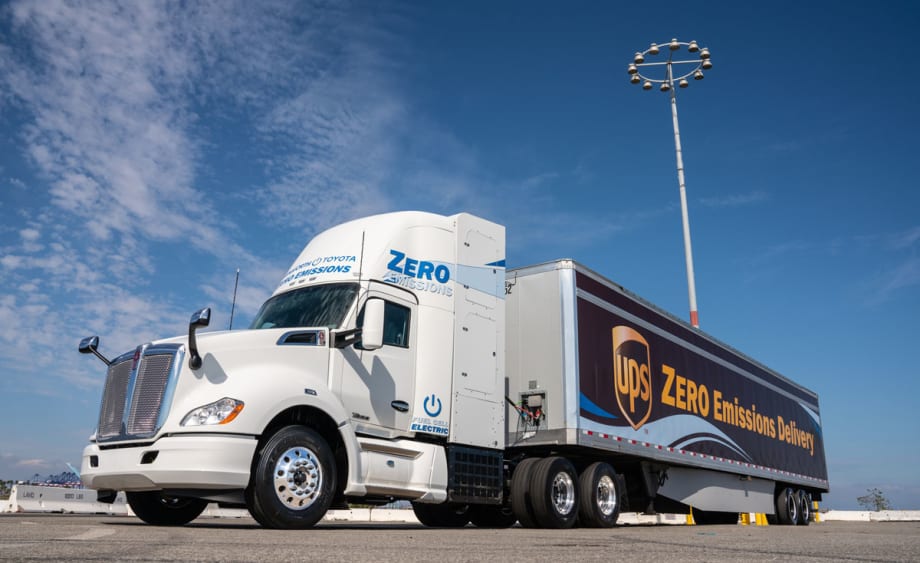
The Kenworth Toyota Fuel Cell Electric Truck (FCET) features the T680.
Photo courtesy Kenworth
4 min to read
In an effort to further reduce emissions and highlight the benefits of hydrogen fuel cell technology, Kenworth announced that it will develop 10 zero-emissions Kenworth T680s powered by Toyota hydrogen fuel cell electric powertrains to be used at the Ports of Los Angeles, throughout the Southern California and Central Coast areas, and in Merced County.
Toyota and Kenworth unveiled the jointly developed fuel cell electric heavy-duty truck, the result of a collaboration with the California Air Resources Board and the Port of Los Angeles, at press event held at the LA Ports in an effort to highlight Earth Day on April 22.
“The operation of these vehicles will provide data that will be critical in supporting the ongoing development of zero emissions powertrains, as well as the expansion of hydrogen fueling infrastructure,” said Mike Dozier, general manager of Kenworth and Paccar vice president. “Moving forward, we see zero-emissions powertrains as an important part of our product portfolio both to meet the needs of our customers, while also reducing the environmental impact of society’s day to day activity.
The FCET zero-emission truck expands on the capabilities of Toyota’s first two Project Portal Proof of Concept truck with improved capability, packaging and performance. The new truck features a range of more than 300 miles per fill. It is expected to begin drayage operations in the fourth quarter of this year.
Toyota and Kenworth plan to deploy 10 of the FCET trucks as part of the Zero-and-Near-Zero-Emission Freight Facilities Project (ZANZEFF), hauling cargo received at the twin Ports of Los Angeles and Long Beach, throughout the L.A. Basin. The trucks will be operated by Toyota Logistics Services, UPS, Total Transportation Services and Southern Counties Express.
The latest FCET uses the Kenworth T680 Class 8 model combined with Toyota's fuel cell electric technology.
"Toyota is committed to fuel cell electric technology as a powertrain for the future because it's a clean, scalable platform that can meet a broad range of mobility needs with zero emissions," said Bob Carter, executive vice president for automotive operations at Toyota. "The ZANZEFF collaboration and the innovative 'Shore-to-Store' project allow us to move heavy-duty truck fuel cell electric technology towards commercialization."
Since 2017, the original two Project Portal Proof of Concept trucks have logged more than 14,000 miles of testing and real-world drayage operations.
CARB has awarded $41 million to the Port of Los Angeles for the ZANZEFF project as part of California Climate Investments, a California initiative that uses cap-and-trade dollars to reduce greenhouse gas emissions, strengthen the economy and improve public health and the environment.
Headed by the Port of Los Angeles, the project is part of a "Shore-to-Store" plan and provides a hydrogen fuel cell electric technology framework for freight facilities to structure operations for future goods movement. The initiative is aimed at reducing emissions by over 500 tons of greenhouse gas and 0.72 weighted tons of NOx, ROG and PM10.
The Port of Los Angeles will develop the project in several phases, encompassing initiatives in Southern California, the Central Coast Area, and Merced County. The initial phase is designed to kick-start the leap to a new class of goods movement vehicles, while reducing emissions in designated disadvantaged communities.
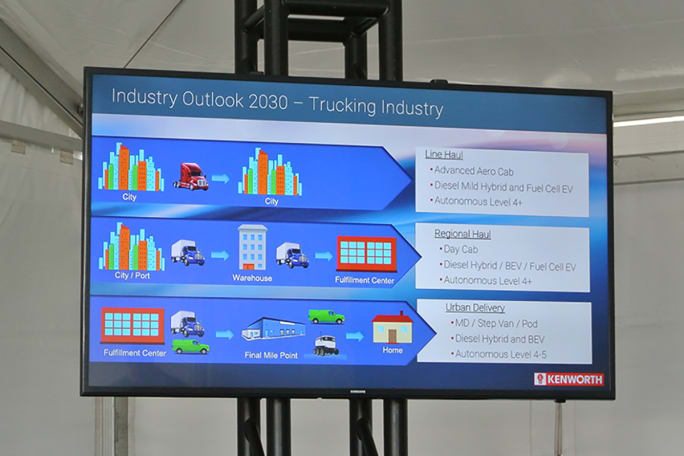
Kenworth Chief Engineer Patrick Dean illustrated the company's outlook on the adoption of alt-fuel and autonomous technology for 2030.
Source: Kenworth
“We see diesel engines having a long future in long haul trucking, especially in the U.S. So, probably about 5% of that market space is going to be electrified powertrains,’ said Patrick Dean, chief engineer at Kenworth. “But on the regional haul, there’s a much larger impact for electric powertrains, probably more in the 20% region.”
With the FCET truck as the first phase, the project will eventually go on to develop two new large-capacity heavy-duty hydrogen fueling stations and expand use of zero emissions technology in cargo terminal and warehouse environments.
“The collaboration between the Port of Los Angeles, Kenworth, Toyota and Shell is providing an excellent opportunity to demonstrate the viability of fuel cell electric technology in both drayage service and regional haul commercial vehicle applications operating in Southern California,” said Dozier. “The performance of the 10 Kenworth Class 8 trucks being developed under this program – the first of which debuted today – is targeted to meet or exceed that of a diesel-powered truck, while producing water as the only emissions byproduct.”
An earlier version of this story featured an incorrect photo, showing an older Kenworth T660 developed by Toyota for hydrogen – which is not the T680 integrated jointly by Kenworth and Toyota. unveiled April 22. We apologize for the confusion.
More Fuel Smarts

How Volvo Updated Its D13 for EPA 2027 [Watch]
Volvo’s updated D13 promises lower emissions without sacrificing performance or fuel economy. Take a closer look at what changed inside the engine in this HDT Spotlight video.
Read More →
Diesel Price Spike Shortens Payback for Natural Gas Trucks, Report Says
Energy Vision estimates fleets could recover the higher purchase price of an RNG-fueled Class 8 tractor in 1.3 to 2.8 years under current fuel-price scenarios.
Read More →
Calstart Becomes Catalyst Mobility, Reflecting Broader Focus
Calstart is now Catalyst Mobility, reflecting the nonprofit’s growing national role in clean transportation, including zero-emission trucks, infrastructure and incentive programs.
Read More →

Record Diesel Prices Squeeze Trucking Fleets
Average U.S. diesel prices have climbed to nearly $6 a gallon, surpassing the 2022 record as tight refinery capacity and Middle East disruptions keep fuel costs elevated.
Read More →
Sponsored•September 9, 2026
How Fuel Delivery Shapes Engine Performance
Fuel delivery depends on more than what happens at the injector. For fleet, maintenance and technical professionals, looking at the full path from pump to injector can provide useful context for understanding engine performance.
Read More →
East Coast Port Launches $45M Electric Truck Push
The Port Authority of New York and New Jersey announced millions in incentives for zero-emission drayage trucks, yard tractors, and new charging hubs near the port.
Read More →
California Bill Could Shed Light on Electric Truck Prices
Why do battery-electric Class 8 trucks remain so expensive? A California bill headed to Gov. Gavin Newsom would give fleets and state agencies more visibility into what manufacturers charge.
Read More →
Detroit Opens Orders for EPA 2027 Engines
Detroit isn’t starting from scratch to meet EPA 2027 diesel emissions standards. Its Gen 6 DD13 and DD15 engines keep much of today’s platform while updating the fuel and aftertreatment systems.
Read More →
Zero-Emission Truck Corridor Planned for West Coast
California, Oregon, Washington, British Columbia and Baja California are coordinating plans for truck charging and hydrogen fueling from Canada to Mexico.
Read More →
A Closer Look at Kenworth’s Electric T880E Vocational Truck [Video]
Learn more about Kenworth's T880E battery-electric vocational truck at the Paccar Technical Center, including its range, applications, upfitting considerations, and PTO options, in this HDT Spotlight video.
Read More →