




Test-Driving the Shell Starship Tech Truck
The Shell Starship technology demonstrator truck gives a glimpse of what the near future of trucking will be like for drivers and fleets.

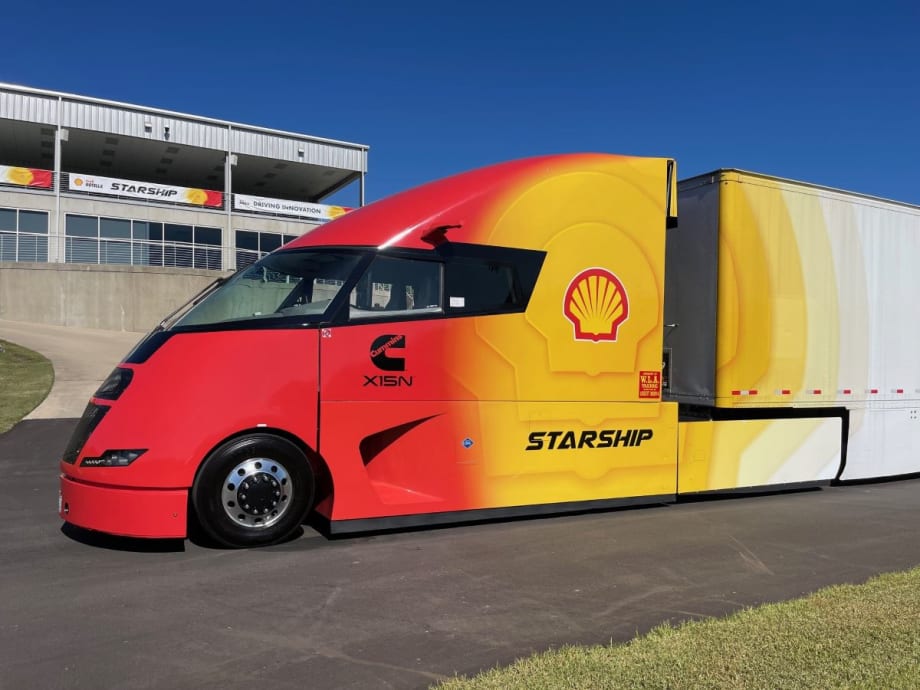
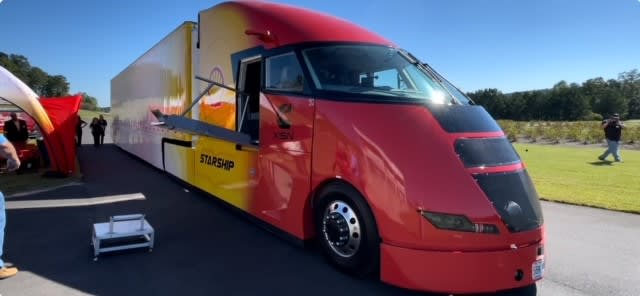
The Shell Starship awaits a fresh driver at the Barber Motorsports Facility in Birmingham, Alabama.
Photo: Jack Roberts
What is it like to drive an advanced, rolling test truck like the Shell Starship? It’s a question I’ve pondered since first laying on the truck back in 2018.
Well, following a press briefing by Shell Lubricant engineers on the detailing the latest enhancements on the truck, I was finally about to find out.
The setting was the superb Barber Motorsports Racetrack, Motorsports and Museum outside of Birmingham, Alabama. The weather was perfect, with the Starship absolutely gleaming in the bright October sunlight.
It was a great day for a test drive. And I was interested to see for myself what it’s like driving arguably the hottest truck engine in the country right now: The Cummins X15N natural gas engine.
And even though we weren’t going to get up to highway speeds on the test drive, this was still a rare opportunity to drive a truck jam-packed with cutting-edge technology.
And that started with climbing up into the cab. This is done via an upward retracting cabin door with integrated steps – very much like an airliner cabin door.
Inside, the Starship’s interior is rather plain. This is a test truck, after all. And not a tricked-out highway cruiser designed for people to live in.
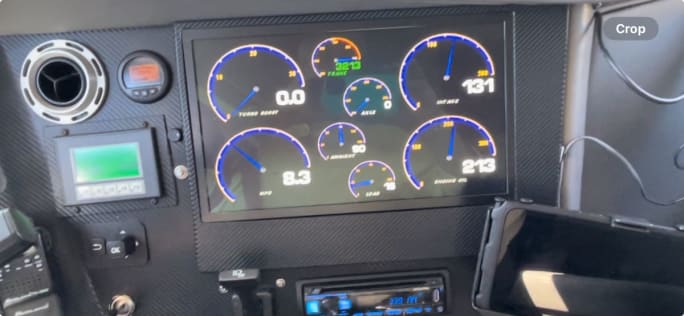
The large display screen in the Starship's center dash console displays large gauges a driver can read at a glance.
Photo: Jack Roberts
That aside, the Starship interior is surprisingly roomy and extremely quiet. And with a little work, it could easily offer the same amenities and relaxation space as any Class 8 long-haul tractor on the market today.
The center-steering position found on early Starship variants has been replaced by a conventional driver-passenger seating arrangement. Mainly it’s a change that was made to better accommodate test drives with riders onboard.
But, interestingly, Heather Duffy, marketing communications manager for Shell, told me that feedback has found that drivers simply do not like center-steer seating positions for a variety of reasons.
A Fresh Take on Cab Interiors
When you attend a Shell Starship briefing, most of the attention is focused on the truck’s powertrain and aerodynamic advancements. But the technological innovation on the truck extends into the cab as well.

Forward views over the Starship's nose are exceptional.
Photo: Jack Roberts
I found the driver’s position in the Starship to be extremely well thought out. Vehicle controls were logically placed and easy to reach. Instrumentation was excellent – particularly the large, programmable, display screen mounted prominently in the center dash structure. This display screen features quick and easy touch-pad access to all sorts of critical vehicle information. And this information is brilliantly presented on the screen in large graphics that drivers can scan and retain with a quick glance.
As you might expect, views out over the long, bullet-shaped nose were nothing short of fantastic. You really get a true, panoramic field of view sitting in the Starship, including outstanding lines of sight downward and to the sides.
These external views are supplemented by the rear-view camera screens mounted on the A-pillars and a right-side blind-spot display screen top-center above the windshield.
I’m a fan of rear-view camera systems and think their time has come in trucking. The display screens offer crisp, brilliant views to the sides and behind the tractor-trailer. And they seem to have a more integrated look and feel in the Starship cab than I usually see in conventional trucks.
In any event, the display screens were completely unobtrusive and did not interfere with external sight lines at all. I find them to be completely natural and intuitive to use when driving.
Maybe it’s the huge front and side windows, but the interior of the Starship just has a bright, roomy, open feel to it that you just don’t get inside most truck cabs. The cab is absolutely flooded with natural light. There’s no sense of claustrophobia or dark nooks and crannies anywhere. It’s easy to see that with a little work, the Starship cab could easily be a comfortable and productive place for drivers to live and work.
Good is the Enemy of Perfect
But more than anything else, I was keen to finally drive a Cummins X15N natural gas engine.
I’ve become increasingly convinced that natural gas is being overlooked in the mad rush to convert the North American commercial vehicle fleet to zero-emission powertrain technologies.
Natural gas is a mature, proven fuel that the trucking industry has a good deal of experience with. Moreover, natural gas infrastructure – while still not adequate for a massive transition away from diesel fuel – is still light years ahead of electric charging or hydrogen fueling stations for commercial vehicles.
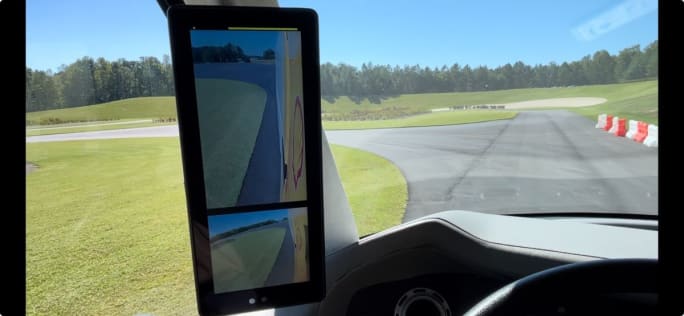
The rear-view camera display screens are well-integrated into the Starship's A-pillars.
Photo: Jack Roberts
Moreover, RNG producers say they have plenty of fuel on hand and can easily ramp up production to meet increased demand.
And yet, the regulatory agencies that are driving the push toward ZEV commercial vehicle technology don’t give natural gas the time of day.
Why is that?
Well, a suggestion I hear a lot is that the regulatory agencies have a “bias” against internal combustion engines. Remember, the policy wonks coming up with the rules are True Believers in a Green Energy future.
And they’ve been conditioned by more than half a century of negative perceptions to view all ICEs as inherently outdated and dirty technology – no matter the fuel being used.
But, as Kevin Otto, who was at the Shell event in his role as a technology analyst for the North American Council for Freight Efficiency noted, there are some real concerns with the widespread use of renewable natural gas as a transportation fuel.
For starters, manufacturing and transporting natural gas involves the risk of allowing methane to escape into the atmosphere. And, Otto noted, methane is a much more virulent contributor to climate change than carbon once it’s in the atmosphere.
The other issue Otto pointed out is that natural gas is not a zero-emission fuel.
“Aftertreatment on a natural gas engine is a heck of a lot easier than it is with the diesel,” Otto said. “Because you can basically use an automotive-style, three-way catalyst on a natural gas engine. Whereas the diesel requires selected catalytic reduction, a diesel particulate filter, carbon reduction and things like that to reduce soot.”
Still, natural gas engines can still get down to near-zero sustainability levels at the tailpipe, Otto noted. Which is vastly better than any diesel engine could ever achieve.
“With natural gas, NOx output at the tailpipe drops down to .35, or thereabouts, depending on the aftertreatment system,” Otto explained. “So natural gas – while not a zero-emission fuel – is a whole lot better than diesel from an NOx standpoint.
In simple terms, running renewable natural gas gets a truck engine to about 95% of the way to being a completely zero-emission vehicle.
Admittedly, natural gas isn’t a perfect green fuel for trucking. But it’s damn close. It’s sure as hell closer to zero-emissions than any diesel engine running out there today.
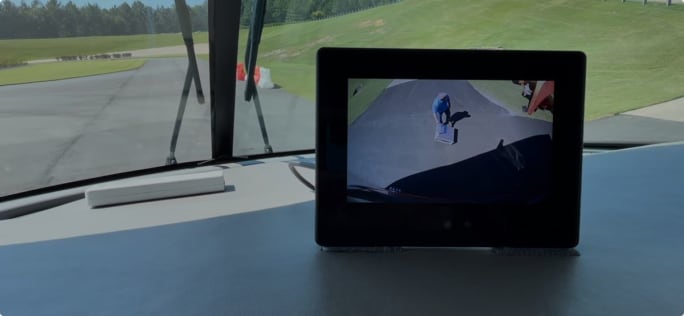
The right-side-downward camera display screen mounted atop the dash gives drivers excellent views of this notorious blind-stop area on Class 8 trucks.
Photo: Jack Roberts
And yet – if a fleet in California or any other CARB state wants to purchase a natural gas truck engine and put it to work, there are ZERO incentives in place – either on a state or federal level – to help with acquisition costs. And the fleet gets ZERO downstream credit for adopting this clean fuel technology.
And that seems preposterous to me… Perhaps even borderline criminal. Particularly when I walk in the other room and see the devastation on TV from two back-to-back, climate change-fueled monster hurricanes.
It is obvious that trucking needs an immediate clean fuel solution for super-regional and long-haul applications. And renewable natural gas is standing by waiting to step into that role.
If the regulatory agencies would only back off of their zero-emissions=or-die mentality, that is.
Diesel-Like Power and Performance
Of course, there’s a major caveat that goes along with that little sermon I just threw at you: All of that assumes that a heavy truck engine powered by renewable natural gas can be plugged into fleet operations and perform as well as diesel engines.
And for me, that was the ultimate purpose – and question to be answered – by my Shell Starship test drive.
Once I was settled into the driver’s seat with my seat belt secured, starting the Cummins X15N was as simple and straightforward as starting any diesel truck engine. The engine was exceptionally smooth at idle. And, if anything, perhaps a tad quieter than a diesel. But sonically, you can’t tell that there’s not a diesel engine powering the truck.
Shifting the Eaton Cummins Endurant AMT into gear was as simple as twisting my fingers on the right-hand stalk coming off the steering column. And the truck immediately started easing forward.
Acceleration was incredibly smooth and very muted. There was absolutely no sense that the X15N was straining or struggling to get the truck up and moving – although admittedly the truck wasn’t heavily loaded.
Otto noted in his presentation that natural gas engines simply don’t have the carbon output that diesels so. They are also not as efficient as diesels. So, in practical terms, Otto said, that means that a natural gas engine is about 15% less powerful than a comparable diesel engine.
That was a common knock against natural gas engines 20 years ago. But happily, the incredible advances in automated transmissions in the intervening years – particularly on the power management software side of the equation – have largely mitigated that disadvantage. In simple terms, I just didn’t notice any degradation in power or torque during my drive.
The right-side cab automatically retracts as the Shell Starship prepares for another run around the track.
Photo: Jack Roberts
I was alone on the track. So, there was no traffic to worry about. I still made a point to pan around the cab and check the rear-view camera screens. And sightlines both inside and outside the cab were every bit as good as I expected they would be.
Clearly a much more in-depth X15N drive is in order before I can render a full verdict on the engine. But my early impressions were positive. And the Starship offered an interesting look into what the next generation of truck interiors and exteriors may look like.
Far from being a vanity project, the Shell Starship is breaking new ground in trucking technology. And it will be interesting to see where this one-off truck goes next.
More Fuel Smarts

How Volvo Updated Its D13 for EPA 2027 [Watch]
Volvo’s updated D13 promises lower emissions without sacrificing performance or fuel economy. Take a closer look at what changed inside the engine in this HDT Spotlight video.
Read More →
Diesel Price Spike Shortens Payback for Natural Gas Trucks, Report Says
Energy Vision estimates fleets could recover the higher purchase price of an RNG-fueled Class 8 tractor in 1.3 to 2.8 years under current fuel-price scenarios.
Read More →
Calstart Becomes Catalyst Mobility, Reflecting Broader Focus
Calstart is now Catalyst Mobility, reflecting the nonprofit’s growing national role in clean transportation, including zero-emission trucks, infrastructure and incentive programs.
Read More →

Record Diesel Prices Squeeze Trucking Fleets
Average U.S. diesel prices have climbed to nearly $6 a gallon, surpassing the 2022 record as tight refinery capacity and Middle East disruptions keep fuel costs elevated.
Read More →
How Fuel Delivery Shapes Engine Performance
Fuel delivery depends on more than what happens at the injector. For fleet, maintenance and technical professionals, looking at the full path from pump to injector can provide useful context for understanding engine performance.
Read More →
East Coast Port Launches $45M Electric Truck Push
The Port Authority of New York and New Jersey announced millions in incentives for zero-emission drayage trucks, yard tractors, and new charging hubs near the port.
Read More →
California Bill Could Shed Light on Electric Truck Prices
Why do battery-electric Class 8 trucks remain so expensive? A California bill headed to Gov. Gavin Newsom would give fleets and state agencies more visibility into what manufacturers charge.
Read More →
Detroit Opens Orders for EPA 2027 Engines
Detroit isn’t starting from scratch to meet EPA 2027 diesel emissions standards. Its Gen 6 DD13 and DD15 engines keep much of today’s platform while updating the fuel and aftertreatment systems.
Read More →
Zero-Emission Truck Corridor Planned for West Coast
California, Oregon, Washington, British Columbia and Baja California are coordinating plans for truck charging and hydrogen fueling from Canada to Mexico.
Read More →
A Closer Look at Kenworth’s Electric T880E Vocational Truck [Video]
Learn more about Kenworth's T880E battery-electric vocational truck at the Paccar Technical Center, including its range, applications, upfitting considerations, and PTO options, in this HDT Spotlight video.
Read More →