




Shell Showcases Latest Starship Enhancements
Shell offered journalists a look at the latest enhancements and technology on its Starship technology demonstrator truck at a press briefing at the Barber Motorsports Complex outside Birmingham, Alabama.

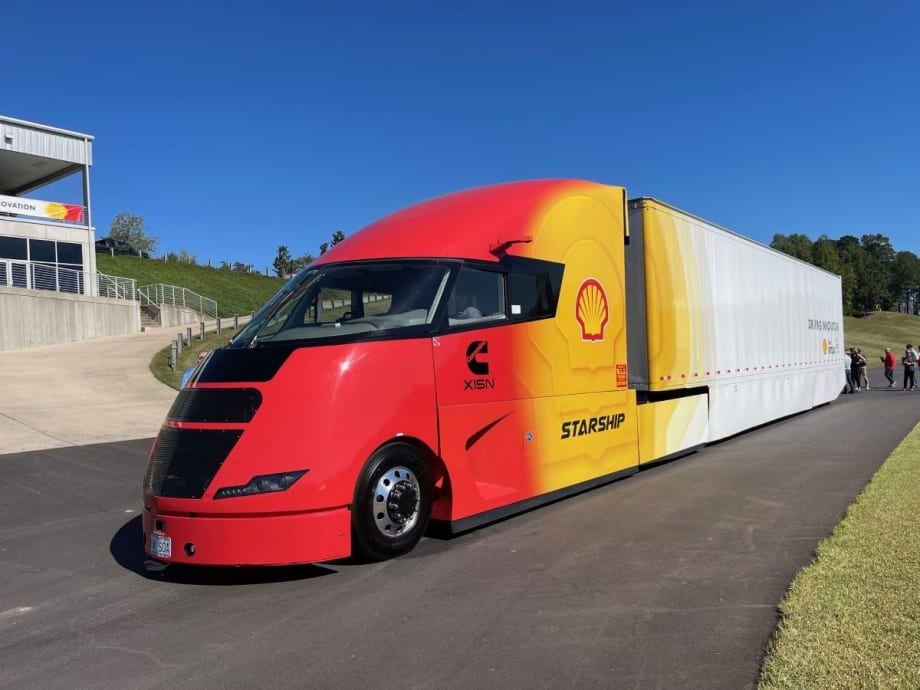
Shell showed off the latest version of its Starship technology demonstrator truck at a press event outside of Birmingham, Alabama, on October 8, 2204.
Photo: Jack Roberts
It’s not every day you get a chance to drive a one-of-a-kind truck. It’s an event that had only happened once before in my career as a trucking journalist, in fact. That is until I visited the Shell Starship media event at the superb Barber Motorsports facility outside of Birmingham, Alabama, on Oct. 8.
Because after years of simply looking at the Starship, Shell was finally allowing a few CDL-holding journalists like me the opportunity to take it around the track a couple of times.
A Lab on Wheels
The Shell Starship is a technology demonstration platform the giant, global gas, oil and lubrication supplier has developed to test various new Class 8 truck technologies. The goal is to help fleets understand which technologies can prove beneficial in the move toward emission-free fleet operations in the future.
“The Starship program initially started as a test bed truck to see what what's possible today with readily available technology,” noted Heather Duffy, marketing communications manager for Shell, ahead of the test drives.
She pointed out that sleek, bullet-nosed Starship cab is a unique design. But that’s it. “Every other component and system on the truck is something that a fleet could add to their own trucks to be able to actualize some real carbon savings, as well as operational on savings.”
From a Shell perspective, the Starship gives Shell a unique opportunity to demonstrate how its oils and lubricants work to improve fleet fuel economy, Duffy added.
2 Easy MPG Enhancements
In 2016 when Shell started the Starship program, 15W-40 was the standard oil for Class 8 fleets in North America. But the Starship, with its Cummins X15N natural gas engine, creates challenges compared to diesel ICEs. Which has given Shell the chance to fine-tune its next generation of engine oils for natural gas trucking applications.
“Natural gas engines run hotter and need a different additive pack than what you would normally have in a diesel engine,” Duffy explained. So, this truck is really a lab on wheels for us.”
Some of the technology Shell engineers put on the Starship works, and some of it doesn’t. But that’s the whole point of a laboratory, Duffy said.
“Fleet operators are not just going run out and try something new,” she explained. “They want to know if it’s been tried and tested and if it works. Which is why we’re very transparent about all the different technology we put on the truck and the results we get.”

Every component on the Shell Starship can be spec'd today by any North American fleet, according to Heather Duffy, marketing and communications manager for Shell Lubricants.
Photo: Jack Roberts
Case in point are the Bridgestone steer tires on the Starship, Duffy said.
“They are extra-wide, low-rolling resistance tires,” she said. “Originally, these were rear tires that we worked with Bridgestone to put on the truck and see how well they worked. It turned out the fuel economy savings from the steer tires was pretty impressive. In fact, Bridgestone now has their own line of steer tires based off of that collaboration.”
All of which drives home Duffy’s point: Tires and engine oil are two easy things for fleets to adopt and see substantial fuel savings.
“Fuel economy is one of the number one things that fleets can do to reduce overall ownership,” she said. “And a lower viscosity engine oil is one of the most effective ways to do that. We’ve seen up to three percent fuel economy savings with our new T6 and 5w-30 engine oils in fleet operations today. If you add tires into the equation, it’s a win-win solution for fleets. Because not only do you reduce your fleet’s carbon output, but you’re also able to see real cost savings for your company.”
The Importance of Freight-Ton Efficiency
Ryan Manthiri, engineering manager for the program, said that freight-ton efficiency is central to the Starship’s design and dictates the technology and systems that go onto its chassis or into its cab.
“This concept is centered on the truck's ability to carry the maximum allowable playoff using the smallest amount of energy,” Manthiri explained. “And we've shown through the demonstration once that freight-ton efficiency is a more meaningful lecture for freight efficiency, because it doesn't just consider fuel economy alone. It takes into account the load being carried. And that's a more economical and sustainable metric for measuring for its emissions. Because when you’re loading a truck to its maximum capacity, it might seem it will obviously lower your fuel economy. And it might seem counterintuitive in terms of total cost of ownership. In actuality, that energy that you use to overcome aerodynamic drag or rolling resistance, or to even accelerate the truck up a hill, that's all of fixed costs that becomes less significant per time because you shift.
There are four key enablers for freight-ton efficiency, Manthiri said. The first is light-weighting. “Basically, we strip as much weight off the truck as possible in order to load heavy and maximize payload,” he noted. “And we do this on Starship, specifically, by utilizing lightweight components throughout the chassis diagram.”
Second, Shell engineers work to reduce as many opposing forces acting on the truck as possible – things like volume resistance, rolling resistance and aerodynamic drag.
The third aspect to consider is powertrain efficiency. “At the heart of Starship is its powertrain with the Cummins X15N natural gas engine paired with an Eaton Endurant automated transmission,” Manthiri explained. “So obviously, if the power chain is the heart, then the lubricant is its lire blood. And so central to the Starship’s development and performance are lubricants which contact almost every component, component within the truck, and its powertrain. And because natural gas engines tend to run hotter than diesels, oxidation protection is critical in these applications.”
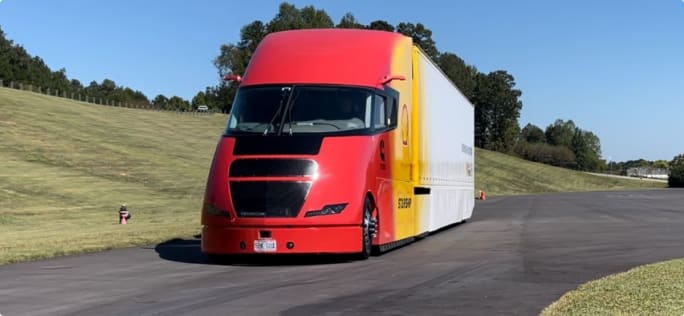
The Shell Starship has an aerodynamic drag coefficient about half of that on conventional tractors on the road today.
Photo: Jack Roberts
That is why Shell engineers use FA4 category oils in Starship. Manthiri said these oils are designed to deliver oxidation stability, aeration control and shear stability.
“This is why in the Starship 3.1 truck we've gone with Shell Rotella Natural Gas Plus which is a SAE 5W-30 FA4 synthetic oil,” Manthiri said. “This oil has a lower high-temperature/high-shear versus duration. In simple terms the lower the oil viscosity, the higher your fuel economy. So Shell can deliver improved fuel economy for natural gas engines while still providing the same protection as CK4 foundations.”
Aggressive Aerodynamics
The final component Starship designers focus on is the advanced aerodynamic profile of the truck. Built from lightweight carbon fiber, some of the systems feature solar-powered auxiliary electrical systems to extend and retract, in addition to a custom boat tail at the rear of the trailer that reduces drag as air flows past the rear of the truck.
On top of that, the Starship cab features a rounded, bullet-like shape complimented by rounded A-pillars, a curved windshield and aerodynamic, rear-view camera systems in place of conventional mirrors.
“All of these things are basically done to minimize drag,” Manthiri explained. “We want to reduce the amount of turbulent air flow zones in, under and over the truck. And all of these features working together gives us a proficient drag around .25. And that is compared to conventional production trucks on the road, which have an aerodynamic drag coefficient of around .60. So, that effectively means Starship’s aerodynamic drag is about half that of a traditional tractor on the road today.”
More Fuel Smarts
Trucking’s Diesel Squeeze Isn’t Letting Up
With diesel topping $6 a gallon nationally, ATA's Bob Costello explains why fleets should prepare for continued pressure at the pump.
Read More →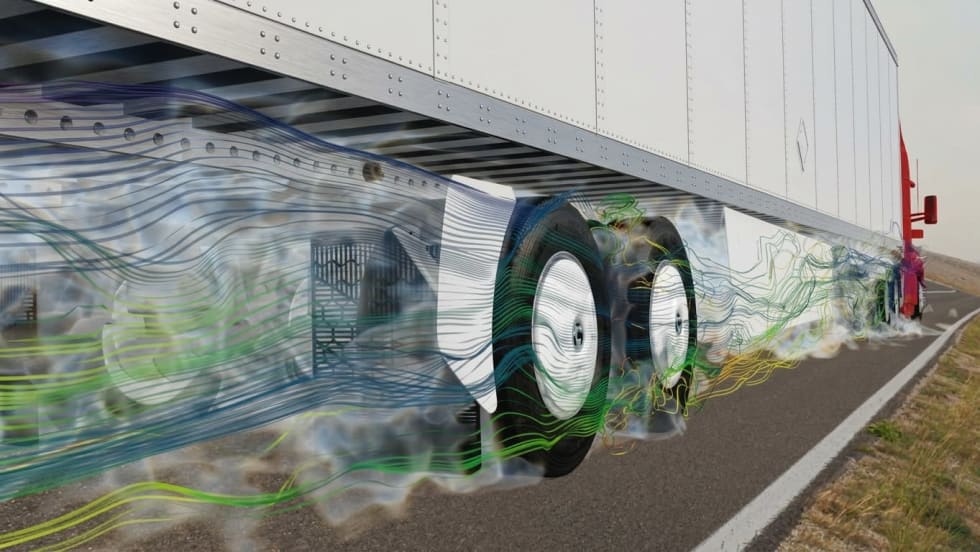
FlowBelow Redesigns Trailer AeroSlider to Cut Fuel Use
The lighter trailer aerodynamic system installs in less than 45 minutes, according to the company, with potential payback in under a year depending on fuel prices and trailer mileage.
Read More →
Why Diesel Price Relief Efforts May Fall Short
Diesel prices have eased from September’s record high, but doubts about additional Russian supply and limits on dyed-diesel tax relief mean trucking fleets still face expensive fuel. And prices could go higher.
Read More →
Why Small Fuel Savings Matter in Trucking
Can better fuel economy help pay for driver raises? In this podcast, GP Transco explains how small efficiency gains create room to reinvest in its people.
Read More →
How GP Transco Cuts Trucking Fuel Costs, a Tenth of a Gallon at a Time
What’s another tenth of a mile per gallon worth? GP Transco shares how equipment upgrades and driver coaching turn small gains into meaningful fuel savings.
Read More →
Electric Yard Tractors Move Beyond Pilots
Operating-cost savings have overtaken sustainability goals as the leading reason surveyed fleets are adopting battery-electric terminal tractors, according to new NACFE research.
Read More →
Geotab Links Fleet Card to Vehicle Data
The new card combines fuel discounts with telematics-based purchase controls. Geotab’s analysis also points to potential savings from choosing lower-priced fuel stops.
Read More →
Fleet Economics Shape Electric Truck Outlook
ACT Research expects costs, charging infrastructure, and technology improvements to drive zero-emission commercial vehicle adoption as federal regulations and incentives retreat.
Read More →
Wex Adds Cardless Fuel Payments for Over-the-Road Customers
A new fuel card feature for Wex customers offers convenience and security.
Read More →
New California Law Could Shed Light on Electric Truck Prices
Why do battery-electric Class 8 trucks remain so expensive? A California bill signed by Gov. Gavin Newsom would give fleets and state agencies more visibility into what manufacturers charge.
Read More →