




DOE SuperTruck 3 to Focus on Truck Electrification
The Department of Energy's SuperTruck 3 program will provide funding for research and development of electric and fuel-cell trucks, including a broader range of vehicles than the tractor-trailers in the first two programs.

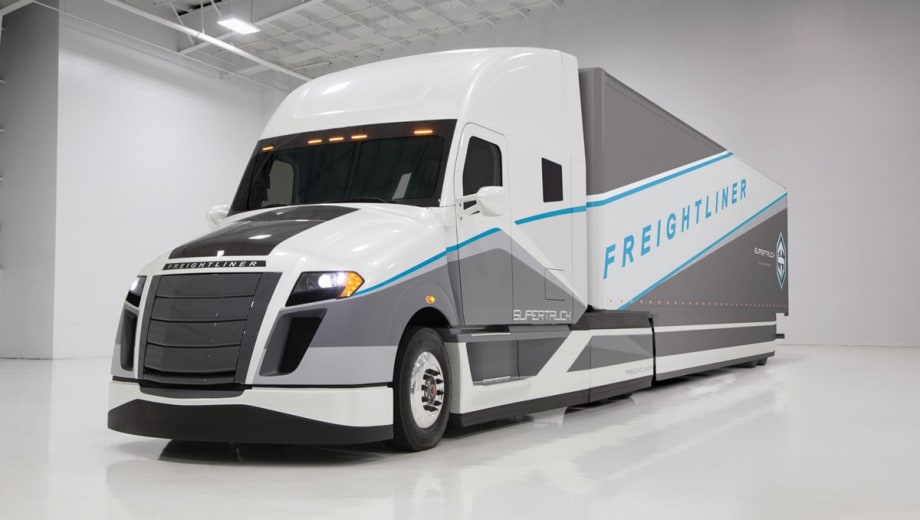
Freightliner's original SuperTruck team achieved a 115% freight efficiency improvement and 12.2 mpg.
Photo: Daimler Trucks North America
The third installment of the Department of Energy’s SuperTruck research and development funding project will focus on electric and fuel-cell trucks, and will address a broader range of vehicles than the tractor-trailers involved in the first two projects.
Secretary Jennifer Granholm announced $100 million in funding for SuperTruck 3 during a webinar April 15. Joining that webinar was the North American Council for Freight Efficiency, which also is focusing on electric trucks in its Run on Less Electric demonstration project this year.
The initial SuperTruck project, launched in 2009 by the DOE’s Office of Energy Efficiency and Renewable Energy, aimed to improve heavy-duty tractor-trailer freight efficiency by 50%.
Within seven years, teams from Volvo, Daimler, Cummins/Peterbilt, and Navistar had exceeded that goal.
The five SuperTruck 2 projects, launched in 2016, are on track to more than double Class 8 mpg, according to the DOE.
“Getting to net-zero carbon emissions by 2050 means we must aggressively cut down the largest source of emissions: the transportation sector,” Granholm said. “DOE’s first two SuperTruck initiatives led the biggest truck makers in the American semi market to take massive leaps in fuel efficiency. This new funding triples down on that progress with a push towards electrifying trucks of all sizes, along with efforts to expand EV charging access and develop low-emission car engines.”
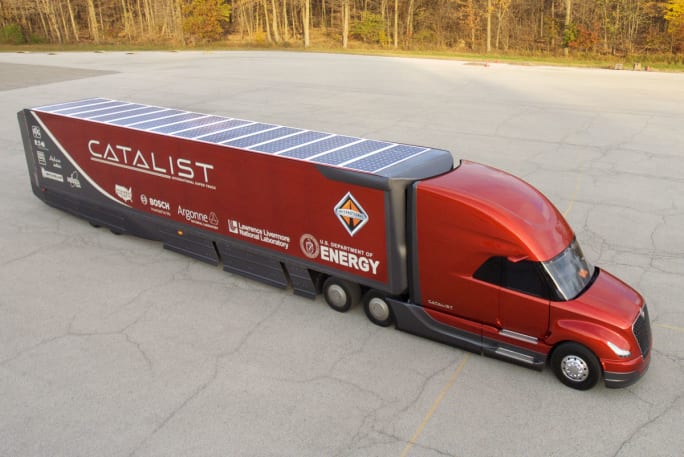
Navistar's Catalist SuperTruck featured solar panels.
Photo: eNow
Now EERE’s Vehicle Technologies Office and Hydrogen and Fuel Cell Technologies Office are partnering to offer up to $100 million in funding over four years (subject to appropriations) for the SuperTruck 3 project. This project is designed to pioneer electrified medium- and heavy-duty trucks and freight system concepts that achieve even higher efficiency and lower emissions. The funding focuses on a range of approaches to electrification: all-electric, plug-in hybrid systems using renewable biofuels, and hydrogen and fuel cell technologies, including hybridization strategies such as fuel cell range extenders.
Granholm said SuperTruck 3 will fund projects “that push the envelope event further, through electrification of vehicles and hydrogen fuel cells. And not just for semis. We want all kinds of trucks – garbage trucks, delivery trucks, tow trucks – really any medium or heavy duty truck on the road, we want them to run on alternative or cleaner energy.”
Charging/fueling Infrastructure
In addition to SuperTruck 3, another new DOE project will address the challenge of charging/fueling infrastructure for all sizes of low-GHG vehicles of all sizes.
The Vehicle Technologies Office is offering up to $62.75 million as part of its Low Greenhouse Gas Vehicle Technologies Research, Development, Demonstration, and Deployment program. This project will fund innovative solutions to reducing emissions and increasing efficiencies for on- and off-road vehicles.
To accelerate electric vehicle adoption, this funding will support expansion of EV infrastructure and charging, along with community-level EV demonstrations that can lower barriers to EV adoption — such as piloting EV car sharing and installing EV charging in apartment complexes. The FOA is also open to projects developing advanced engines and fuels that operate with lower emissions.
Both of these opportunities, Granholm said, combined mean “over $162 million dollars, subject to appropriation, which we know we have the support of, to develop clean transportation technologies for vehicles of all sizes. It is a powerful salvo in our war on the climate crisis.”
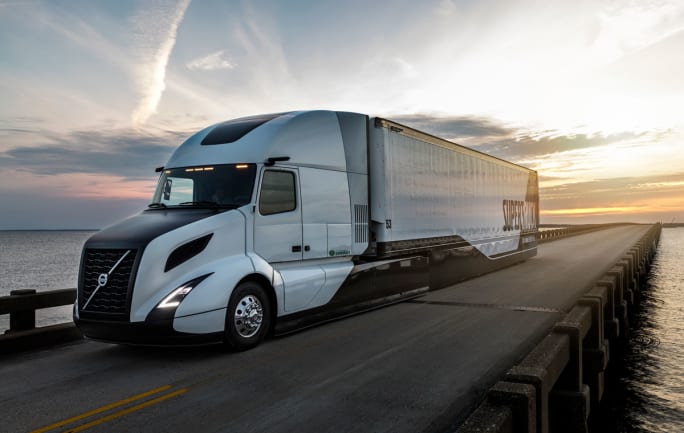
Turbo compounding for the Volvo D13 engine was just one of the efficiency features that were developed on Volvo's SuperTruck that it adopted for regular commercial truck models.
Photo: Volvo Trucks North America
Michael Berube, acting deputy assistant secretary for transportation in the DOE’s Office of Energy Efficiency and Renewable Energy, oversees EERE’s Sustainable Transportation sector. He said developing infrastructure isn’t just about battery-electric charging, but also about hydrogen for fuel cells.
“We envision through this SuperTruck initiative to get some of that hydrogen refueling infrastructure out there, maybe more in the demonstration phase, but it’s important to get that first experimentation and learnings out there.”
SuperTruck and Run on Less
Mike Roeth, NACFE executive director, noted that his experience with the SuperTruck program goes back to the mid-2000s when he was with Navistar. While the SuperTruck project and truck OEM research has led to diesel engines with amazingly low emissions and good fuel economy, he said, it also has created additional complexity, with the addition of aftertreatment systems, for instance.
In comparison, he said, battery-electric trucks are “elegantly simple.”
“Battery electric starts with smaller urban trucks and will find its way into semis,” he said, noting that both the SuperTruck 3 program and NACFE’s Run on Less Electric demonstration this year address that much broader range of vehicles. He also said there’s a place for fuel-cell vehicles and hybrids where fuel cells can extend battery range.
“There will be a lot of choices for manufacturers and fleets going forward, but we think battery electric and hydrogen fuel cell will be the predominant and necessary ones as we enter into 2040 and 2050 carbon-free transportation [goals] that the secretary talks about.”
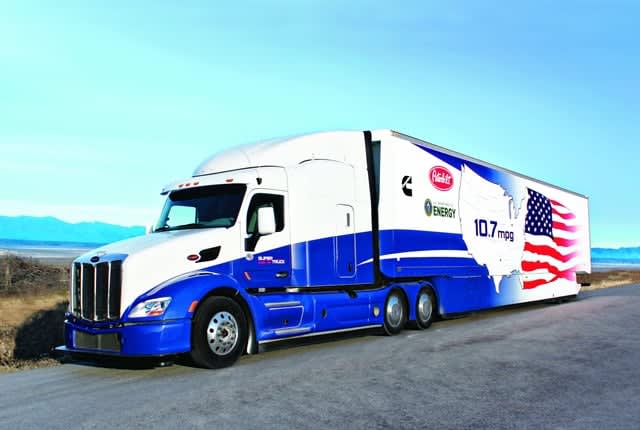
Because return on investment isn't a constraint on SuperTruck projects, some of the technology, such as waste heat recovery on the Cummins-Peterbilt SuperTruck, isn't something we've seen make it into commercial models.
Photo: Jim Park
In many ways the SuperTruck program and Run on Less are unintentionally linked, he explained. The original SuperTruck projects, “as they deployed prototype trucks and started to show some big numbers, 10, 11 mpg, it became obvious that some of those technologies were ready for market; others still haven’t come to fruition. Waste heat recovery as an example, hasn’t been the ROI to really get into the trucks. But so much has.”
The Run on Less programs took the technology that was becoming commercially available, much of it a result of the work done during the SuperTruck program, and demonstrated its real-world performance. In its first Run on Less in 2017, seven truckers driving cross country averaged 10.1. mpg. “That 10.1 and the fuel economy these guys do for their companies every day wouldn’t have happened without the SuperTruck program,” he said.
He was joined by two drivers from that Run on Less project, Joel Morrow of Ploger Transportation and Clark Reed from Nussbaum Transportation. They, too praised the development and validation of efficiency technologies that work in the real world, including relatively small things such as solar panels to help charge electric auxiliary power units to reduce idling for driver comfort.
“A lot of these high-risk, high-reward technologies are essential to hit our environmental goals and transportation industry goals we want as far as productivity,” Morrow said, “but validating that these technologies are ready for the real world is just super important. I want to say how important it is for programs like SuperTruck and NACFE to validate technologies before they go out in the world.” And that’s especially true, he said, for smaller fleets like Ploger and for owner-operators.
Looking forward at SuperTruck 3 and Run on Less Electric, Morrow said, “Infrastructure seems to be very much the limiting factor as far as [electric] heavy-duty vehicles. We would love to deploy a couple of electric vehicles in our local operations at Ploger, but there’s no infrastructure to support that, so our hands are kind of tied.”
More Fuel Smarts

How Volvo Updated Its D13 for EPA 2027 [Watch]
Volvo’s updated D13 promises lower emissions without sacrificing performance or fuel economy. Take a closer look at what changed inside the engine in this HDT Spotlight video.
Read More →
Diesel Price Spike Shortens Payback for Natural Gas Trucks, Report Says
Energy Vision estimates fleets could recover the higher purchase price of an RNG-fueled Class 8 tractor in 1.3 to 2.8 years under current fuel-price scenarios.
Read More →
Calstart Becomes Catalyst Mobility, Reflecting Broader Focus
Calstart is now Catalyst Mobility, reflecting the nonprofit’s growing national role in clean transportation, including zero-emission trucks, infrastructure and incentive programs.
Read More →

Record Diesel Prices Squeeze Trucking Fleets
Average U.S. diesel prices have climbed to nearly $6 a gallon, surpassing the 2022 record as tight refinery capacity and Middle East disruptions keep fuel costs elevated.
Read More →
How Fuel Delivery Shapes Engine Performance
Fuel delivery depends on more than what happens at the injector. For fleet, maintenance and technical professionals, looking at the full path from pump to injector can provide useful context for understanding engine performance.
Read More →
East Coast Port Launches $45M Electric Truck Push
The Port Authority of New York and New Jersey announced millions in incentives for zero-emission drayage trucks, yard tractors, and new charging hubs near the port.
Read More →
California Bill Could Shed Light on Electric Truck Prices
Why do battery-electric Class 8 trucks remain so expensive? A California bill headed to Gov. Gavin Newsom would give fleets and state agencies more visibility into what manufacturers charge.
Read More →
Detroit Opens Orders for EPA 2027 Engines
Detroit isn’t starting from scratch to meet EPA 2027 diesel emissions standards. Its Gen 6 DD13 and DD15 engines keep much of today’s platform while updating the fuel and aftertreatment systems.
Read More →
Zero-Emission Truck Corridor Planned for West Coast
California, Oregon, Washington, British Columbia and Baja California are coordinating plans for truck charging and hydrogen fueling from Canada to Mexico.
Read More →
A Closer Look at Kenworth’s Electric T880E Vocational Truck [Video]
Learn more about Kenworth's T880E battery-electric vocational truck at the Paccar Technical Center, including its range, applications, upfitting considerations, and PTO options, in this HDT Spotlight video.
Read More →