




Commentary: Are SuperTrucks a Waste of Money?
SuperTrucks have been called a waste of taxpayer money or government-funded marketing. Executive Contributing Editor Rolf Lockwood might disagree.
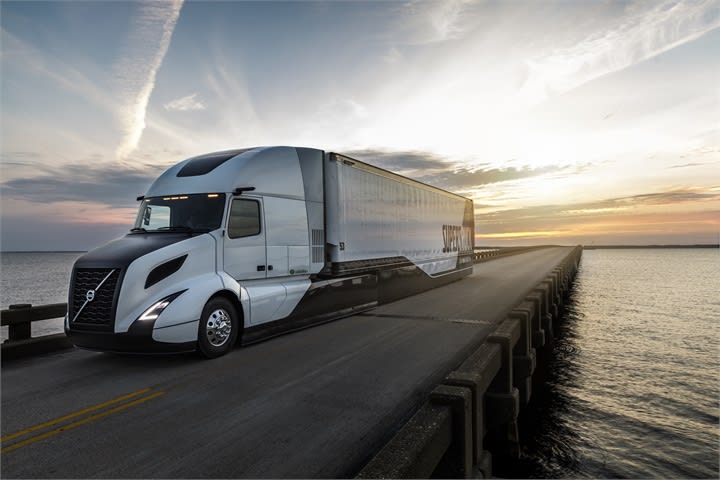
Is the SuperTruck program a huge waste of money or an important avenue for technology development?
Photo courtesy Volvo Trucks
How could anyone object to the Department of Energy’s SuperTruck program? Beats me, but I do hear people wondering why the DOE, along with a few truck makers and component suppliers, invest so much money in what is obviously essential research. I’ve heard it called a waste of taxpayers’ money. I’ve heard it dismissed as OEMs showing off, or looking for a marketing angle.
I just don’t get it.
At this crucial point in the evolution of truck technology, why on earth wouldn’t we spend this money? Social and business pressures — not to mention regulatory forces — are demanding new efficiencies. We simply have to know more, understand more, if we’re to avoid greeting the on rushing future with our hands tied behind our backs.
In a nutshell, how could anyone be satisfied with 6 mpg when 9 or 10 is readily achievable?
First of all, the SuperTruck investment isn’t that much money in the overall scheme of things. We’re now well into SuperTruck II, and Kenworth’s project, for instance, is only getting $8 million in DOE funding. They’re partnering with UPS on this one. They could get as much as another $12 million over the next three years if Congress, which has been supportive so far, gives a green light. So that’s $20 million, rather more than I’ll ever see in my bank account, but really just a drop in the bucket. Kenworth and UPS have yet to divulge what they’ll spend on this adventure.
All told, the DOE announced in 2016 that $80 million would be set aside for several SuperTruck II projects, including some involving medium-duty trucks. More could come, the department said, if Congress sees fit.
Far more important than the relatively small investment is the wide collection of insights gained into new technologies that might — or might not — make our trucks better. And easier on the planet. How else are we to find out if the engineers and chemists and all the other geeky sorts can make things like aluminum frames and waste-heat recovery work?
Better they experiment on SuperTrucks than on the vehicles they sell to you fleet owners. The EPA has already shown us how that works, and it sure wasn’t pretty.
Aside from Kenworth and UPS, the SuperTruck II program is also funding projects run by Daimler, Navistar, and Volvo. It aims to develop and demonstrate long-haul truck technologies that can achieve a greater than 100% improvement in vehicle freight efficiencies relative to the 2009 baseline, and also to provide engine thermal brake efficiencies greater than or equal to 55%.
In announcing the program at the Work Truck Show in 2016, Reuben Sarkar, then deputy assistant secretary for sustainable transportation at DOE, said, “This new funding will not only accelerate innovation but also foster rapid market adoption of new energy-efficient vehicle technologies.”
DOE originally launched its SuperTruck initiative in 2010, funding demo trucks from Cummins/Peterbilt, Daimler, Volvo, and Navistar.
Volvo’s SuperTruck I effort, for example, was good for a whopping 12 mpg and even 13 mpg in selected tests. Compared to a 2009 Volvo VNL tractor, it was a net 3,200 pounds lighter and produced 40% less drag.
Surely we want to know how all that was reached. And how it could be repeated.
Related: Super Trucks: Pie in the Sky, or Pathway to Super Fuel Savings?
More Fuel Smarts

How Volvo Updated Its D13 for EPA 2027 [Watch]
Volvo’s updated D13 promises lower emissions without sacrificing performance or fuel economy. Take a closer look at what changed inside the engine in this HDT Spotlight video.
Read More →
Diesel Price Spike Shortens Payback for Natural Gas Trucks, Report Says
Energy Vision estimates fleets could recover the higher purchase price of an RNG-fueled Class 8 tractor in 1.3 to 2.8 years under current fuel-price scenarios.
Read More →
Calstart Becomes Catalyst Mobility, Reflecting Broader Focus
Calstart is now Catalyst Mobility, reflecting the nonprofit’s growing national role in clean transportation, including zero-emission trucks, infrastructure and incentive programs.
Read More →

Record Diesel Prices Squeeze Trucking Fleets
Average U.S. diesel prices have climbed to nearly $6 a gallon, surpassing the 2022 record as tight refinery capacity and Middle East disruptions keep fuel costs elevated.
Read More →
How Fuel Delivery Shapes Engine Performance
Fuel delivery depends on more than what happens at the injector. For fleet, maintenance and technical professionals, looking at the full path from pump to injector can provide useful context for understanding engine performance.
Read More →
East Coast Port Launches $45M Electric Truck Push
The Port Authority of New York and New Jersey announced millions in incentives for zero-emission drayage trucks, yard tractors, and new charging hubs near the port.
Read More →
California Bill Could Shed Light on Electric Truck Prices
Why do battery-electric Class 8 trucks remain so expensive? A California bill headed to Gov. Gavin Newsom would give fleets and state agencies more visibility into what manufacturers charge.
Read More →
Detroit Opens Orders for EPA 2027 Engines
Detroit isn’t starting from scratch to meet EPA 2027 diesel emissions standards. Its Gen 6 DD13 and DD15 engines keep much of today’s platform while updating the fuel and aftertreatment systems.
Read More →
Zero-Emission Truck Corridor Planned for West Coast
California, Oregon, Washington, British Columbia and Baja California are coordinating plans for truck charging and hydrogen fueling from Canada to Mexico.
Read More →
A Closer Look at Kenworth’s Electric T880E Vocational Truck [Video]
Learn more about Kenworth's T880E battery-electric vocational truck at the Paccar Technical Center, including its range, applications, upfitting considerations, and PTO options, in this HDT Spotlight video.
Read More →