





Related: Driving Volvo’s SuperTruck
Super Trucks: Pie in the Sky, or Pathway to Super Fuel Savings?
The DOE SuperTruck projects have demonstrated what’s possible. The next challenge is to turn the possible into the practical.
June 14, 2017
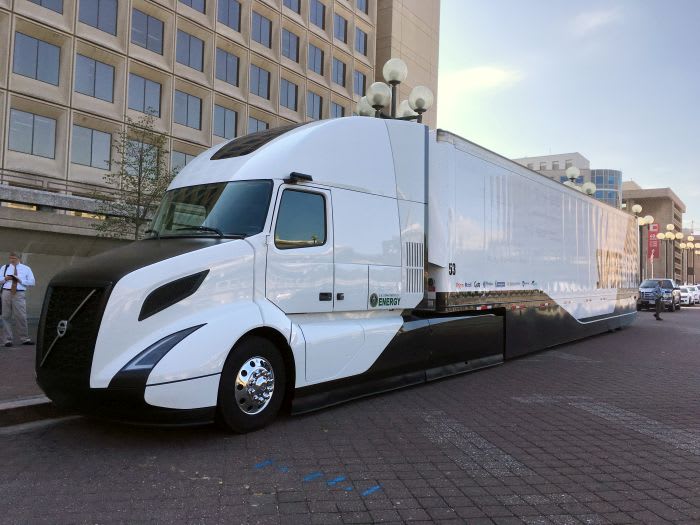
Volvo Truck’s SuperTruck was revealed in September 2016. It achieved more than 12 mpg during the test run, and demonstrated an 88% improvement in freight efficiency and a 70% improvement in fuel efficiency over the baseline truck, a 2009 Volvo VNL 670. Photo: Jim Park
6 min to read

Volvo Truck’s SuperTruck was revealed in September 2016. It achieved more than 12 mpg during the test run, and demonstrated an 88% improvement in freight efficiency and a 70% improvement in fuel efficiency over the baseline truck, a 2009 Volvo VNL 670.Photo: Jim Park
The September 2016 unveiling of Navistar’s SuperTruck brought to a close the first round of the U.S. Department of Energy funded research and development project aimed at improving freight efficiency and reducing heavy-truck fuel consumption. The results were spectacular. And that begs the question, where do we go from here?
HDT reported on each SuperTruck as it was unveiled, and looking back, one can see the similarities in the various approaches the truck makers took, as well as those unique to each project.
The most obvious development in each case was the aerodynamic work. All the OEs went long on aero, an easy target. That’s not to say the task was simple, as there was extensive design work along with modeling and testing. But at the end of the day, the closer each could get to the ideal aerodynamic shape, i.e., something similar to a rain drop, the greater the gains would be. Each OE ran into the brick wall of trailer shape, of course, but added a lot of bolt-on gear to the trailer to change what they could.
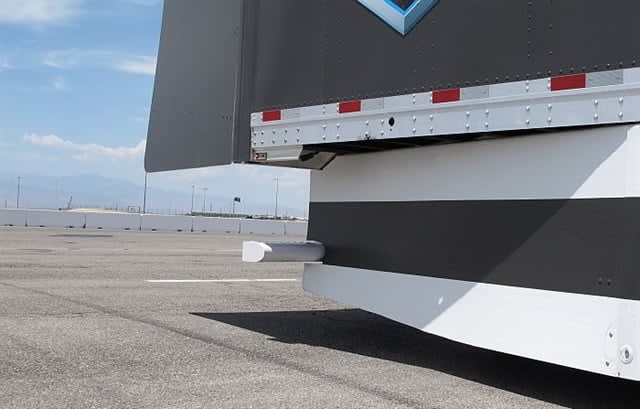
The rear of Daimler’s trailer featured a rear fairing, a sculpted underride guard and tapered lower side skirts. The concept was similar across all four trucks, but execution was slightly different.Photo: Jim Park
All used full-length trailer skirts that reached from close to the ground up to the bottom rail of the trailer. The problem is the potential for body damage resulting from day-to-day use. Fleets would never accept the maintenance problems associated with that sort of side skirt, but it’s interesting to note that some of today’s newer products are taller than previous versions. Maybe there is a growing acceptance that the aero benefits might outweigh the maintenance headaches.
The Cummins-Peterbilt truck featured retractable side skirts that could swing inward to provide about 8 inches of ground clearance when needed. On that trailer, the skirts had to be retracted manually, but Peterbilt said the system could be easily tied to road speed and deployed automatically at higher speeds where the likelihood of hitting something is low.
On top of the skirting, each of the SuperTruck teams added various aero treatments to the nose and base of their trailers to improve airflow, and each achieved varying degrees of success. All the aero devices were add-ons, rather than factory installations from trailer makers.
Navistar did something no other team did, and that was to fundamentally change the shape of the truck. The suspensions on the steering axle and the trailer bogies could each be lowered by a couple of inches while at highway speed, while the drive axle ride-height did not change. That gave the entire vehicle a slight airfoil shape, which is proven to be more aerodynamic than a flat trailer at a uniform height from front to back.
Several trailer makers overseas are designing trailers with a tear-drop shape, which lowers the back of the van body by close to a foot. It’s said to produce a 12% improvement in fuel economy, but you give up a lot of height at the door opening.
Interestingly, Navistar says the aero treatment applied to the trailer has more of an impact on the tractor rather than the other way around. Dean Oppermann, chief engineer for advanced vehicles and the SuperTruck group at International, told me his team approached the aero problem from back to front. An engineer from another OE once told me it would make great sense for the truck makers to acquire their own trailer manufacturer and to begin designing trailers to match their tractors’ aero profiles.
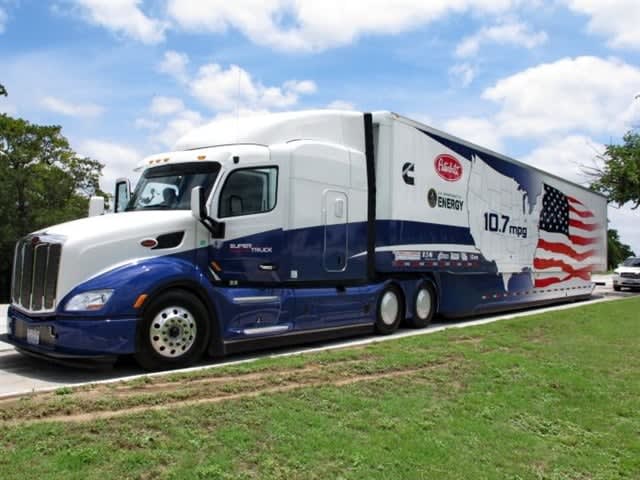
The Cummins/Peterbilt SuperTruck was the first project completed in February 2014. At 10.7 mpg on the official test run, it demonstrated a 75% increase in fuel economy, a 43% reduction in greenhouse gas emissions and an 86% gain in freight efficiency.Photo: Jim Park
Semi-advanced technology
The four SuperTruck projects yielded an impressive list of what I respectfully refer to as semi-advanced technology – new ways of looking at an old problem. By the project’s nature, everything was a bit of a science project intended to demonstrate ways of reducing emissions and improving freight efficiency, not to pass the market test for feasibility, cost/benefit, and fleet acceptance.
That said, we saw clutched air compressors that cut in only when the truck was coasting or braking, not when it was running under power, thus harvesting energy from the momentum of the vehicle. We saw components such as fans, oil and water pumps and the like operating at variable speeds and on an as-needed basis, further eliminating draw on the engine.
We even saw an old idea reimagined in a louvered radiator opening that remains closed most of the time for better aerodynamics, and opens only when air flow is needed for cooling.
There were some interesting tweaks to electrical systems where 48-volt charging and storage systems were used to power components such as HVAC compressors and hotel loads on three-voltage busses, 12, 24 and 48 volts. Each different voltage was assigned to a component or system that operated more efficiently at a voltage other than the current 12 volts.
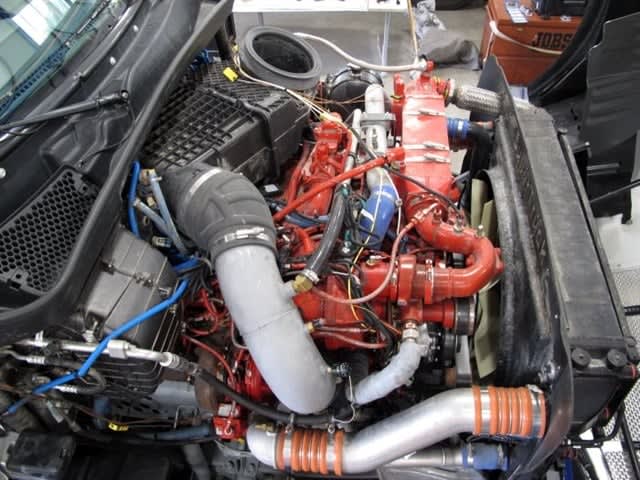
The early generation of a Rankine Cycle waste heat recovery system proved the concept works, but it was heavy, complex and expensive.Photo: Jim Park
We also saw wide use of lithium-ion storage cells as well as AGM batteries for hotel loads and ultra-capacitors for starting. Each of these has its own advantages, and when the technology was applied in a thoughtful manner it produced fuel-saving results.
Lightweighting also got wide exposure across the four projects, with something like 3,000 pounds, give or take, shaved off each of the baseline trucks before an additional 2,000 pounds of hardware was added. This yielded a net weight reduction of about 1,000 pounds per truck. Volvo, for example, used an all-aluminum frame for a savings of 900 pounds along with liberal use of carbon fiber in the tractor body panels.
The Cummins-Peterbilt truck used aluminum-matrix brake drums, which are 50 pounds lighter than cast iron drums. That team also used variable-gauge steel in some crossmembers and magnesium in others. Lightweight metals were also used in the cab and trailer for additional weight reduction.
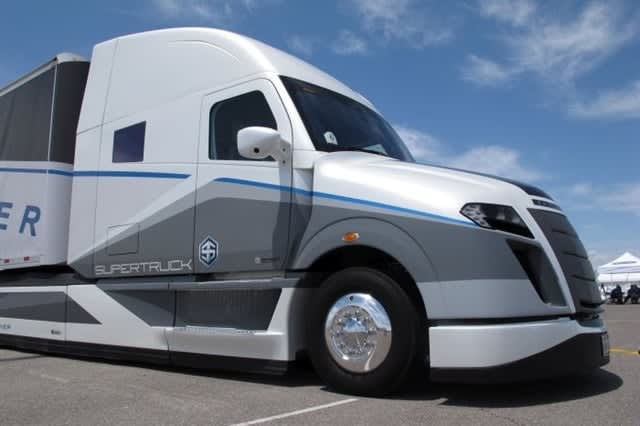
Daimler’s SuperTruck was the second project completed. It was unveiled at the 2015 Mid-America Trucking Show. At 12.2 mpg, it achieved a 115% freight efficiency improvement, and hit 50.2% brake thermal efficiency.Photo: Jim Park
11L engines
All the aerodynamic trim and the work that went into lowering rolling resistance and mechanical drag on the powertrain allows the trucks to cruise at 65 mph with a gross weight of about 65,000 pounds at an astonishing 125-140 hp. The 11L engines used by all but the Daimler and Volvo teams came in lighter, had less internal parasitic drag and took up less space under the hood than a 13L or 15L engine allowing for additional aero modifications.
Torque does most of the work with a downsped driveline, but in the real world we need horsepower on hills. These small-block engines delivered adequate horsepower and torque for this exercise, but probably would not be embraced except by really forward-thinking carriers whose freight lanes allowed them.
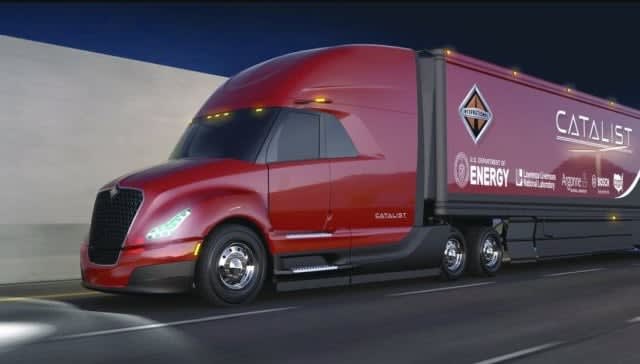
Navistar’s SuperTruck, the fourth and final truck, was revealed in September 2016. Called “CatalIST,” it achieved a freight efficiency improvement of 104% compared to the DOE’s control vehicle, 50.5% brake thermal efficiency, and it ran the test course at 13 mpg.Photo: Navistar
The U.S. DOE set specific energy saving targets for SuperTruck I, and they were all shattered by the four SuperTruck teams. The goal of the project was to get truck and engine makers thinking beyond products that can be commercialized in three to five years. Many of the technologies developed for the project have already found their way into current OEM offerings, and others are a model-year or two away. Others may be 10 years out, but these demonstrations will give engineers and consumers an unprecedented opportunity to see which technologies have potential, and which do not.
Subscribe to Our Newsletter
More Fuel Smarts
Trucking’s Diesel Squeeze Isn’t Letting Up
With diesel topping $6 a gallon nationally, ATA's Bob Costello explains why fleets should prepare for continued pressure at the pump.
Read More →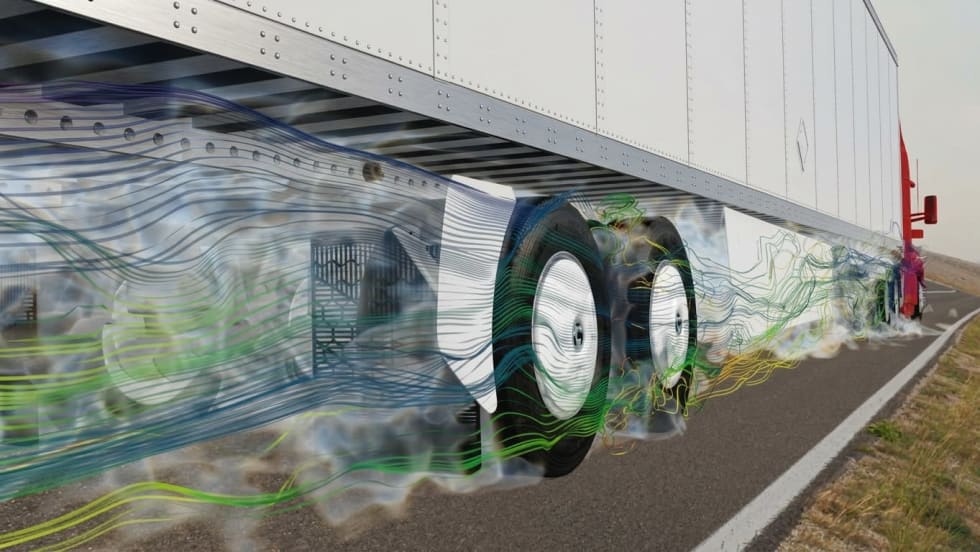
FlowBelow Redesigns Trailer AeroSlider to Cut Fuel Use
The lighter trailer aerodynamic system installs in less than 45 minutes, according to the company, with potential payback in under a year depending on fuel prices and trailer mileage.
Read More →
Why Diesel Price Relief Efforts May Fall Short
Diesel prices have eased from September’s record high, but doubts about additional Russian supply and limits on dyed-diesel tax relief mean trucking fleets still face expensive fuel. And prices could go higher.
Read More →
Why Small Fuel Savings Matter in Trucking
Can better fuel economy help pay for driver raises? In this podcast, GP Transco explains how small efficiency gains create room to reinvest in its people.
Read More →
How GP Transco Cuts Trucking Fuel Costs, a Tenth of a Gallon at a Time
What’s another tenth of a mile per gallon worth? GP Transco shares how equipment upgrades and driver coaching turn small gains into meaningful fuel savings.
Read More →
Electric Yard Tractors Move Beyond Pilots
Operating-cost savings have overtaken sustainability goals as the leading reason surveyed fleets are adopting battery-electric terminal tractors, according to new NACFE research.
Read More →
Geotab Links Fleet Card to Vehicle Data
The new card combines fuel discounts with telematics-based purchase controls. Geotab’s analysis also points to potential savings from choosing lower-priced fuel stops.
Read More →
Fleet Economics Shape Electric Truck Outlook
ACT Research expects costs, charging infrastructure, and technology improvements to drive zero-emission commercial vehicle adoption as federal regulations and incentives retreat.
Read More →
Wex Adds Cardless Fuel Payments for Over-the-Road Customers
A new fuel card feature for Wex customers offers convenience and security.
Read More →
New California Law Could Shed Light on Electric Truck Prices
Why do battery-electric Class 8 trucks remain so expensive? A California bill signed by Gov. Gavin Newsom would give fleets and state agencies more visibility into what manufacturers charge.
Read More →