




What Happens When FMCSA Comes to Audit Your Driver Logs?
Electronic logging devices may mean less paper, but some companies still can run into some trouble during an FMCSA compliance investigation.

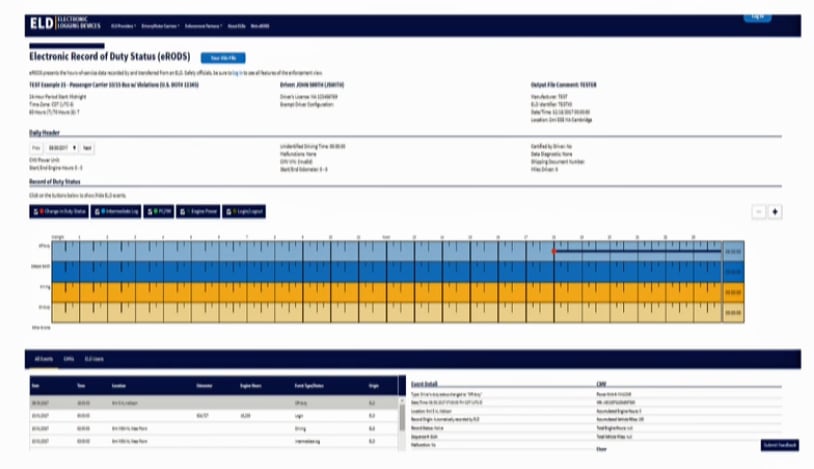
ERODS software makes it easier for compliance investigators to flag possible violations in ELD logs.
Screenshot of Trimble In.Sight. Courtesy Scopelitis Transportation Consulting
Electronic logging devices may mean less paper than the logbooks that preceded them, but some heavy-duty trucking companies still can run into trouble during a Federal Motor Carrier Compliance Investigation (also known as a Compliance Review or safety audit).
Dave Osiecki, who performed DOT safety audits in the field before he went to work for the American Trucking Associations before leading Scopelitis Transportation Consulting, has advice for trucking fleets on what safety inspectors look for in driver logs and ELDs when doing a compliance investigation.
No matter what the type of investigation, he said, safety investigators must check the following areas during a compliance investigation, using the acronym CAIR (pronounced “care):
CDL
Authority
Insurance
Red flag violations
On top of that is the Drug and Alcohol Clearinghouse. In any type of investigation, the investigator looks at things such as whether the company is registered for the clearinghouse and if the company is doing the full clearinghouse queries before the driver gets behind he wheel.
There are 16 “red flag” violations, where if an investigator discovered them during or prior to investigation, he or she is supposed to investigate what the company did in response – did they fire the driver, for instance. Examples include operating a truck without a valid CDL, driving after being declared out of service, or operating while using or in possession of drugs.
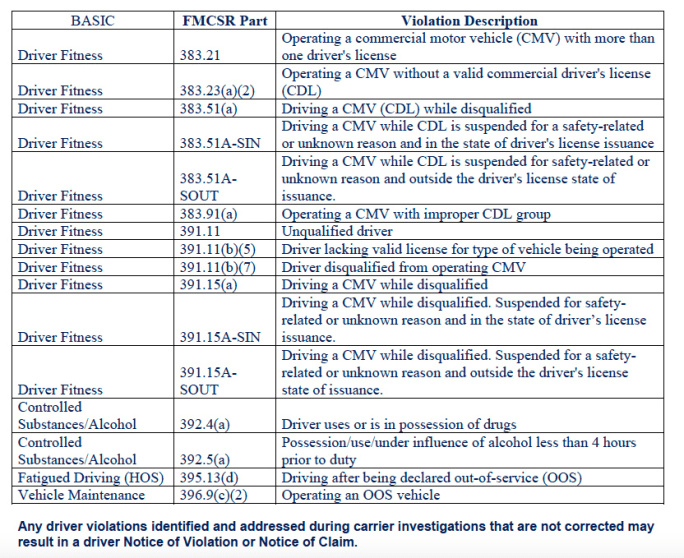
Courtesy Scopelitis Transportation Consulting
How Are ELD Records Audited?
There are two elements, Osiecki explained: a pre-investigation component, and the actual investigation of the records.
In the pre investigation, a safety inspector has to verify that ELDs are required by the company, and that its ELDs meet the requirements of the ELD rule. He or she also confirms that the ELD data can be retrieved electronically and can be transmitted to the investigator, either on site into the laptop, or if it’s an off-site audit, through the portal.
The investigator uses a set formula to determine how many drivers and ELD records will be audited, as well as which drivers and ELD records will be audited. The formula requires them to review at least 30 records of duty status per driver.
For off-site audits, the driver sample is much more limited – for instance, for an on-site review of a fleet with 100 drivers subject to the FMCSRs, they would have to select 11 drivers; for an off-site review, only three.
However, those drivers are not chosen at random, nor does the fleet get to pick its most compliant drivers for the review. Compliance officers will look for drivers with a red-flag violation, with the highest percentiles in the HOS BASIC, drivers involved in crashes, drivers with the highest violation rates, drivers with poor CDLIS driving records, recently hired drivers, and the highest-paid drivers.
The auditor then provides the company with a list of which drivers’ ELD data is being requested and give the company a link to upload that data. The inspector reviews the ELD data for compliance, and requests and reviews supporting documents, such as toll receipts, fuel reports, bills of lading, pay records, and scheduling records.
The Compliance Investigation, Electronic Logging Devices and Heavy Duty Truck Driver Hours of Service
That’s all the pre-investigation. During the actual compliance investigation itself, there are two components: The basic review of ELD records and the review for falsification.
“The basic review really is about, are there hours of service violations,” Osiecki explained. “In the review for falsification, they look deeper to see if there are ways the driver is fudging the electronic record.”
In the basic review, investigators will:
Interview key personnel to understand the fleet’s operations. How do company personnel book and plan dispatch and oversee the movement of the freight? They may follow up with accounts receivable and payroll. “They’re going to try to understand the process from the booking of the freight to the completed trip and the transfer of information,” Osiecki said.
Interview drivers to get their perspective how the process works and to see if it matches up with the story from operations.
Request various back-office reports from the ELD system, such as unassigned driving miles, the edit reports; odometer jump reports, and violation reports.
Review each change of duty status on the graph grid and check it against the ELD record detailed data, looking for violations of the 11-hour, 14-hour, 60/70-hour, and 30-minute break rule. This is less time-consuming than it used to be, Osiecki noted, as investigators can use ERODS software that flags possible trouble spots instead of having to plow through paper logbooks.
Check for unassigned driving miles and ask for explanation if none is provided.
Check the edits report.
Investigate ELD records, checking for system malfunctions or data diagnostics to determine if there’s an impact on hours of service.
And that’s just the “basic review.”
Osiecki reminded trucking companies to keep in mind that there are hundreds of types of ELDs on the market and the investigator isn’t going to know the ins and outs of all of them.
“They may not be familiar with the reports your system generates, so they’re going to lean on the company to educate them a little bit. Have patience with the investigator.”
Looking for Cheating on Driver Hours of Service
While electronic logging devices may be harder to cheat than paper logs, that doesn’t mean fleets aren’t responsible for overseeing them.
Common ELD violations include:
The motor carrier failing to ensure the driver’s ELD record was accurate.
The motor carrier failing to electronically product ELD records upon request.
The motor carrier failing to review records of unidentified driving time and/or annotate the record explaining why the time was unassigned.
One of the common things investigators look for in digging for ELD cheating is the same driver using different logins, or not logging in. They will review the list of login IDs and the login activity, Osiecki said, and they also will look at unassigned driving time.
They also will verify that the on-duty location matches the location where the driver went off-duty, to check that the vehicle was not moved while the driver was off-duty (or allegedly in the sleeper berth.) If these locations are different, and the driver does not have a team driver, that ELD record may be false.
Common Areas Where Investigators Discover Hours of Service Violations
The 30-minute break is another common place where investigators find non-compliance issues. Under current rules, drivers must take an off-duty 30-minute break after eight hours on-duty. The safety investigator will compare the odometer reading at the beginning and end of that break to identify any movement that would break the rules that require drivers to be in non-driving status during their mandatory break.
Personal conveyance is the most common source of false log violations, so the investigator will check for off-duty/PC driving activity and ensure it adheres to FMCSA guidance. Beginning and ending odometer values may identify excessive distance that points to a need to dig further into that personal conveyance use.
Investigators will verify annotations and edits to make sure edits are done for justified reasons, and will check the edited versions against the original.
As the training manual notes, Osiecki said, “Falsification may occur when driver edits on-duty/not-driving time to off-duty or sleeper time.”
This is the new way drivers falsify their logs, he said.
Another thing that many fleets may not think about: Investigators will look at the ELD support system setting to make sure there aren’t any features that allow fleets to customize settings in a way that would violate the rules – such as increasing the 5 mph threshold where the ELD automatically puts the driver in on-duty driving status, or disabling the volume being muted during sleeper berth time.
The investigator will review malfunction and diagnostic codes that could point to possible tampering, or to a carrier’s failure to address malfunctions and repair ELDs as required.
Finally, the investigator will compare the electronic logs to the supporting documents, such as fueling records. Supporting documents must be filed in a way that allows for easy matching to ELD records by compliance investigators.
More Safety & Compliance

From One Generation to the Next: How Mentorship Builds Safer Truck Drivers
After three decades in trucking, Harold Perry shares what he's learned about driver safety, mentorship, and helping the next generation build confidence behind the wheel.
Read More →
FMCSA Pauses Biennial-Update Enforcement Amid Motus Transition
Carriers whose updates were due on or after June 1 have more time, while FMCSA works to stabilize its new registration system and warns of phishing sites impersonating its new carrier registration system, Motus.
Read More →
ZF Expands Commercial Vehicle Push in North America
ZF is expanding its North American commercial-vehicle presence with new transmission applications, electrification, trailer technology and autonomous-driving systems.
Read More →
Truck Drivers Need More Than Another Alert
Fleets have more visibility into truck health, safety events, and driver activity than ever. The next challenge is turning all that information into useful guidance for the person who has to decide what to do next.
Read More →
Tesla Wants a Self-Driving Semi. Are Cameras Enough?
Could Tesla’s camera-only autonomous driving technology work on an 80,000-pound Semi? In this commentary, HDT's Deborah Lockridge takes a look at Tesla, Cybercab, and how autonomous trucks see the road.
Read More →
What DOT’s Automated Vehicle Strategy Means for Trucking
The U.S. Department of Transportation issued a new automated-vehicle strategy that outlines plans for driverless-truck regulations, cross-state freight corridors, and federal safety standards.
Read More →
NYC Expands Speed, Pedestrian Safety Tech Across Fleet
New York City is expanding intelligent speed assistance and pedestrian-alert systems across its municipal fleet, moving the technologies from pilot programs into vehicle procurement and retrofit requirements.
Read More →
FMCSA Removes 110 Truck Driver Training Schools from Certified ELDT List
Federal regulators also are targeting more than 160 additional training providers and launching a nationwide audit of third-party CDL skills testers as part of a broader crackdown on trucking fraud.
Read More →
Beyond DOT Compliance: What Makes a Trucking Fleet Truly Safe?
A trucking fleet can follow every rule and still make unsafe decisions. The real test comes when safety conflicts with freight, productivity, or cost.
Read More →
Hours of Service Pilot Programs: FMCSA Readies for 2027 Rollout
Two pilot programs could eventually reshape hours-of-service rules, giving truck drivers options to pause their 14-hour clock or use longer split sleeper rest periods.
Read More →