




How a Fake Co-Driver Led to a Fatal Truck-Bus Crash
It’s too easy for motor carriers and truck drivers to cheat on electronic logging devices, says the National Transportation Safety Board, resulting in dangerous driver fatigue — a major factor in a fatal 2022 crash between a semi-truck and a bus.

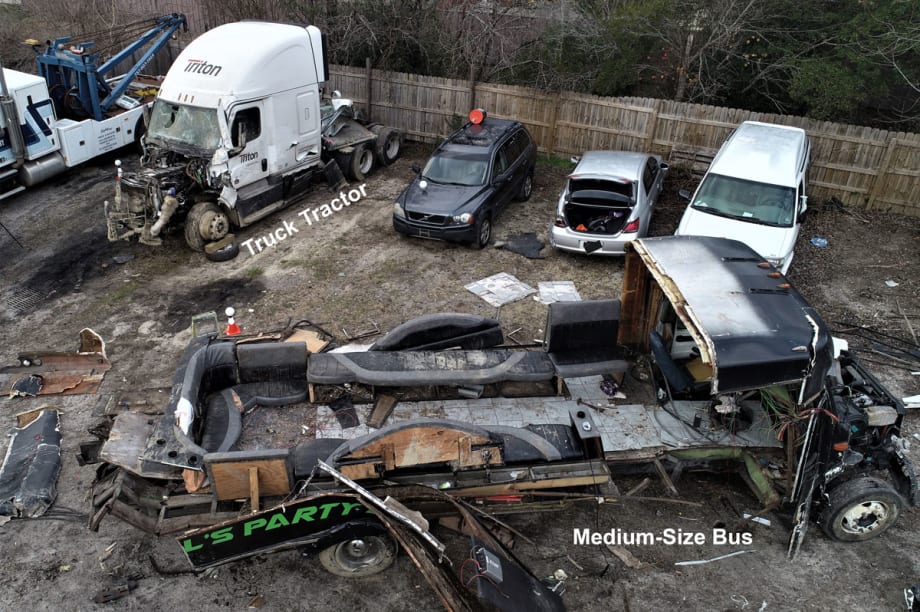
Triton Logistics was fined and given a conditional safety rating following an FMCSA compliance review. It faces litigation from victims' families for its role in the fatal 2022 truck-bus crash.
Photo: NTSB
It’s too easy for motor carriers and truck drivers to cheat on electronic logging devices, says the National Transportation Safety Board, resulting in dangerous driver fatigue — a major factor in a fatal 2022 crash between a semi-truck and a bus.
The NTSB is recommending stronger state and federal regulations for motor carriers in its report on the December 2022 crash on Interstate 64 in Williamsburg, Virginia.
The party bus was traveling at 20 to 25 mph in the right lane, while the truck was traveling at 65 to 70 mph with cruise control engaged. The speed limit on I-64 is 70 mph. The semi-truck hit the rear of the slower-moving bus. The truck driver did not brake or take any evasive action.
Three of the bus occupants died, while nine occupants and the truck driver sustained serious injuries.
The NTSB determined that the truck driver’s lack of response to the slower-moving bus was due to fatigue from excess driving time and lack of sleep opportunity.
The motor carrier, Triton Logistics, created fictitious driver accounts for its electronic logging device systems that allowed drivers to exceed federal hours-of-service regulations and drive while fatigued.
The investigation also determined that the bus’s significantly slower speed contributed to the severity of the crash.
NTSB Makes Recommendations on ELD Rules, Collision Avoidance, and More
As a result of the investigation, the NTSB is issuing six new recommendations and reiterating three previous recommendations. New recommendations include:
The Federal Motor Carrier Safety Administration should strengthen electronic logging device requirements to prevent opportunities for the creation of fake driver accounts. Regulations, it said, should require providers of electronic logging devices to create and produce an audit log, to include date, time and editor for driver logins, driver’s license numbers, and active driver list changes.
The Commonwealth of Virginia should offer management safety guidance to new intrastate motor carrier licensees covering license class, drug and alcohol testing, fatigue management, vehicle maintenance, and safe commercial vehicle operation.
Triton Logistics should implement a process to regularly verify the accuracy of drivers’ records of duty, implement a robust fatigue management program, and proactively use onboard inward- and forward-facing video event recording to improve driver training.
The Commercial Vehicle Safety Alliance should use this crash to educate its members on the importance of safeguarding the electronic logging device system to prevent falsification of information.
The board also reiterated previous safety recommendations that are relevant to this crash:
The National Highway Traffic Safety Administration should complete performance standards for assessing forward collision avoidance systems in commercial vehicles. NHTSA should also require that all buses and trucks over 10,000 pounds be equipped with onboard video recorders that record data associated with an event.
The Federal Motor Carrier Safety Administration should provide guidance to motor carriers on the use of onboard video recordings to ensure driver compliance with regulations and safe operations.
Truck Driver's 'Sleep Opportunities' Were Limited, Indicating Driver Fatigue
The NTSB used data from the truck’s electronic logging device (ELD), his cell phone records, and his interviews to determine what had happened in the days before the crash.
The day of the crash was the 61-year-old truck driver’s seventh consecutive day on duty.
When interviewed by the NTSB, the driver said he did not keep to a specific sleep pattern but would stop driving when he felt tired. He preferred to drive at night. He said he had slept for about five hours shortly before the crash.
The driver didn’t get more than five hours of consecutive sleep opportunities in the three days leading up to the crash, the board found. And, it noted, those “sleep opportunity” periods weren’t necessarily used for rest.
Footage from the truck’s forward-facing video showed that in the 3 minutes before the crash, the truck repeatedly drifted over into the shoulder area and then back into the right lane, crossing the white shoulder line nine times in 3 minutes.
A Fake Co-Driver Allowed Trucker to Cheat on Hours of Service Regulations
When NTSB examined the ELD data from the day of the crash, it showed that the truck driver was operating in a driver/codriver arrangement.
The driver involved in the crash told the Virginia State Police that he had dropped off his co-driver at a truck stop just before the crash. However, after further investigation, the NTSB found that the person who the supposed co-driver was no longer a Triton employee and had been dismissed eight days before the crash.
The alleged co-driver told the board he didn’t even know the crash-involved driver and had never occupied the truck with him or even driven long-distance trips for Triton.
During his interview, the truck driver stated that Triton had instructed that if he exceeded his allowable driving hours, he was to stop, call the Triton HOS department, and Triton personnel would log him out of the ELD and log in a new driver. He could then continue driving.
Both the NTSB and FMCSA spoke to four former Triton drivers who had been identified by roadside inspection notes as drivers who had recently dropped off co-drivers at truck stops, who told similar stories.
Triton’s HOS manager denied creating additional logins for drivers to use, stating that might have been “a mistake.”
Postcrash, the Federal Motor Carrier Safety Administration conducted an on-site focused compliance review of Triton. It found violations that included making or permitting a driver to make a false report regarding duty status and requiring or permitting a driver to drive more than 11 hours.
As a result of the review, the FMCSA assigned Triton a conditional safety rating and a fine of $36,170 for violations related to failure to conduct postcrash alcohol testing, falsification of records, and exceeding maximum driving time.
Fleet Safety Policies Did Not Address Driver Fatigue
Triton Logistics Inc., the NTSB noted, had many safety procedures and policies in effect at the time of the crash.
These included rules of conduct for drivers, a formal written orientation procedure, postcrash procedures, a drug and alcohol policy, a ban on cell phone use and texting, and a roadside inspection rewards and penalties program. The carrier had an established controlled substance and alcohol testing program and an established hiring process.
Triton had the speed of all its truck-tractors electronically governed at 69 mph and used a Samsara forward-facing video and safety management system.
However, the company carrier did not have a stand-alone fatigue management policy and did not schedule routes to manage fatigue. Triton drivers could choose when to drive (for example, they could choose to drive overnight rather than during the day.)
At the time of the crash, Triton used an electronic tablet-based ELD from RoadStar LLC as the provider.
Fleet Deleted Standard Truck Safety Features That Could Have Mitigated Crash
The NTSB reported that advanced vehicle technologies, including automatic emergency braking and adaptive cruise control, were available as standard equipment for the 2022 Freightliner Cascadia, but the carrier opted not to purchase these systems.
Last year, a proposed rule put out by the DOT would require new commercial vehicles over 10,000 pounds to have automatic emergency braking systems.
Since 2015, Daimler Trucks North America has provided the Detroit Assurance Safety Suite as an optional feature on all new Freightliner Cascadias and, since 2018, has marketed it as a standard feature, noted the report. The Detroit Assurance Safety Suite included forward collision warning, automatic emergency braking, and adaptive cruise control, among other features.
Triton ordered the truck without collision avoidance technology, resulting in a price discount. Triton told the NTSB that the owner and several of the drivers had field-tested an earlier version of the equipment, and they did not like its performance.
“We found that the collision may have been avoided or its severity lessened had these systems been installed on the truck-tractor,” said the board in its report.
“Because commercial vehicle customers can elect not to purchase collision avoidance systems, even those that are considered standard equipment, federal requirements are necessary to increase widespread deployment of this technology."
More on Falsifying Driver Logs Using Electronic Logging Devices
More Safety & Compliance

FMCSA Pauses Biennial-Update Enforcement Amid Motus Transition
Carriers whose updates were due on or after June 1 have more time, while FMCSA works to stabilize its new registration system and warns of phishing sites impersonating its new carrier registration system, Motus.
Read More →
ZF Expands Commercial Vehicle Push in North America
ZF is expanding its North American commercial-vehicle presence with new transmission applications, electrification, trailer technology and autonomous-driving systems.
Read More →
Truck Drivers Need More Than Another Alert
Fleets have more visibility into truck health, safety events, and driver activity than ever. The next challenge is turning all that information into useful guidance for the person who has to decide what to do next.
Read More →
Tesla Wants a Self-Driving Semi. Are Cameras Enough?
Could Tesla’s camera-only autonomous driving technology work on an 80,000-pound Semi? In this commentary, HDT's Deborah Lockridge takes a look at Tesla, Cybercab, and how autonomous trucks see the road.
Read More →
What DOT’s Automated Vehicle Strategy Means for Trucking
The U.S. Department of Transportation issued a new automated-vehicle strategy that outlines plans for driverless-truck regulations, cross-state freight corridors, and federal safety standards.
Read More →
NYC Expands Speed, Pedestrian Safety Tech Across Fleet
New York City is expanding intelligent speed assistance and pedestrian-alert systems across its municipal fleet, moving the technologies from pilot programs into vehicle procurement and retrofit requirements.
Read More →
FMCSA Removes 110 Truck Driver Training Schools from Certified ELDT List
Federal regulators also are targeting more than 160 additional training providers and launching a nationwide audit of third-party CDL skills testers as part of a broader crackdown on trucking fraud.
Read More →
Beyond DOT Compliance: What Makes a Trucking Fleet Truly Safe?
A trucking fleet can follow every rule and still make unsafe decisions. The real test comes when safety conflicts with freight, productivity, or cost.
Read More →
Hours of Service Pilot Programs: FMCSA Readies for 2027 Rollout
Two pilot programs could eventually reshape hours-of-service rules, giving truck drivers options to pause their 14-hour clock or use longer split sleeper rest periods.
Read More →
New Guide Offers Pet Safety Tips for Truck Drivers
Hundreds of thousands of pets travel in truck cabs. A new safety guide from Volvo Trucks and the Center for Pet Safety offers practical advice for truck drivers who bring dogs and cats along for the ride.
Read More →