




How to Make Automatic Emergency Braking Right For Your Fleet
Address driver objections to AEB and other advanced driver assistance systems by highlighting technology advances and training.

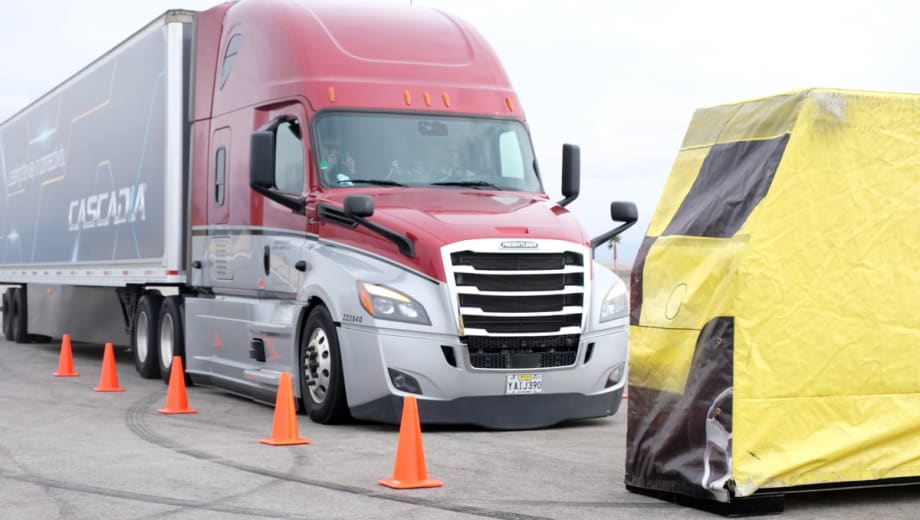
Forward-collision mitigation with active braking, or automatic emergency braking, detects a potential obstacle and issues audio and visual warnings as well as partial and full braking if necessary.
Photo: Jim Park
There can be only one captain of a ship. But captains usually have crews to update them on critical events on a voyage. Capt. Edward J. Smith of RMS Titanic reportedly ignored repeated warnings from his crew about the presence of an ice field somewhere off in the distance and proceeded full steam ahead right across the path of a waiting iceberg.
Smith had neither the benefit of foresight nor reliable tools that might have prevented that calamity. On top of that, he chose to ignore good advice. Had someone in a position of sufficient authority second-guessed Smith’s decision, Titanic would likely have become little more than a reference in a shipping registry.
The same can be said for truck drivers who eschew fairly reliable safety technology such as adaptive cruise control, automatic emergency braking, and lane centering equipment. That said, had Smith been cursed with a whining pesky first mate who harped on the risk of ice while the seas were calm and the sun brightly shining, the captain likely would have demoted him to a stoker.
Such is the difficulty of getting drivers to accept today’s advanced safety systems. Even if the advice they’re getting is sound, drivers often ignore it because it’s something they don’t want to hear. And there is the nagging issue of annoying and disconcerting false alarms.
Earlier generations of some of forward-collision warning and mitigation systems were prone to false alerts. In some cases, overhead metal signs would trigger warnings, sometimes decelerating the truck. In other cases, vehicles in adjacent lanes on curvy roads would trigger the system. Sometimes it was guard rails. Understandably, such false alerts were not only annoying, but also diminished drivers’ confidence in the technology.
In other cases, as with stability control systems for example, drivers complained of overly sensitive system responses when rounding corners. While drivers would swear they were not driving too fast for the turn, the systems determined otherwise. Even though it’s impossible to reliably determine the roll-over threshold of a truck in a corner without a good deal of sensor input (and every load is different), drivers preferring to believe their seat-of-the-pants feelings continue to give electronic stability control systems (ESC) a bad name.
Why New Systems Are Different
Getting buy-in now means educating drivers on how the latest systems operate. These systems have become more reliable in recent years. They use more robust sensing technologies and the system responses have improved. At some truck makers they have become standard equipment.
Suppliers say truly false alerts have been nearly eliminated.
“When radar was the only [detection technology], it was prone to mis-detection,” says Andy Pilkington, product group director for driver assistance at Bendix. “It was a single sensor, and older technology. Over the past 10 years or so the sensors have vastly improved, but the game-changer was the addition of a camera.”
Today’s systems use radar and a camera to provide better situational awareness for the vehicle. Combined, the two technologies provide a more complete picture of what’s going on, better than a radar alone or a camera alone could provide. Radar is really good at tracking moving targets and determining time and distance between the vehicle and a target. Cameras are much better at object recognition — identifying what the target is.
“The radar and the camera have different fields of view, and when fused together they’re very synergistic,” says Dan Williams, director of ADAS and autonomy at ZF Group. “With those two sensors, the information that you get from either of those two sensors increased. That’s what provides the input for a vehicle response.”
In other words, the likelihood of a false alert is significantly reduced. For example, if the radar reacts to an overhead sign, in most cases, the camera won’t corroborate the threat and no alert will occur.
Is It Good Enough For a Mandate?
Highway-safety advocacy groups have been calling on officials to require forward-collision avoidance and mitigation systems on heavy trucks for years.
Two years ago, the Insurance Institute for Highway Safety released the results of a study that concluded equipping large trucks with forward-collision warning and automatic emergency braking systems could eliminate more than two out of five crashes in which a truck rear-ends another vehicle.
The IIHS looked at some 2,000 crashes that occurred over more than 2 billion vehicle miles traveled during 2017-19. It found that forward-collision warning and AEB systems reduced rear-end crashes — the specific type of collision they’re designed to prevent — by 44% and 41%, respectively. In other words, trucks equipped with forward-collision warning had 22% fewer crashes and trucks with AEB had 12% fewer crashes than those without either technology.

New systems use a combination of sensors to greatly reduce false alerts, which are a cause for consternation among drivers.
Photo: Kenworth
“This study provides evidence that forward-collision warning and AEB greatly reduce crash risk for tractor-trailers and other large trucks,” says Eric Teoh, IIHS director of statistical services. “That’s important information for trucking companies and drivers who are weighing the costs and benefits of these options on their next vehicles.”
The National Transportation Safety Board has also been advocating for mandatory ADAS and AEB systems. Board member Michael Graham offers an example of a rear-end crash on Interstate 84 in Boise, Idaho. A lane was closed due to construction and traffic was lined up for a mile. The in-cab camera showed the truck still traveling at 60 mph as it bore down upon the stopped traffic.
“The driver never even tried to stop,” Graham says. The tractor-trailer plowed into a Jeep, which was forced under the tractor-trailer in front of it. The truck driver was killed, along with three people in the Jeep. The NTSB concluded the driver was likely suffering from severe fatigue, and that a collision mitigation system could have prevented the crash. But the owner-operator had “deleted” the standard spec for such a system when he bought his truck — to save about $2,500.
In 2015, in response to a petition from IIHS and other safety advocates, the National Highway Traffic Safety Administration agreed to begin testing and evaluating forward-collision-mitigation systems that incorporate automatic emergency braking, with a view toward requiring such technology on heavy trucks over 26,000 lbs. gross vehicle weight. It has been conducting research, and an effort to make AEB mandatory appears to be moving ahead under the Biden Administration. According to the federal Unified Regulatory Agenda, NHTSA was expected to issue its proposed rules for AEB in heavy trucks in April, with the Federal Motor Carrier Safety Administration to release its coordinating proposal shortly afterward. Although those proposals have not yet been published, advanced safety systems with automatic emergency braking was made a requirement for the new younger-driver pilot program.
Automakers already have committed to make AEB standard on virtually all light-duty cars and trucks with a gross vehicle weight of 8,500 lbs. or less no later than Sept. 1 of this year, and on virtually all trucks with a gross vehicle weight between 8,501 lbs. and 10,000 lbs. no later than Sept. 1, 2025.
If and when we see a heavy-truck AEB mandate is still up in the air. The potential benefits are pretty clear. The costs, not so much. They previously have included significant driver dissatisfaction.
Addressing Driver Complaints
Leonard’s Express of Farmington, New York, was an early adopter of forward collision mitigation. CEO Ken Johnson says earlier generations of the technology caused some indigestion, but he believes improvements to the technology and better technician and driver training have smoothed over those early bumps.
“We’re certainly interested in evaluating anything that can make our fleet safer, and we’ll continue to do so,” he says. “I don’t necessarily want to be out there on the bleeding edge, but we do want to stay out in front on safety with this technology.”
Johnson says he gets the occasional complaint from a driver, but nothing like he used to.
“I had to go ask my risk control department if we were still getting many complaints, because I haven’t heard any, and I used to get complaints all the time,” he says. “One of the things that helped was training our technicians to be able to realign some of the sensors and buying the tools to assist with that. And the sensors themselves have improved, especially with regard to corrosion resistance and performance in snow and ice.”
A couple of years ago fleets might have been forgiven for not wanting to install such systems in their trucks for fear of prompting an exodus of drivers. Today, the systems are more reliable and prompt fewer complaints. Some owner-operators are even opting to install advanced driver assistance systems on their own.
Better Training is Key
“I don’t want to be out here with drivers that aren’t paying attention to their driving,” says independent owner-operator James Hostetler. He recently bought a new Freightliner Cascadia equipped with Detroit Assurance 5.0 — and it was his decision to do so.
“One of the reasons we’re at where we’re at right now is because drivers will run into the back of construction zones without braking much at all,” he says. “These systems [adaptive cruise and AEB] are designed to mitigate the impact of an imminent collision, but they can also influence driver behavior in a positive way by getting them to maintain a safer following distance and not drive so aggressively.”
Hostetler says few drivers respond well to technology that’s forced on them without appropriate training and an explanation of how it’s designed to work. The caliber of driver training varies from company to company, he says, and some drivers get little to no training on how the systems operate.
“I took the time to research this technology, and I did adjust some driving behaviors,” he says. “Am I the better for it? Absolutely. Are these systems perfect? No. [But] now that I understand how they work, I get far fewer false alerts than other drivers report.”
Most driver complaints stem from following distance alerts. It’s actually not distance, to be clear, but a time interval based on vehicle speed and the gap between vehicles. In the wilds of Wyoming, it’s not difficult to maintain a 2- to 3-second following distance. In Atlanta or Chicago, it’s much harder.
“Adaptive cruise control is designed keep a minimum following distance behind a forward vehicle,” says Bendix’s Pilkington. “Some drivers really like it. Some don’t. We find the driver’s acceptance of the system depends upon how far that following distance is set. We hear drivers say they feel like they are going backwards all day because cars are constantly cutting in front of them and then they have to increase following distance.
“I think there’s a sweet spot there for dialing in the right following distance, where it doesn’t feel like you’re always being cut off,” he adds.
All of the ADAS suppliers offer calibrations for the following distance, but historically fleets have disabled the in-cab adjustment feature in lieu of a fleet-prescribed following distance. Hostetler has full control over his system and knows how to temporarily disable some of the functionality. That, he says, goes a long way to improving his satisfaction with the system’s performance.
“It has made me a better driver,” he says. “I don’t tailgate because it never ends well with this system. Keeps me back where I need to be. It gives me a better idea of what three or four seconds looks like.”
Do We Need Mandates?
Given the fairly reasonable cost of ADAS and AEB technology and the potential benefits, it’s hard to argue against it, especially in today’s litigious environment. Given driver reluctance to embrace it, it’s easier to understand why some fleets are leery about implementing it. That said, many drivers’ opinions are probably based on other drivers’ impressions of older technology that really could be annoying.
Actively seeking driver buy-in rather than a my-way-or-the-highway approach will surely smooth a technology roll-out. Leonard’s Express’ Johnson worked with his supplier to make it so drivers wouldn’t even know the system is there — unless something happens.
“The best scenario is the driver goes about his business and the product works, but he doesn’t know it because he’s driving the way he should be,” Johnson says.
Like an ocean liner, trucks can have only one driver. ADAS technology and AEB can make it seem to drivers that something is trying to wrest control of the truck away from them. ADAS is not so much a second pair of hands on the wheel, but a backup in case the view forward is muddied by poor visibility conditions, driver fatigue, or poor decision-making. Capt. Edward J. Smith could probably tell us a lot about bad decision-making, but he went down with his ship.
This article originally appeared in the July 2022 issue of Heavy Duty Trucking.
More Equipment

How Volvo Updated Its D13 for EPA 2027 [Watch]
Volvo’s updated D13 promises lower emissions without sacrificing performance or fuel economy. Take a closer look at what changed inside the engine in this HDT Spotlight video.
Read More →
Michelin Tire Improves Efficiency and Durability for Regional Fleets
The Michelin X Multi Energy D2 is a regional haul drive tire engineered to help fleets improve fuel efficiency, durability and traction in demanding stop-and-go operations.
Read More →
ZF Expands Commercial Vehicle Push in North America
ZF is expanding its North American commercial-vehicle presence with new transmission applications, electrification, trailer technology and autonomous-driving systems.
Read More →
Tesla Wants a Self-Driving Semi. Are Cameras Enough?
Could Tesla’s camera-only autonomous driving technology work on an 80,000-pound Semi? In this commentary, HDT's Deborah Lockridge takes a look at Tesla, Cybercab, and how autonomous trucks see the road.
Read More →
Kodiak: Driverless Long-Haul Truck Launch on Track for 2026
Kodiak AI says its driverless long-haul safety case is 93% complete and it remains on track to begin commercial operations by year-end 2026.
Read More →
What DOT’s Automated Vehicle Strategy Means for Trucking
The U.S. Department of Transportation issued a new automated-vehicle strategy that outlines plans for driverless-truck regulations, cross-state freight corridors, and federal safety standards.
Read More →
East Coast Port Launches $45M Electric Truck Push
The Port Authority of New York and New Jersey announced millions in incentives for zero-emission drayage trucks, yard tractors, and new charging hubs near the port.
Read More →
PlusAI Going Public to Fund Autonomous Truck Launch
A SPAC deal could provide PlusAI with up to $300 million as it works toward a 2027 commercial launch of factory-built autonomous trucks.
Read More →
NHTSA Moves to Rewrite Truck Fuel-Economy Rules
The National Highway Traffic Safety Administration says it lacks authority to regulate medium- and heavy-duty truck engines separately from complete vehicles, but the existing standards have not yet been eliminated.
Read More →
Detroit Opens Orders for EPA 2027 Engines
Detroit isn’t starting from scratch to meet EPA 2027 diesel emissions standards. Its Gen 6 DD13 and DD15 engines keep much of today’s platform while updating the fuel and aftertreatment systems.
Read More →