





Seat Belt Violations: During CVSA's 2026 Roadcheck, 667 seat belt violations were issued in North America. In Canada, Mexico, and the U.S., it is illegal for commercial drivers not to wear seat belts. Drivers face regulatory penalties and fines under federal regulations for failing to buckle up.
Fatal Crash Exposes Toll Plaza Risks
An NTSB investigation found that last-minute lane changes and large speed differences at an Ohio toll plaza created a hazard the truck driver couldn't avoid in time.
October 16, 2026
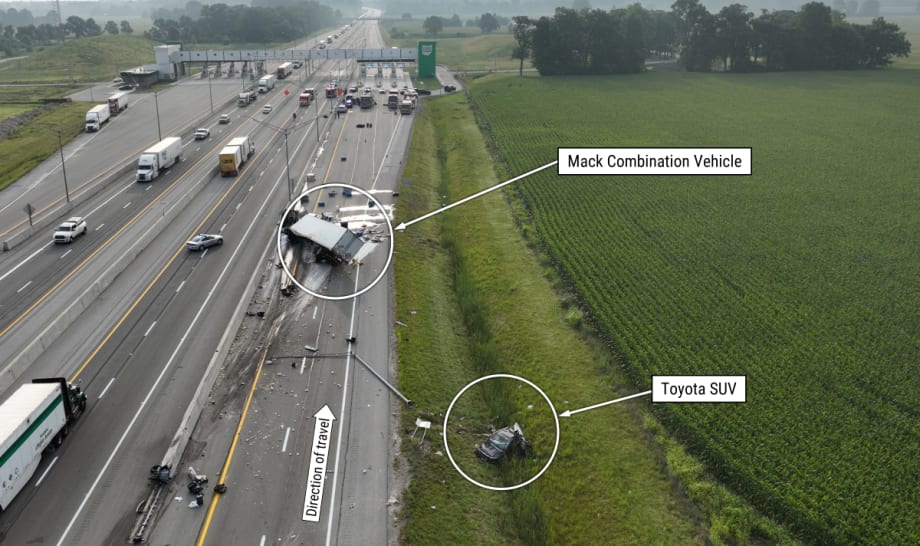
After its investigation of a fatal truck-car crash at an Ohio toll plaza, the National Transportation Safety Board urged the Federal Highway Administration to update toll facility standards and guidance.
Credit:
Ohio State Highway Patrol; annotations by NTSB
4 min to read
A passenger car driver’s last-minute attempt to reach a toll booth can leave a truck driver little chance to prevent a crash — even when the truck is traveling within the speed limit.
That’s one finding from a National Transportation Safety Board investigation into a fatal 2024 collision on the Ohio Turnpike. The report examines how a toll plaza’s design, missing information about payment options, and a fatigued SUV driver’s decisions combined to create a deadly encounter.
The NTSB recommended that Ohio eliminate low-speed toll lanes at four plazas and switch to fully electronic tolling. Investigators concluded that such a configuration would have prevented the crash.
What Happened at Swanton
The crash occurred about 5:29 a.m. on August 15, 2024, at the Swanton Township Toll Plaza near Toledo.
An SUV traveling east in the left high-speed lane slowed and moved right toward the manual toll booths, crossing into the path of a tractor-trailer. The 2019 Mack combination vehicle struck the SUV, hit the concrete barrier separating the high-speed and low-speed lanes, and overturned.
Two SUV passengers died. The SUV driver, another passenger, and the truck driver were seriously injured. Hazardous materials spilled from the trailer, but investigators attributed the injuries to crash forces rather than chemical exposure.
The plaza had opened in its hybrid configuration just four months earlier. Drivers could continue through the electronic toll lanes at 70 mph, while drivers using the manual booths had to slow to 10 mph before stopping to pay.
Too Little Time to React
Electronic records showed the truck traveling about 70 mph as the SUV moved into its lane. The SUV continued slowing and reached about 15 mph at impact.
Investigators found that although the truck driver likely could see the SUV, recognizing how quickly the gap was closing would have been difficult. His higher seating position further complicated that judgment.
The NTSB determined that his braking response fell within a reasonable range, given the circumstances. But he did not have enough time to avoid or lessen the collision.
Investigators ruled out truck driver fatigue, impairment, and cellphone use as contributing factors. They found no hours-of-service violations in the electronic logs they reviewed.
The report also addressed automatic emergency braking. The truck did not have the optional Bendix Wingman system that included AEB. Based on the manufacturer’s stated limitations in detecting vehicles moving across a lane at an angle, investigators said that system likely would not have responded, or would have responded too late to prevent this crash.
Payment Information Came Too Late
The NTSB identified the SUV driver’s slowing and lane change as the probable cause. Fatigue likely reduced her awareness of the approaching plaza and surrounding traffic.
But investigators also found a problem with the information presented to drivers.
Overhead signs labeled the high-speed lanes “E-ZPass Only.” They did not explain that a driver who missed the manual toll booths could pay online. That information appeared on a sign 1.3 miles beyond the plaza.
The turnpike already had equipment that could read license plates at highway speeds. According to the report, Swanton already had the equipment needed to support payment without a transponder.
Investigators concluded that explaining payment options before drivers reached the plaza could reduce the pressure to make a sudden lane change.
The maneuver was far from isolated. Reviewing video from the 21 days before the crash, investigators counted 1,099 vehicles crossing the striped separation area between the high-speed and low-speed lanes — about 52 a day. It likely was more than that, because darkness and passing vehicles sometimes blocked the camera’s view.
Seat Belts and Emergency Access
The investigation also identified factors affecting injuries and emergency response.
The SUV driver was wearing her seat belt. Her three rear-seat passengers were not, and all three were ejected. The truck driver also was unbelted.
Investigators concluded that seat belts likely would have prevented one passenger’s death and reduced another’s injuries. The other passenger’s seating area had lost survivable space in the collision.
Fire and EMS responders faced an additional obstacle: They had to travel 7 miles to reach a turnpike entrance. Although the NTSB found the overall response adequate and concluded that the access delay did not change the injury outcome in this crash, it warned that similar delays could affect survival in future incidents.
Changes Recommended for Ohio and Beyond
The NTSB called for fully electronic high-speed tolling and permanent closure of low-speed lanes at the Westgate, Swanton Township, Newton Falls, and Eastgate plazas in Ohio. It also recommended interim improvements to signs and pavement markings.
The board urged the Federal Highway Administration to update toll facility standards and guidance, including signs explaining payment options beyond transponders.
Other recommendations call for improved emergency access to the turnpike and an Ohio law allowing primary enforcement of seat belt use in every seating position.
The full report and investigation materials are available from the NTSB.
More Safety & Compliance

When Language Stops the Truck: The Return of ELP Out-of-Service Orders
English language proficiency rules for commercial drivers aren’t new, but renewed out-of-service enforcement has raised the stakes. Here’s what carriers need to know before a driver reaches a roadside inspection.
Read More →
Sponsored•October 6, 2026
A Camera Isn't a Safety Program. Here's What Brokers Are Screening for Now
Footage alone may not be enough to pass broker vetting processes. Here's what counts as a defensible safety program now.
Read More →
Marijuana and Trucking’s Drug-Testing Dilemma
Marijuana is getting stronger, laws are changing, and drug tests still can’t reliably establish impairment. What does that mean for truck drivers and the fleets that employ them?
Read More →

PrePass, Kodiak Connect Driverless Trucks to Roadside Enforcement
The system will allow enforcement agencies to verify Enhanced Inspection information and decide whether Kodiak’s autonomous trucks can bypass roadside screening sites.
Read More →
From One Generation to the Next: How Mentorship Builds Safer Truck Drivers
After three decades in trucking, Harold Perry shares what he's learned about driver safety, mentorship, and helping the next generation build confidence behind the wheel.
Read More →
FMCSA Pauses Biennial-Update Enforcement Amid Motus Transition
Carriers whose updates were due on or after June 1 have more time, while FMCSA works to stabilize its new registration system and warns of phishing sites impersonating its new carrier registration system, Motus.
Read More →
ZF Expands Commercial Vehicle Push in North America
ZF is expanding its North American commercial-vehicle presence with new transmission applications, electrification, trailer technology and autonomous-driving systems.
Read More →
Truck Drivers Need More Than Another Alert
Fleets have more visibility into truck health, safety events, and driver activity than ever. The next challenge is turning all that information into useful guidance for the person who has to decide what to do next.
Read More →
Tesla Wants a Self-Driving Semi. Are Cameras Enough?
Could Tesla’s camera-only autonomous driving technology work on an 80,000-pound Semi? In this commentary, HDT's Deborah Lockridge takes a look at Tesla, Cybercab, and how autonomous trucks see the road.
Read More →
What DOT’s Automated Vehicle Strategy Means for Trucking
The U.S. Department of Transportation issued a new automated-vehicle strategy that outlines plans for driverless-truck regulations, cross-state freight corridors, and federal safety standards.
Read More →