




NTSB Recommends Driver Monitoring, Collision Avoidance Tech
The National Transportation Safety Board is pushing for mandatory driver monitoring technology and greater use of advanced safety systems in commercial trucks as a result of its investigation into a fatal 2023 crash.

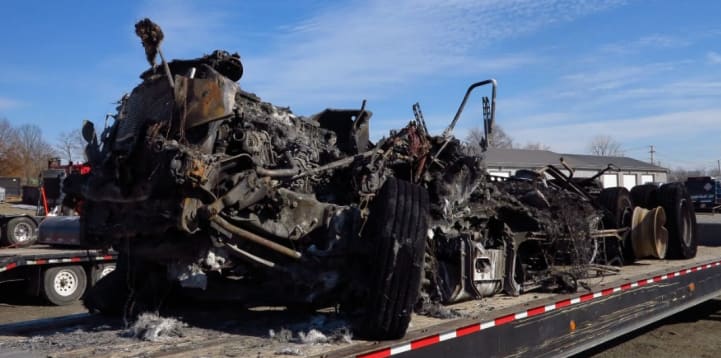
The tractor was completely burned in the post-crash fire. All that remained at the front of the trailer were the vertical ribs and roof rails.
Photo: NTSB
The National Transportation Safety Board is pushing for real-time driver monitoring technology and greater use of advanced safety systems in commercial trucks as a result of its investigation into a fatal 2023 crash in Ohio.
A truck driver’s inattention led to him driving into the back of a line of slow-moving vehicles on Interstate 70 near Etna, Ohio at an estimated speed of more than 70 mph, according to the NTSB report released September 24.
The crash involved two passenger vehicles, a chartered motorcoach carrying school children, and another truck. The crash and resulting fire killed six people and injured more than 40.
Details of the Crash
The morning of Nov. 14, 2023, a 2019 Freightliner Cascadia pulling a 2017 Strickland trailer, operated by Mid-State Systems Inc., was traveling west on I-70 when it crashed into the back of a line of traffic caused by an earlier minor crash. This triggered a chain-reaction collision and fire that spread to the other vehicles.
Immediately before the crash, the truck was traveling about 72 mph, and the other four vehicles were traveling between 3 and 15 mph. The NTSB did not find evidence to suggest that the truck driver took any evasive action before the crash.
Three students on the motorcoach and three people in a passenger vehicle were killed.
In addition to the driver’s inattention and his failure to respond to the traffic queue, several other issues contributed to the crash, the NTSB said, including ineffective traffic management and lack of information on traffic conditions to travelers.
In addition, the truck lacked an in-vehicle driver monitoring system that could have alerted the truck driver to return his attention to the road.
The speed difference between the truck and the slowed traffic, along with the post-crash fire, also increased the severity of the injuries.

The driver of the tractor-trailer said he didn't remember the crash and "woke up" to the sight of fire outside his cab.
Photo: NTSB
Why Didn’t the Truck Driver Slow Down or Stop?
Although the NTSB report found that the cause of the crash was driver inattention, it couldn’t determine what caused the inattention.
The truck driver told officials after the crash that the only thing he remembered about the crash was that he “woke up” and saw the fire outside his truck.
The board found no indication that the truck driver was impaired by drugs or alcohol or any medical factors that contributed to the crash. Nor was there any indication that the driver was fatigued.
There was, however, a question of whether there may have been distraction from a phone.
Cell phone records showed that the driver was not using native calling or texting applications at the time of the crash. Data use for the truck driver’s mobile phone reached high levels just before the crash. However, because the phone was destroyed during the post-crash fire, the NTSB was not able to analyze the phone to determine if the driver may have been using other apps on the phone at the time.
The NTSB noted that in 2022, the truck driver was stopped for driving 75 mph in a 60-mph zone. The inspection report said the driver had his mobile phone open and that a video game was loaded and visible, but the driver denied that he was using the game application while driving.
Truck Safety Technology in the Spotlight
The Freightliner was equipped with standard electronic cruise control with intelligent powertrain management. According to the build sheet and officials from the motor carrier, the truck’s speed was limited by a governor to 70 mph.
The truck was not equipped with advanced driver assistance systems or collision avoidance systems, and in fact, the company that bought the truck had gotten a discount for not ordering the ADAS features.
The NTSB pointed out that since 2015, Daimler Trucks North America has provided the Detroit Assurance Safety Suite as an optional feature on all new Freightliner Cascadias and, since 2018, has marketed it as a standard feature.
This advanced driver assistance system suite included forward collision warning, automatic emergency braking, and adaptive cruise control, among other features.
Mid-State Systems leased its vehicles from Maplewood Leasing LLC, a leasing company owned by the same individual who owns Mid-State Systems. Maplewood Leasing ordered new vehicles annually using the same two dealerships and the same specification order sheets.
Although the Freightliner in the crash was equipped with the latest engine and transmission configurations, the order sheets had not been updated or modified to include any of the latest collision avoidance technologies, according to NTSB.
The truck was also not equipped with a driver monitoring system, nor was such a system available as original equipment at the time the truck was manufactured.
A spokesperson from Daimler informed the NTSB that DMSs are being researched for inclusion in future Detroit Assurance Safety Suites.
“We’ve seen this crash scenario far too often — and it’s preventable,” said NTSB Chairwoman Jennifer Homendy in a news release about the report.
“Proven technologies can warn drivers of slowed traffic and prevent collisions before they happen. What’s needed are stronger vehicle safety standards, better traffic incident management, and swift action on our recommendations. Lives depend on it.”
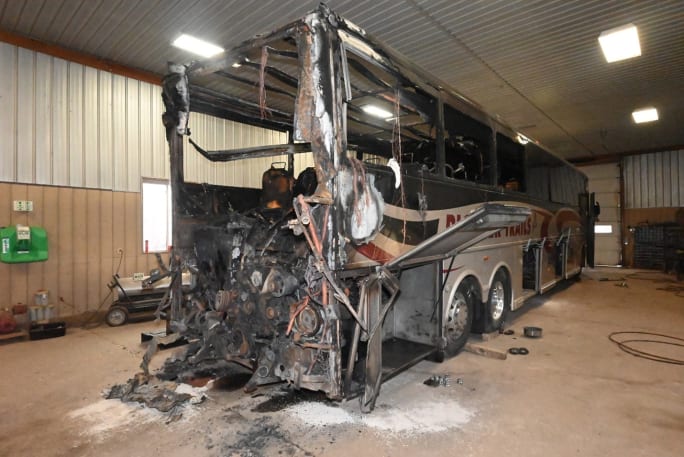
The NTSB in its report said it has been concerned about motorcoach and bus interior material flammability and smoke emission standards for nearly 50 years and has issued multiple safety recommendations to NHTSA.
Photo: NTSB
NTSB Safety Recommendations
The NTSB issued eight new safety recommendations and reiterated two previous recommendations as a result of its investigation. (The board has no power to propose or implement regulations.)
These recommendations include stronger federal guidance to states on managing traffic queues after incidents and on communications between responding agencies; performance standards for collision avoidance technology in commercial vehicles; requirements for driver monitoring systems in commercial vehicles; and more rigorous interior fire safety standards for motorcoaches.
Wanted: Mandatory Driver Monitoring Systems
The board recommended to the National Highway Traffic Safety Administration that commercial vehicles with gross vehicle weight ratings greater than 10,000 pounds be required to have driver monitoring systems that detect risky driving behavior, such as driver inattention, and that provide instantaneous feedback that communicates to the driver the need to bring attention back to the driving task.
It also reiterated a previous safety recommendation it had made to NHTSA, to complete, as soon as possible, the development and application of performance standards and protocols for the assessment of forward collision avoidance systems in commercial vehicles.
NTSB recommended that industry associations such as the American Trucking Associations, Owner-Operator Independent Drivers Association, and Teamsters educate their members about the NTSB’s report and promotethe potential safety benefits of in-cab alert technology to encourage owner-operators and carriers to use these systems.
It also recommended that these groups educate members on the safety benefits of collision avoidance technologies including forward collision warning (FCW), automatic emergency braking (AEB), and driver monitoring systems; and the safety risks associated with opting out of purchasing the advanced driver assistance systems, including FCW and AEB, offered by heavy vehicle manufacturers.
The full report is available on the NTSB’s website.
More Safety & Compliance

FMCSA Pauses Biennial-Update Enforcement Amid Motus Transition
Carriers whose updates were due on or after June 1 have more time, while FMCSA works to stabilize its new registration system and warns of phishing sites impersonating its new carrier registration system, Motus.
Read More →
ZF Expands Commercial Vehicle Push in North America
ZF is expanding its North American commercial-vehicle presence with new transmission applications, electrification, trailer technology and autonomous-driving systems.
Read More →
Truck Drivers Need More Than Another Alert
Fleets have more visibility into truck health, safety events, and driver activity than ever. The next challenge is turning all that information into useful guidance for the person who has to decide what to do next.
Read More →
Tesla Wants a Self-Driving Semi. Are Cameras Enough?
Could Tesla’s camera-only autonomous driving technology work on an 80,000-pound Semi? In this commentary, HDT's Deborah Lockridge takes a look at Tesla, Cybercab, and how autonomous trucks see the road.
Read More →
What DOT’s Automated Vehicle Strategy Means for Trucking
The U.S. Department of Transportation issued a new automated-vehicle strategy that outlines plans for driverless-truck regulations, cross-state freight corridors, and federal safety standards.
Read More →
NYC Expands Speed, Pedestrian Safety Tech Across Fleet
New York City is expanding intelligent speed assistance and pedestrian-alert systems across its municipal fleet, moving the technologies from pilot programs into vehicle procurement and retrofit requirements.
Read More →
FMCSA Removes 110 Truck Driver Training Schools from Certified ELDT List
Federal regulators also are targeting more than 160 additional training providers and launching a nationwide audit of third-party CDL skills testers as part of a broader crackdown on trucking fraud.
Read More →
Beyond DOT Compliance: What Makes a Trucking Fleet Truly Safe?
A trucking fleet can follow every rule and still make unsafe decisions. The real test comes when safety conflicts with freight, productivity, or cost.
Read More →
Hours of Service Pilot Programs: FMCSA Readies for 2027 Rollout
Two pilot programs could eventually reshape hours-of-service rules, giving truck drivers options to pause their 14-hour clock or use longer split sleeper rest periods.
Read More →
New Guide Offers Pet Safety Tips for Truck Drivers
Hundreds of thousands of pets travel in truck cabs. A new safety guide from Volvo Trucks and the Center for Pet Safety offers practical advice for truck drivers who bring dogs and cats along for the ride.
Read More →