




Related: Electric and Hydrogen Fuel Cell Trucks at the NACV Show [Video]
Is California Actually Ready for Electric Commercial Trucks?
The California Air Resources Board wants to accelerate zero-emissions vehicle technology in the next 10 years through regulation. But OEMs and fleets have concerns about the viability of new technology in large-scale use.

Steven Martinez・Web Editor

The California Air Resources Board wants to accelerate zero-emissions vehicle technology in the next 10 years through regulation. But OEMs and fleets have concerns about the viability of new technology in large-scale use.
Image by StockSnap from Pixabay
6 min to read
Love it or hate it, the state of California has made it a priority to be at the forefront of emissions regulations. In its latest big move, the California Air Resources Board proposed a new Advanced Clean Truck rule, which aims to seriously push electric and other zero-emissions technologies into real world service.
The proposal is long, but its main goal is to have zero-emissions vehicles make up 7% of all Class 4 to 8 truck sales and 3% of all other truck sales by 2024. By 2030, the state wants to see those numbers rise to 50% of Class 4 to 8 truck sales and 15% of all other truck sales.
They’re lofty goals, to be sure.
The rule isn’t directly targeting fleets; mostly it affects truck manufacturers by requiring them to sell a certain percentage of electric vehicles. Fleets run by the state will be required to buy a lot of these vehicles, but the primary goal of the proposal is to push clean vehicle technology development through investment.
In CARB’s own words, “the purpose of the proposed ACT regulation is to accelerate the widespread adoption of zero-emission vehicles in the medium- and heavy-duty truck sector and reduce the amount of harmful emissions generated from on-road mobile sources.”
Electric truck development has accelerated on its own the past few years. Following Tesla’s electric Semi announcement in 2017, most of the major truck and equipment manufacturers have announced various electric and zero-emissions truck development projects. At this year’s North American Commercial Vehicle Show in Atlanta, there were some real standouts – and some of these vehicles are out in the real world already, testing the waters.
Still, electric vehicles have thus far mostly been relegated to small-scale testing, almost exclusively in short-haul and yard tractor capacities. Tesla, which launched its electric Tesla Semi, like all of Elon Musk’s products, with much fanfare and stories of fleets pre-ordering these future trucks hundreds at a time, has yet to actually deliver one of these vehicles yet.
There is no doubt that it is still very much the early days of this technology – a fact that is not lost on truck makers and fleets alike. So, with the first milestone of CARB’s proposal only four years away, a lot needs to go right in the interim.
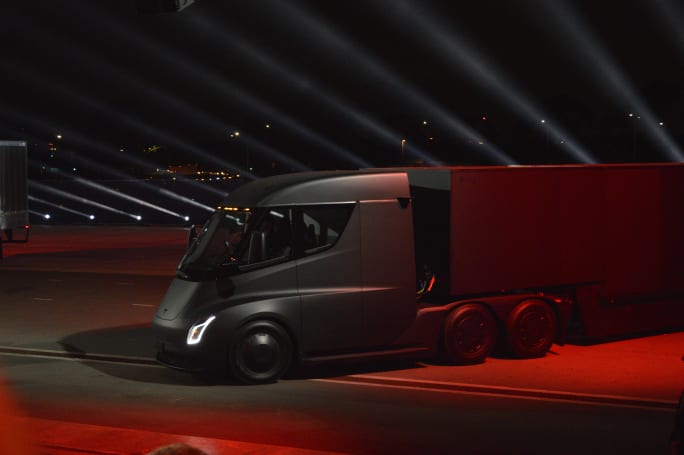
Tesla's Semi electric truck made a big splash when it was announced in 2017, but it still hasn't made its way to fleets.
Photo: Jack Roberts
What does the trucking industry think?
Nevertheless, OEMs expressed cautious optimism.
Officials from Mack Trucks said they are watching the development of the Advanced Clean Truck rule very closely. “As part of the Volvo platform, we as a group are very focused on battery electric,” said Martin Weissburg, president of Mack Trucks. “The fully electric Mack LR in refuse is coming, and other products are in the pipeline as well.”
Kevin Baney, general manager of Kenworth, said that, “We as an OE would have a certain percentage of trucks in California that would have to be zero emissions," Referring to the fluid nature of regulatory proposals, he noted, "that number continues to change.” Kenworth has hydrogen fuel cell electric trucks in tests at the California ports in a joint project with Toyota.
Baney noted that although the cost of the technology is coming down, it is still expensive. “Our position is there will still have to be subsidies in order for customers to run battery electric trucks. We’ll see where it goes – we’ll be ready for it.”
Roger Nielsen, president and CEO of Daimler Trucks North America, told HDT that Daimler intends to be a leader in the electric and zero-emissions vehicle arena. He referred to the company’s battery-electric Innovation Fleet in California, which includes electric versions of the Freightliner Cascadia and M2 medium-duty truck. Fleets like Penske Truck and NFI are already partnering with Daimler to take delivery of these electric trucks and use them in regular operations.
The Innovation Fleet, Nielsen said, "reflects our ability, our capability to work closely with these regulatory agencies to make sure they understand what’s technologically feasible as well as understanding what the pace of introduction should be,” he said. “We’re working for series production of battery-electric vehicles by 2021. As battery capacity suppliers come on board, definitely we can get out there and show everyone we have an attractive set of vehicles, and they can be run at a cost comparative to what competitors are running.”
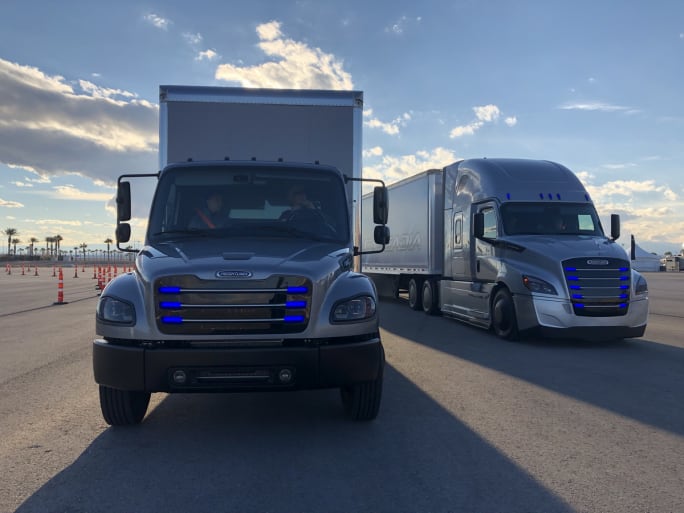
Daimler's battery-electric Innovation Fleet in California includes electric versions of the Freightliner Cascadia and M2 medium-duty truck.
Photo: Jim Park
One area of concern is on the infrastructure side for both battery-electric and hydrogen fuel cell truck variants. “Customers need to meet with the utility company and the energy supply companies, and they need to come together to figure out how we’re going to create, distribute, and retail electricity.”
“We’re learning what the power infrastructure needs are, and it’s a little sobering, not only what it takes but how long it might take to get the infrastructure in place,” he told HDT.
Of course, all of this technological development is moot unless someone is actually buying and using these vehicles. Weston LaBar, CEO of the Harbor Trucking Association, which represents intermodal carriers operating at several major ports on the West Coast, was more emphatic on the problem with infastructure.
“We think the state has done a terrible job in its push toward electrification,” he told HDT. “We don’t see the state making the progress necessary with the utilities to ensure that the infrastructure is there to support it.”
In CARB’s own proposal, the agency acknowledged the current limitations of electric vehicle technology when it comes to range in commercial trucking. Because of this, short-range operations, like those at the ports, are a likely entry point for the technology. Some port carriers are currently participating in early electric vehicle trials, and LaBar said these fleets have already seen what limitations electric trucks have.
“We have members that actually have commercially deployed electric vehicles and members that have used incentive dollars to procure that equipment that is not yet commercially available,” said LaBar. “Many of our members that have electric vehicles have fleets of over 250 trucks, and their facilities can’t accommodate more than two to three electric vehicles for charging based on the amperage that goes into their facility.”
He also noted that because electric trucks are also heavier than their internal-combustion counterparts, even if the trucks have enough range to complete a day’s work in some situations, they still don’t make economic sense for many fleets. “Any of our heavy haul overweight corridor carriers, this is not an option for them whatsoever, because the weight of the vehicle diminishes the amount of cargo that they can haul even if it was able to do it from a duty cycle standpoint,” he said.
“I think what we’ve come to the realization of is that at this point in time, it’s not a feasible alternative – not saying it couldn’t be in the future – but there’s a lot left that needs to be achieved to make it a feasible alternative,” said LaBar. “They’re going to have to take real data from these demonstration projects to see what’s feasible and not feasible so they don’t impact commerce.”
Subscribe to Our Newsletter
More Fuel Smarts

How Volvo Updated Its D13 for EPA 2027 [Watch]
Volvo’s updated D13 promises lower emissions without sacrificing performance or fuel economy. Take a closer look at what changed inside the engine in this HDT Spotlight video.
Read More →
Diesel Price Spike Shortens Payback for Natural Gas Trucks, Report Says
Energy Vision estimates fleets could recover the higher purchase price of an RNG-fueled Class 8 tractor in 1.3 to 2.8 years under current fuel-price scenarios.
Read More →
Calstart Becomes Catalyst Mobility, Reflecting Broader Focus
Calstart is now Catalyst Mobility, reflecting the nonprofit’s growing national role in clean transportation, including zero-emission trucks, infrastructure and incentive programs.
Read More →

Record Diesel Prices Squeeze Trucking Fleets
Average U.S. diesel prices have climbed to nearly $6 a gallon, surpassing the 2022 record as tight refinery capacity and Middle East disruptions keep fuel costs elevated.
Read More →
Sponsored•September 9, 2026
How Fuel Delivery Shapes Engine Performance
Fuel delivery depends on more than what happens at the injector. For fleet, maintenance and technical professionals, looking at the full path from pump to injector can provide useful context for understanding engine performance.
Read More →
East Coast Port Launches $45M Electric Truck Push
The Port Authority of New York and New Jersey announced millions in incentives for zero-emission drayage trucks, yard tractors, and new charging hubs near the port.
Read More →
California Bill Could Shed Light on Electric Truck Prices
Why do battery-electric Class 8 trucks remain so expensive? A California bill headed to Gov. Gavin Newsom would give fleets and state agencies more visibility into what manufacturers charge.
Read More →
Detroit Opens Orders for EPA 2027 Engines
Detroit isn’t starting from scratch to meet EPA 2027 diesel emissions standards. Its Gen 6 DD13 and DD15 engines keep much of today’s platform while updating the fuel and aftertreatment systems.
Read More →
Zero-Emission Truck Corridor Planned for West Coast
California, Oregon, Washington, British Columbia and Baja California are coordinating plans for truck charging and hydrogen fueling from Canada to Mexico.
Read More →
A Closer Look at Kenworth’s Electric T880E Vocational Truck [Video]
Learn more about Kenworth's T880E battery-electric vocational truck at the Paccar Technical Center, including its range, applications, upfitting considerations, and PTO options, in this HDT Spotlight video.
Read More →