




Penske, NFI to Test Daimler’s Electric Trucks in Regular Operations
Penske Truck Leasing and NFI have agreed to use Daimler Trucks North Americas' pre-production electric trucks, the eCascadia and eM2 106, in real-world operations to help the OEM test and develop the trucks for commercialization.

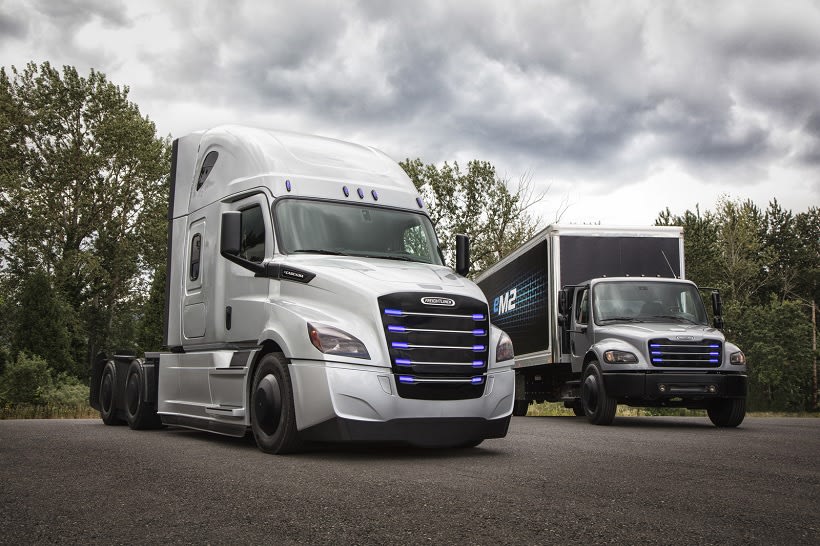
Penske Truck Leasing and NFI have agreed to use Daimler Trucks North Americas' pre-production electric trucks, the eCascadia and eM2 106 in real world operations to help the OEM test and develop the trucks for commercialization.
Photo courtesy Daimler Trucks North America
Penske Truck Leasing and NFI have agreed to partner with Daimler Trucks North America in operating the Freightliner Electric Innovation Fleet of electric vehicles which includes the recently unveiled heavy-duty eCascadia and eM2 106 medium-duty trucks.
Through its Innovation fleet of 30 vehicles, DTNA will involve customers in the development of commercial electric vehicles in order to better understand how they will be used and where they will be most effective. Penske will take on 10 eCascadias and 10 eM2s for use in California and the Pacific Northwest, while NFI will use 10 eCascadias for drayage activities in Southern California.
The Innovation Fleet will start delivering vehicles to Penske and NFI as soon as late 2018. To speed up the development process, DTNA will also operate electric trucks within its own Product Validation Engineering test fleet in Oregon. The company plans use knowledge gained form these partnerships to prepare its facilities and fleet operations for electric trucks as soon as 2021.
“Running multiple trucks in real-world applications will provide better insights for our engineers into the requirements of integrating electric commercial vehicles into fleet operations," said Roger Nielsen, president and chief executive officer of DTNA. "We are partnering with these two customers for this phase of the co-creation process because they have use cases that closely fit the target applications we have identified.”
DTNA has also announced the Electric Vehicle Council has been tasked with preparing customers in evaluating and integrating electric vehicle solutions into their operations. The information from Innovation Fleet testing will be shared with the customer base through the Council. It will also discuss planned product offerings with customers and gather feedback as the company moves toward commercializing electric trucks.
The Electric Vehicle Council will also work with customers to establish the necessary charging infrastructure, vehicle deployment, and service support that will be required when electric trucks become commercially available. DTNA also plans to offer consulting services to assist with site selection based on truck applications, available government incentives, infrastructure deployment, and route identification as part of a preliminary review prior to commercial electric vehicle business proposals.
"The DTNA approach to bring commercial electric vehicles to market is holistic. With the Freightliner Electric Innovation Fleet, we will be working, hands on, with Penske and NFI," said Richard Howard, senior vice president, sales and marketing, Freightliner Trucks. "While heavy-duty electric vehicles present the greatest engineering challenges, we're committed to a process that leads to series production vehicles that are safe, reliable and efficient.”
Related: Daimler Trucks North America to Build Electric Cascadia, M2 Trucks
More Fuel Smarts

How Volvo Updated Its D13 for EPA 2027 [Watch]
Volvo’s updated D13 promises lower emissions without sacrificing performance or fuel economy. Take a closer look at what changed inside the engine in this HDT Spotlight video.
Read More →
Diesel Price Spike Shortens Payback for Natural Gas Trucks, Report Says
Energy Vision estimates fleets could recover the higher purchase price of an RNG-fueled Class 8 tractor in 1.3 to 2.8 years under current fuel-price scenarios.
Read More →
Calstart Becomes Catalyst Mobility, Reflecting Broader Focus
Calstart is now Catalyst Mobility, reflecting the nonprofit’s growing national role in clean transportation, including zero-emission trucks, infrastructure and incentive programs.
Read More →

Record Diesel Prices Squeeze Trucking Fleets
Average U.S. diesel prices have climbed to nearly $6 a gallon, surpassing the 2022 record as tight refinery capacity and Middle East disruptions keep fuel costs elevated.
Read More →
How Fuel Delivery Shapes Engine Performance
Fuel delivery depends on more than what happens at the injector. For fleet, maintenance and technical professionals, looking at the full path from pump to injector can provide useful context for understanding engine performance.
Read More →
East Coast Port Launches $45M Electric Truck Push
The Port Authority of New York and New Jersey announced millions in incentives for zero-emission drayage trucks, yard tractors, and new charging hubs near the port.
Read More →
California Bill Could Shed Light on Electric Truck Prices
Why do battery-electric Class 8 trucks remain so expensive? A California bill headed to Gov. Gavin Newsom would give fleets and state agencies more visibility into what manufacturers charge.
Read More →
Detroit Opens Orders for EPA 2027 Engines
Detroit isn’t starting from scratch to meet EPA 2027 diesel emissions standards. Its Gen 6 DD13 and DD15 engines keep much of today’s platform while updating the fuel and aftertreatment systems.
Read More →
Zero-Emission Truck Corridor Planned for West Coast
California, Oregon, Washington, British Columbia and Baja California are coordinating plans for truck charging and hydrogen fueling from Canada to Mexico.
Read More →
A Closer Look at Kenworth’s Electric T880E Vocational Truck [Video]
Learn more about Kenworth's T880E battery-electric vocational truck at the Paccar Technical Center, including its range, applications, upfitting considerations, and PTO options, in this HDT Spotlight video.
Read More →