




Related: Will Future Trucks Be Powered by Batteries or Fuel Cells?
Regional Haul, Yard Tractors Are Well-Suited for Electrification
Regional haul and yard tractors represent two good opportunities for the early adoption of fully-electric Class 8 trucks, according to speakers at the North American Commercial Vehicle Show.
by James Menzies
November 5, 2019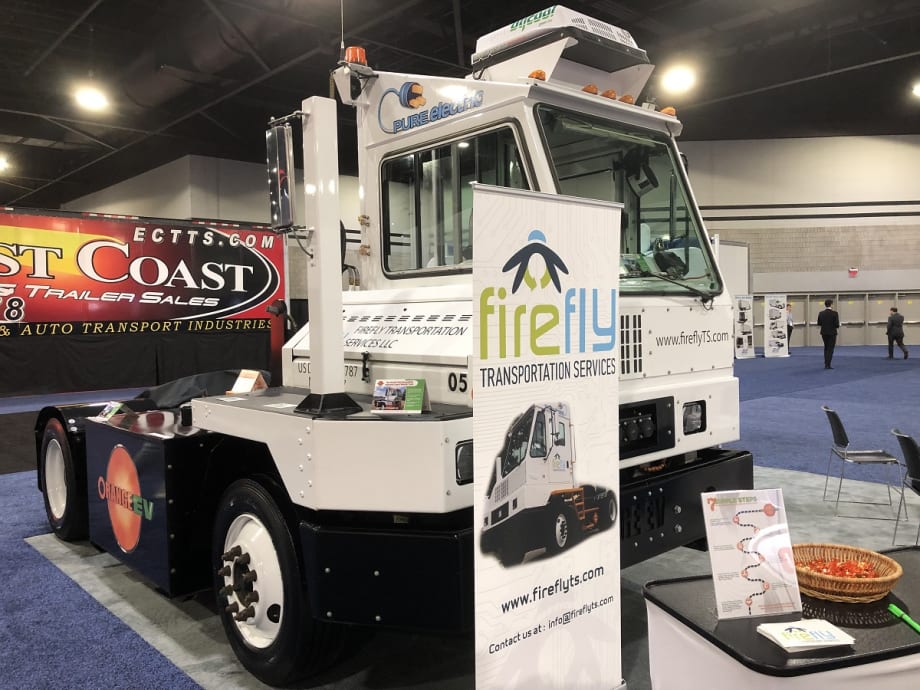
Regional haul and yard tractors, like Orange EV's electric terminal tractor (pictured), represent two good opportunities for the early adoption of fully-electric Class 8 trucks.
Photo: James Menzies
3 min to read
Regional haul and yard tractors represent two good opportunities for the early adoption of fully-electric Class 8 trucks, according to speakers at the North American Commercial Vehicle Show.
Mike Roeth, head of the North American Council for Freight Efficiency (NACFE), shared findings from a confidence report that found regional haul applications are a good fit for electric trucks.
“Regional haul is really ideal for battery-electric trucks in particular, and also all alternative fuels,” he said.
A commonly cited concern about electric trucks is the payload penalty associated with the weight of the battery packs. However, Roeth noted about 8,000 lbs come out of the truck, including the engine, transmission, emissions system, and some 700 lbs of fluids alone.
The best application for electric trucks is a dedicated route day cab duty cycle, where the trucks return to their home terminal nightly, Roeth explained. He acknowledged the benefits of running electric trucks are still difficult to calculate a payback on, such as their quiet operation, ability to improve ergonomics with lower step height, and lack of emissions.
Roeth also noted the battery technology has advanced more quickly than anticipated, though there’s still room for improvement in weight and performance.
Mike Saxton, chief commercial officer of electric terminal tractor producer Orange EV, was joined by Mike Bohnstengel, head of Firefly Transportation Services, to discuss the benefits of electric terminal trucks. The Chicago-based company provides trailer spotting services using the all-electric Orange EV yard truck.
Saxton noted yard trucks are ideally suited to electrification, and in most cases, infrastructure requirements are minimal, since the majority of truck yards have fewer than five terminal trucks. To ensure a successful deployment, Saxton said it’s vital to consult closely with the electric truck manufacturer, and to discuss all aspects of the truck’s utilization.
“Be specific in your duty cycle expectations,” he said. “The better the data you rive to your OEM, the better we can configure and ensure the solution is built to suit that duty cycle.”
One of the benefits is that maintenance is simplified, with no engine, transmission, radiator, or liquid-based cooling system required. There’s no fuel tank, exhaust system, or emissions controls.
“You’ve eliminated most of the things that cause headaches for you in terms of maintenance and repair,” said Saxton.
About US$25,000-$40,000 a year is saved on fuel and maintenance. Saxton presented a case study involving DHL, which replaced two diesel units at a Chicago yard in 2016. It saved about $40,000 annually per vehicle.
Firefly Transportation Services deployed its electric terminal trucks last year. It has reduced its fuel costs by about 80%, Bohnstengel said. Its total operational savings, when taking into account the higher acquisition cost of the trucks, was 10-12%.
One of the benefits, Bohnstengel said, is the electric trucks Firefly uses come with telematics, which can generate more than 30 reports the company uses to improve its customer service.
“We have been able to harness that data from the vehicle, which a lot of our competitors do not do,” he said. “We parlay that data into really showing the customer the added value of this type of technology. It’s a level of data they haven’t seen before and we are starting to see a greater appreciation for that.”
Saxton said fleets with heavy usage will experience the greater savings. While the baseline savings is $25,000 to $40,000 per truck in a moderate use environment, Saxton noted the trucks can come at two to three times the purchase price compared to a diesel.
James Menzies is an editor at TruckNews.com where this article originated. This article was used under a cooperative editorial sharing agreement between HDT and Newcom Media.
More Fuel Smarts

How Volvo Updated Its D13 for EPA 2027 [Watch]
Volvo’s updated D13 promises lower emissions without sacrificing performance or fuel economy. Take a closer look at what changed inside the engine in this HDT Spotlight video.
Read More →
Diesel Price Spike Shortens Payback for Natural Gas Trucks, Report Says
Energy Vision estimates fleets could recover the higher purchase price of an RNG-fueled Class 8 tractor in 1.3 to 2.8 years under current fuel-price scenarios.
Read More →
Calstart Becomes Catalyst Mobility, Reflecting Broader Focus
Calstart is now Catalyst Mobility, reflecting the nonprofit’s growing national role in clean transportation, including zero-emission trucks, infrastructure and incentive programs.
Read More →

Record Diesel Prices Squeeze Trucking Fleets
Average U.S. diesel prices have climbed to nearly $6 a gallon, surpassing the 2022 record as tight refinery capacity and Middle East disruptions keep fuel costs elevated.
Read More →
Sponsored•September 9, 2026
How Fuel Delivery Shapes Engine Performance
Fuel delivery depends on more than what happens at the injector. For fleet, maintenance and technical professionals, looking at the full path from pump to injector can provide useful context for understanding engine performance.
Read More →
East Coast Port Launches $45M Electric Truck Push
The Port Authority of New York and New Jersey announced millions in incentives for zero-emission drayage trucks, yard tractors, and new charging hubs near the port.
Read More →
California Bill Could Shed Light on Electric Truck Prices
Why do battery-electric Class 8 trucks remain so expensive? A California bill headed to Gov. Gavin Newsom would give fleets and state agencies more visibility into what manufacturers charge.
Read More →
Detroit Opens Orders for EPA 2027 Engines
Detroit isn’t starting from scratch to meet EPA 2027 diesel emissions standards. Its Gen 6 DD13 and DD15 engines keep much of today’s platform while updating the fuel and aftertreatment systems.
Read More →
Zero-Emission Truck Corridor Planned for West Coast
California, Oregon, Washington, British Columbia and Baja California are coordinating plans for truck charging and hydrogen fueling from Canada to Mexico.
Read More →
A Closer Look at Kenworth’s Electric T880E Vocational Truck [Video]
Learn more about Kenworth's T880E battery-electric vocational truck at the Paccar Technical Center, including its range, applications, upfitting considerations, and PTO options, in this HDT Spotlight video.
Read More →