




Driving Fleet Sustainability with Engineering Precision
Testing and data — not hype — guide this fleet innovator’s approach to cutting emissions in a cost-conscious industry.

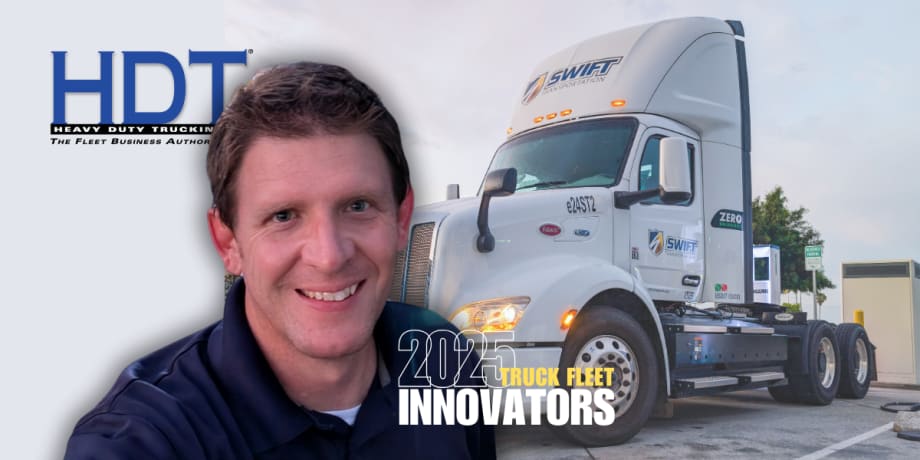
Ryan Kocher’s focus is on understanding the limits of each technology and how it fits into Knight-Swift's operations.
HDT/Knight-Swift
When Ryan Kocher joined Knight-Swift Transportation just under four years ago, the trucking giant already had emissions-reduction goals. His mission? Make them happen.
With a background that includes an engineering degree, experience at Detroit Diesel, work on motorsport turbochargers (including the quad-turbo, dual twin-stage system used in Volvo’s record-holding “Iron Knight” racing truck), and oversight of emissions compliance for small engines, Kocher brought technical depth and a cross-sector perspective to his role as director of emerging equipment technology.
“This role was just a great fit for me,” says Kocher, named an HDT Truck Fleet Innovator for 2025.
“It was exciting and a big challenge to try to take an industry that generally doesn’t like change and try to push things forward.
“We're making good headway, so I’m proud of what I’ve been able to accomplish so far.”
Knight-Swift is Already Exceeding Emissions Goals
In 2020, Knight-Swift announced a short-term goal to reduce CO2 emissions by 5% in five years, using 2019 as a base. By the end of 2024, it had reached 8%.
“So we’re pretty far ahead of that goal,” Kocher says. “I like to think I’ve had something to do with it.”
The longer-term target — cutting emissions in half by 2035 — remains unchanged, even amid shifting political winds.
Knight-Swift’s latest Sustainability Report notes, “The transition from regulatory mandates to market-driven decisions will require smarter capital investments and a careful balance of cost and carbon effectiveness.”
And that’s where all of Kocher’s training and experience shine.
Fueling a Balanced Strategy to Meet Knight-Swift's Emissions Goals
Knight-Swift is exploring battery-electric trucks, but it’s also investing heavily in renewable diesel and evaluating the carbon-reduction potential of renewable natural gas.
“We’ve got a ton of renewable diesel that we brought into the fleet,” Kocher says. “We’re trying to do everything we can to make that fuel plausible outside California.”
The fuel faces headwinds, including regulations and competition for some feedstocks.
Kocher is practical about balancing cost and performance to meet emissions goals.
“If I can do it with renewable diesel instead of electric, why would we spend all the money on charging infrastructure if we can just fill up the truck at a different place or with a different fuel?”
Kocher’s focus is on understanding the limits of each technology and how it fits into the company’s operations.
Doing the kind of deep research and testing that Kocher oversees allows Knight-Swift to tailor solutions not just for its own fleet, but also for sustainability-minded customers — especially those with European ties that face stricter climate mandates.
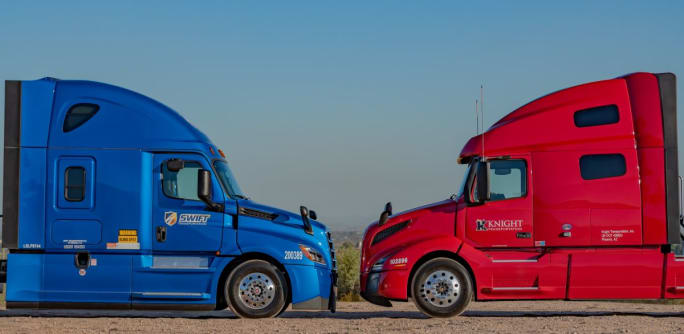
Knight-Swift was named at 2025 Top Green Fleet.
Knight-Swift
Using Data in Testing and Evaluation of New Truck Technologies
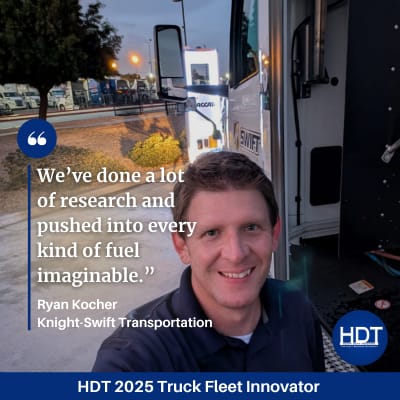
“We’ve done a lot of research and pushed into every kind of fuel imaginable,” Kocher says. Digging into the data allows him to provide feasibility evaluations and risk assessments for company leadership.
And it’s not just alternative fuels and electrification. Kocher supervises all the company’s new-technology testing.
When a vendor approaches him wanting Knight-Swift to consider a new product, he first determines whether it’s worth testing.
“We don’t want to test stuff that we have no intention of buying,” he says.
Then he must find the right place to test, the right drivers, and the best operations to test it in. The goal is to get good data quickly to see if it’s something the company wants to pursue.
Knight-Swift’s size and variety of operations offer a good test bed for truck makers, other OEs, and suppliers, which means Kocher and his team often get to test new products and technologies a bit early.
"That’s really great for me, being able to see what it’s going to do,” he says. “Then we have conclusions well before we need to make purchasing decisions.”
Kocher's Involvement in EPA SuperTruck Project
Knight-Swift is partnering with Paccar on the Environmental Protection Agency’s SuperTruck 3 project, where five teams are working to pioneer electrified medium- and heavy-duty trucks.
The company is running 10 trucks as part of the project and adding 10 more on its own, for a total of 20 electric day cabs for evaluation.
“The focus, especially with the trucks from Paccar, is to really just lean in and study every mile that we run,” Kocher says.
He’s looking for information in areas such as the effect of driver behavior, charger utilization, and what routes will work with electric trucks. The goal is to generate enough data so the company can make decisions in the future.
Unlike some of the hype about electric trucks in the earlier days, Knight-Swift isn’t promising that if this goes well, it will buy more.
“If these 10 go well, we’ll know what to do when there’s a chance to do more. We’ll know what to tell the OEs to do to get us to where we need to be.
“I'm really enjoying the depth of that project.”
Lessons So Far About Electric Trucks
Knight-Swift was testing electric trucks for at least five years, even before Kocher came on board.
One thing he’s learned is that reliability, which early on "was not great," has improved.
Although many believed electric trucks would have lower maintenance requirements than diesel because there are fewer parts, “that still generally has not been true,” Kocher says. “But it’s getting much, much better.”
Despite the advances, Kocher says Class 8 electric trucks face many challenges, including weight and range.
He and his SuperTruck 3 partners have been learning a lot about squeezing out every bit of efficiency from the electric trucks.
“It’s been a fun challenge for me trying to do as much as you can with the least amount possible.”
Evaluating Autonomous Truck Technology
Kocher has also led Knight-Swift’s pilot work with autonomous truck technology, notably with now-defunct Embark.
The pilot test ran for several months, with Knight-Swift drivers in the trucks as the safety driver, not employees of the autonomous truck maker.
“We wanted to learn, what does the technology do for us relative to our driver environment, our driver training, and our safety culture?” Kocher explains.
As the pilot progressed and the drivers gained more trust in the technology, there were fewer and fewer instances of them overriding the autonomous system to take over.
Kocher says the company’s long-term vision of autonomy is that the driver is still very much integrated in the process, one way or another. He believes features of autonomous-truck technology, such as lane centering and smart active steering, improve safety, reduce driver fatigue, and can act as a stepping-stone toward full autonomous trucks.
What's Next for Kocher?
And, as if all that’s not enough to keep him busy, Kocher is leading the assessment of all the recent emissions rule changes. And he has set up programs to manage the complex fleet reporting required for compliance with programs such as California’s Clean Truck Check.
With two more years of the SuperTruck project left, Kocher is looking forward to the delivery of the second generation of electric trucks from the Paccar SuperTruck team.
The trucks will have faster charging capabilities, so the plan is to evaluate their performance in regional operations, going beyond the local or very light regional operations where the company currently uses them.
“Now that our infrastructure is finally installed and we’re past a certain part of the learning curve, I’m excited for the next couple of years to go into optimization mode and really drive that home.”
The company is still evaluating hydrogen fuel cell technology, as well.
“I don’t want to give up on that quite yet,” Kocher says, noting that the ability to refuel in a time frame similar to a diesel truck is appealing compared to the expense of a fast-charger infrastructure for BEVs.
In addition, Knight-Swift was one of the first fleets to get its hands on the new Cummins 15-liter natural gas engine, and Kocher will be looking to deploy more of these where it makes sense.
How Kocher Fosters Company Innovation
Trucking is sometimes resistant to change. How does Kocher address that challenge?
“I’ve learned in this role to have a lot of patience,” he says. “Learning to accept ‘No’ while continuing to make a case is definitely a skill.
“I can try to build excitement for things, but if the business case doesn’t make sense, I have to tell myself, ‘There’s a reason we’re not doing this, and that’s okay for now.’”
He considers these answers to be less of a “No" and more of a “Try again later.”
The challenge then is to figure out how to improve that business case.
“You don’t want to force a square peg into a round hole, but at the same time, you keep digging,” he says. “And that’s the culture I think is being furthered within the company.”
More Equipment

How Volvo Updated Its D13 for EPA 2027 [Watch]
Volvo’s updated D13 promises lower emissions without sacrificing performance or fuel economy. Take a closer look at what changed inside the engine in this HDT Spotlight video.
Read More →
Michelin Tire Improves Efficiency and Durability for Regional Fleets
The Michelin X Multi Energy D2 is a regional haul drive tire engineered to help fleets improve fuel efficiency, durability and traction in demanding stop-and-go operations.
Read More →
ZF Expands Commercial Vehicle Push in North America
ZF is expanding its North American commercial-vehicle presence with new transmission applications, electrification, trailer technology and autonomous-driving systems.
Read More →
Tesla Wants a Self-Driving Semi. Are Cameras Enough?
Could Tesla’s camera-only autonomous driving technology work on an 80,000-pound Semi? In this commentary, HDT's Deborah Lockridge takes a look at Tesla, Cybercab, and how autonomous trucks see the road.
Read More →
Kodiak: Driverless Long-Haul Truck Launch on Track for 2026
Kodiak AI says its driverless long-haul safety case is 93% complete and it remains on track to begin commercial operations by year-end 2026.
Read More →
What DOT’s Automated Vehicle Strategy Means for Trucking
The U.S. Department of Transportation issued a new automated-vehicle strategy that outlines plans for driverless-truck regulations, cross-state freight corridors, and federal safety standards.
Read More →
East Coast Port Launches $45M Electric Truck Push
The Port Authority of New York and New Jersey announced millions in incentives for zero-emission drayage trucks, yard tractors, and new charging hubs near the port.
Read More →
PlusAI Going Public to Fund Autonomous Truck Launch
A SPAC deal could provide PlusAI with up to $300 million as it works toward a 2027 commercial launch of factory-built autonomous trucks.
Read More →
NHTSA Moves to Rewrite Truck Fuel-Economy Rules
The National Highway Traffic Safety Administration says it lacks authority to regulate medium- and heavy-duty truck engines separately from complete vehicles, but the existing standards have not yet been eliminated.
Read More →
Detroit Opens Orders for EPA 2027 Engines
Detroit isn’t starting from scratch to meet EPA 2027 diesel emissions standards. Its Gen 6 DD13 and DD15 engines keep much of today’s platform while updating the fuel and aftertreatment systems.
Read More →