





Commentary: Are SuperTrucks a Waste of Money?
DOE Announces SuperTruck 3 Electric-Truck Projects
The Department of Energy is helping to fund five projects that will develop demonstration vehicles to help accelerate medium- and heavy-duty electrification technologies.
November 1, 2021
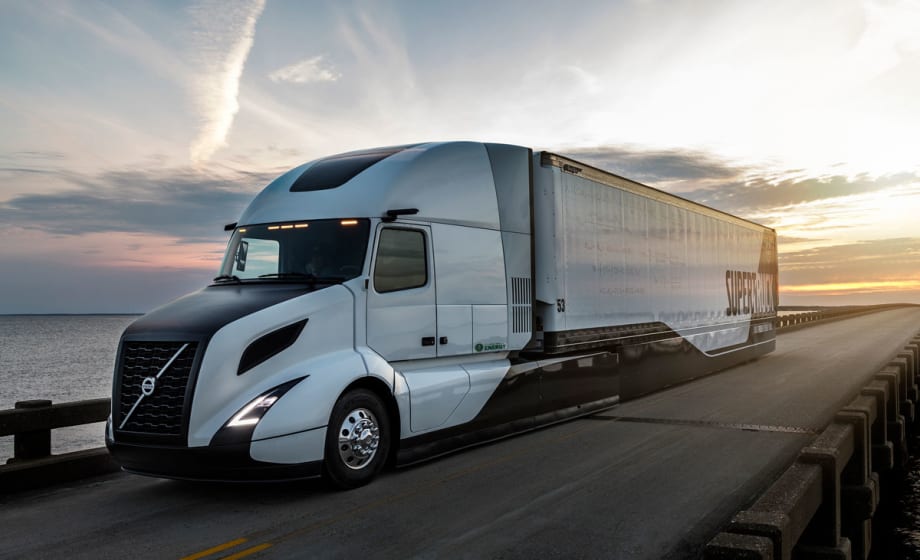
This is the third SuperTruck project for Volvo Trucks North America. Its initial SuperTruck, shown, achieved a freight efficiency improvement of 88% and a 70% improvement in fuel economy (12-13 mpg).
Photo: Volvo Trucks North America
2 min to read
The U.S. Department of Energy announced it will spend $127 million over the next five years to help advance commercial truck electrification technology through its SuperTruck 3 program.
DOE’s Office of Energy Efficiency and Renewable Energy initially launched the SuperTruck initiative in 2009 to improve heavy-duty truck freight efficiency by 50% in the demonstration trucks from program participants. The resulting tractor-trailers achieved 12 and 13 mpg. Many of the technologies developed during those projects can now be found on production trucks.
The second iteration, SuperTruck 2, sought to double fuel efficiency for 18-wheeler trucks. Those projects are still in the works, but the DOE recently announced the Cummins SuperTruck II team had achieved 55% brake thermal efficiency from an engine equipped with waste heat recovery — a significant milestone.
Unlike the previous two SuperTruck projects, SuperTruck 3 focuses on electrification, and also includes medium-duty in addition to heavy-duty. It will provide funding to five vehicle manufacturers to pioneer electrified medium- and heavy-duty trucks and freight system concepts to achieve higher efficiency and zero emissions. Projects will be funded over five years, subject to appropriations, and recipients will match federal funding, dollar-for-dollar.
Paccar, parent company of Kenworth and Peterbilt, will develop 18 Class-8 battery-electric and fuel-cell vehicles with advanced batteries. A megawatt charging station will also be developed and demonstrated. (Award amount: $32.97 million)
General Motors will develop and demonstrate four hydrogen fuel cell and four-battery electric Class 4-6 trucks. The project will also focus on development of clean hydrogen via electrolysis and clean power for fast charging. (Award amount: $26.06 million)
Daimler Trucks North America will develop and demonstrate two Class 8 fuel cell trucks with a 600-mile range, 25,000-hour durability, equivalent payload capacity and range to diesel. (Award amount: $25.79 million)
Ford will develop and demonstrate five hydrogen fuel-cell-electric Class 6 Super Duty trucks targeting cost, payload, towing, and refueling times that are equivalent to conventional gasoline trucks. (Award amount: $24.95 million)
Volvo Group North America will develop a 400-mile-range Class 8 battery-electric tractor-trailer with advanced aerodynamics, electric braking, EV-optimized tires, automation and route planning. A megawatt charging station will be developed and demonstrated. (Award amount: $18.07 million)
More Fuel Smarts

How Volvo Updated Its D13 for EPA 2027 [Watch]
Volvo’s updated D13 promises lower emissions without sacrificing performance or fuel economy. Take a closer look at what changed inside the engine in this HDT Spotlight video.
Read More →
Diesel Price Spike Shortens Payback for Natural Gas Trucks, Report Says
Energy Vision estimates fleets could recover the higher purchase price of an RNG-fueled Class 8 tractor in 1.3 to 2.8 years under current fuel-price scenarios.
Read More →
Calstart Becomes Catalyst Mobility, Reflecting Broader Focus
Calstart is now Catalyst Mobility, reflecting the nonprofit’s growing national role in clean transportation, including zero-emission trucks, infrastructure and incentive programs.
Read More →

Record Diesel Prices Squeeze Trucking Fleets
Average U.S. diesel prices have climbed to nearly $6 a gallon, surpassing the 2022 record as tight refinery capacity and Middle East disruptions keep fuel costs elevated.
Read More →
Sponsored•September 9, 2026
How Fuel Delivery Shapes Engine Performance
Fuel delivery depends on more than what happens at the injector. For fleet, maintenance and technical professionals, looking at the full path from pump to injector can provide useful context for understanding engine performance.
Read More →
East Coast Port Launches $45M Electric Truck Push
The Port Authority of New York and New Jersey announced millions in incentives for zero-emission drayage trucks, yard tractors, and new charging hubs near the port.
Read More →
California Bill Could Shed Light on Electric Truck Prices
Why do battery-electric Class 8 trucks remain so expensive? A California bill headed to Gov. Gavin Newsom would give fleets and state agencies more visibility into what manufacturers charge.
Read More →
Detroit Opens Orders for EPA 2027 Engines
Detroit isn’t starting from scratch to meet EPA 2027 diesel emissions standards. Its Gen 6 DD13 and DD15 engines keep much of today’s platform while updating the fuel and aftertreatment systems.
Read More →
Zero-Emission Truck Corridor Planned for West Coast
California, Oregon, Washington, British Columbia and Baja California are coordinating plans for truck charging and hydrogen fueling from Canada to Mexico.
Read More →
A Closer Look at Kenworth’s Electric T880E Vocational Truck [Video]
Learn more about Kenworth's T880E battery-electric vocational truck at the Paccar Technical Center, including its range, applications, upfitting considerations, and PTO options, in this HDT Spotlight video.
Read More →