




Why Aurora Put Drivers Back Behind the Wheel of Its Autonomous Trucks
Aurora remains committed to both its short- and long-term autonomous development goals, despite Paccar’s request to put a human driver back behind the wheel in Texas.

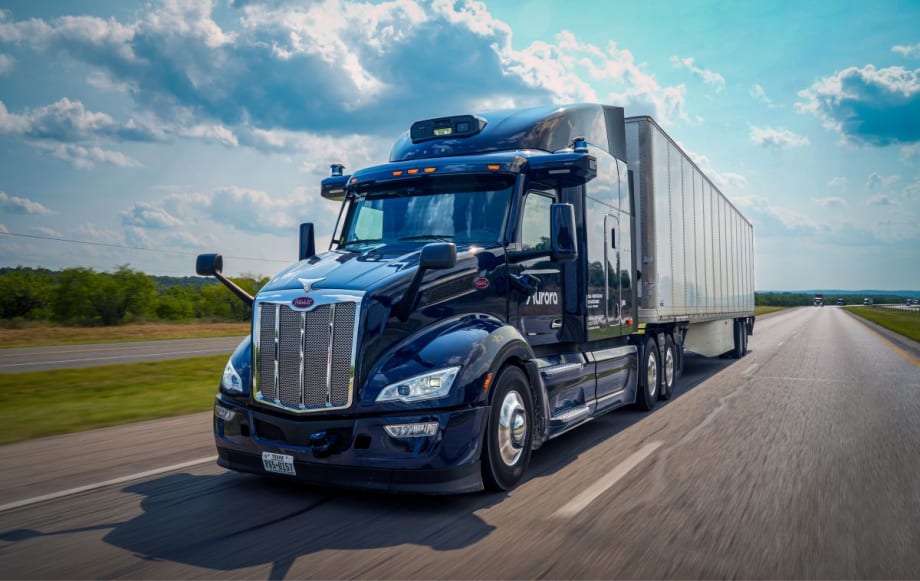
On May 20, Aurora announced that it was putting human drivers back behind the steering wheel in its Texas driverless operations.
Photo: Aurora
Autonomous trucks have been in the news quite a bit lately, indicating impressive progress being made by developers of this cutting-edge, transformative technology.
Reading between the lines, a logical conclusion is that we are drawing very near to seeing driverless trucks enter into real-world fleet operations.
A major announcement from Aurora was part of that uptick in autonomous news.
On May 1, Aurora announced that its autonomous trucks were delivering freight in Texas without a human safety driver positioned behind the steering wheel. (An observer was riding in the truck’s sleeper, however.)
A Sudden Reversal
But on May 20, Aurora suddenly reversed course on this move. The OEM announced that at the request of Paccar – its OEM partner in these “driver out” test runs – it would once again operate the trucks with a human driver behind the wheel.
The news broke via a blog post by Chris Urmson, Aurora’s CEO, which read:
When we launched our driverless trucking service last month, it was a moment guided by safety and underpinned by rigorous testing, painstaking validation, and a deep commitment to our mission. A core part of our strategy has always been building a strong ecosystem of partners across the industry — from OEMs to logistics providers to regulators. These partnerships are essential to delivering a safe, scalable, commercial product.
One of those partners, Paccar, requested we have a person in the driver’s seat, because of certain prototype parts in their base vehicle platform. We are confident this is not required to operate the truck safely based on the exhaustive testing (covering nearly 10,000 requirements and 2.7 million tests) and analysis that populates our safety case. Paccar is a long-time partner and, after much consideration, we respected their request and are moving the observer, who had been riding in the back of some of our trips, from the back seat to the front seat.
This observer will not operate the vehicle — the Aurora Driver will continue to be fully responsible for all driving tasks, including pulling over to a safe location if required. And we've shown we can do that safely, with the Aurora Driver operating for more than 6,000 driverless miles along our commercial launch lane between Dallas and Houston. This change has no impact on our near, mid and long-term development plans.
Our partnerships are critical to our long term strategy. We’re confident in the technology, grateful for our partners, and excited about the driverless road we’re on.
On Track for Autonomous Tech
So, was this move a setback for autonomous technology? Or just an extension of the extreme caution autonomous developers have been exercising for the past decade?
HDT reached out to Aurora for some context.
According to an Aurora spokesperson, the decision to put a driver back behind the wheel of the autonomous trucks in Texas “has no impact on our near-, mid- and long-term development plans.”
Additionally, the spokesperson said the move was not due to safety concerns or any recently discovered technical issues.
The spokesperson pointed to a recent statement from Paccar on its ongoing work with Aurora from Paul Konasewich, general manager, Paccar Innovation Center:
“We're building this very strong foundation that's going to scale nicely. That is the whole point, really. We're not here to do 100 or even a thousand [autonomous] trucks. The whole point is to produce as many of these as customers like [Werner] can use."
“Aurora is continuing to work with both of its OEM partners (Paccar and Volvo) on delivering trucks at scale in the years to come,” the spokesperson added.
“As we’ve said before, we expect to be cash flow positive and a self-funded company, anticipated in 2028,” the spokesperson said. “This parallels our evolution from our Transport-as-a-Service business model (which we're currently in) where Aurora owns and operates the trucks, to our Driver-as-a-Service business model (next several years), where customers buy trucks from our manufacturing partners and manage the operations themselves.”
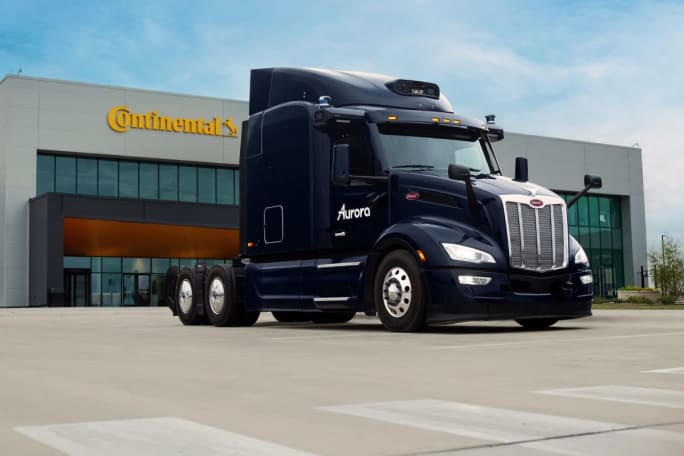
Plans for Continental to begin mass producing Aurora Driver hardware in the near future remain intact.
Photo: Aurora
Both Aurora’s short- and long-term goals, as laid out in the company’s Q1 newsletter, remained unchanged, the spokesperson added. Those goals include:
Delivering “tens” of driverless trucks by the end of 2025
Continued progress with Aurora’s partners on purpose-built self-driving platforms designed for high-volume production
Continued progress with Continental on Aurora’s third generation commercial hardware kit that the company believes will unlock “true” scale on the order of tens of thousands of trucks.
As a reminder, the spokesperson noted that Continental will be making the Aurora Driver hardware in the future, which will be shipped to Paccar and Volvo for integration in the DaaS phase.
Texas Tests Continue
According to Aurora’s spokesperson, the media is confusing the traditional role of a driver with the observers on board its autonomous trucks.
“Observers do not operate or intervene with the Aurora Driver when it's operating in driverless mode,” the spokesperson noted. “They are there to ‘observe’ and to assist with a timely recovery if the Aurora Driver pulls over to the shoulder of the road.
“Reasons for intervening include bad weather and the Aurora Driver determines its operating out of scope (since operation in rain hasn't yet been validated) and it makes the decision to end its trip and pull over.
The observers have no role in making that determination nor taking over while it's still operating and as the blog implies, it's Paccar that has asked for them to be in the front seat, though they could be in any seat as they do not interact with the truck when it's operating in driverless mode.”
In the meantime, Aurora’s trucks will continue to operate in Texas hauling customer freight on Aurora Driver software specifically validated for driverless operations.
“As mentioned, observers do not interact with or have any influence over the truck while it’s hauling commercial loads,” the spokesperson added. “This means the Aurora Driver is fully responsible for all driving, including pulling over to a safe location if required."
More Equipment

How Volvo Updated Its D13 for EPA 2027 [Watch]
Volvo’s updated D13 promises lower emissions without sacrificing performance or fuel economy. Take a closer look at what changed inside the engine in this HDT Spotlight video.
Read More →
Michelin Tire Improves Efficiency and Durability for Regional Fleets
The Michelin X Multi Energy D2 is a regional haul drive tire engineered to help fleets improve fuel efficiency, durability and traction in demanding stop-and-go operations.
Read More →
ZF Expands Commercial Vehicle Push in North America
ZF is expanding its North American commercial-vehicle presence with new transmission applications, electrification, trailer technology and autonomous-driving systems.
Read More →
Tesla Wants a Self-Driving Semi. Are Cameras Enough?
Could Tesla’s camera-only autonomous driving technology work on an 80,000-pound Semi? In this commentary, HDT's Deborah Lockridge takes a look at Tesla, Cybercab, and how autonomous trucks see the road.
Read More →
Kodiak: Driverless Long-Haul Truck Launch on Track for 2026
Kodiak AI says its driverless long-haul safety case is 93% complete and it remains on track to begin commercial operations by year-end 2026.
Read More →
What DOT’s Automated Vehicle Strategy Means for Trucking
The U.S. Department of Transportation issued a new automated-vehicle strategy that outlines plans for driverless-truck regulations, cross-state freight corridors, and federal safety standards.
Read More →
East Coast Port Launches $45M Electric Truck Push
The Port Authority of New York and New Jersey announced millions in incentives for zero-emission drayage trucks, yard tractors, and new charging hubs near the port.
Read More →
PlusAI Going Public to Fund Autonomous Truck Launch
A SPAC deal could provide PlusAI with up to $300 million as it works toward a 2027 commercial launch of factory-built autonomous trucks.
Read More →
NHTSA Moves to Rewrite Truck Fuel-Economy Rules
The National Highway Traffic Safety Administration says it lacks authority to regulate medium- and heavy-duty truck engines separately from complete vehicles, but the existing standards have not yet been eliminated.
Read More →
Detroit Opens Orders for EPA 2027 Engines
Detroit isn’t starting from scratch to meet EPA 2027 diesel emissions standards. Its Gen 6 DD13 and DD15 engines keep much of today’s platform while updating the fuel and aftertreatment systems.
Read More →