




Lion Electric Invests in Integrated Vocational Electric Trucks
The Canadian based Lion Electric Company is developing various types of fully electric specialized Class 8 urban trucks, in collaboration with six partners and with a contribution of $5.9 million from the government of Quebec – but expect to see these trucks offered in the U.S. as well.
by Steve Bouchard, Transport Routier
December 2, 2019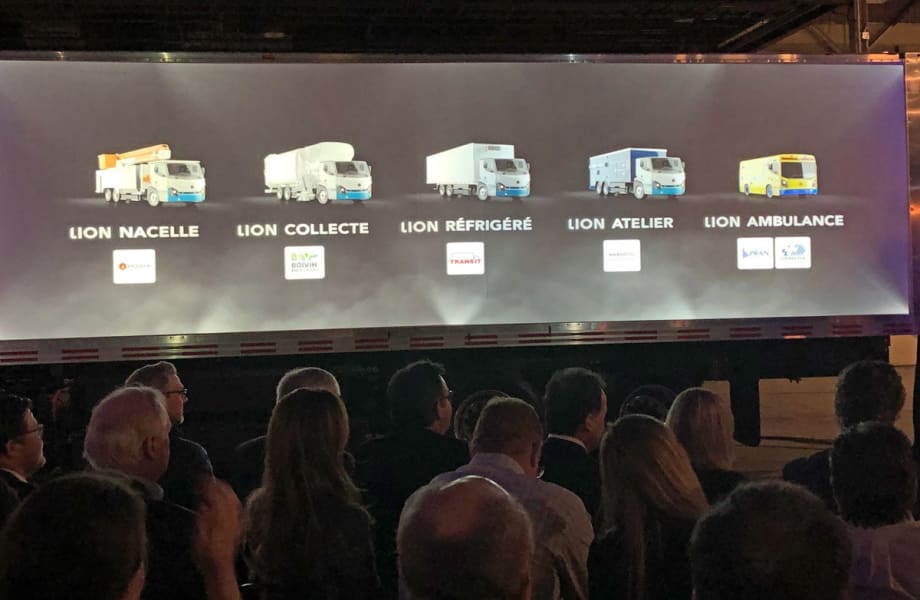
Lion Electric tells reporters about its new vocational electric truck project.
Photo by Steve Bouchard
3 min to read
The Canadian-based Lion Electric Company is developing various types of fully electric specialized Class 8 urban trucks, in collaboration with six partners and with a contribution of $5.9 million from the government of Quebec – but expect to see these trucks offered in the U.S. as well.
The Class 8 all-electric Lion 8 will be developed with fully integrated, primarily electric-powered, vocational equipment: a garbage truck, a refuse truck, a refrigerated truck, a service truck, and an ambulance. The vocational trucks will use the same chassis and powertrains as the fully electric minibus Lion will market next year.
Six partners will work with Lion to develop, manufacture and integrate their respective technologies and specialized equipment on Lion electric vehicles:
• Posi-Plus Technologies, manufacturer of industrial equipment including bucket trucks;
• Boivin Evolution, manufacturer of automated 100% electric refuse;
• Fourgons Transit, manufacturer of dry and refrigerated bodies;
• Maxi Metal, designer and manufacturer of fire trucks and workshop trucks;
• PRAN, specializing in electronic and multiplexing systems for vehicles, and
• Demers Ambulance, the second-largest ambulance manufacturer in North America.
"All this group of leaders gathered in the same project, I think it's a first," said Marc Bédard, CEO and founder of Lion.
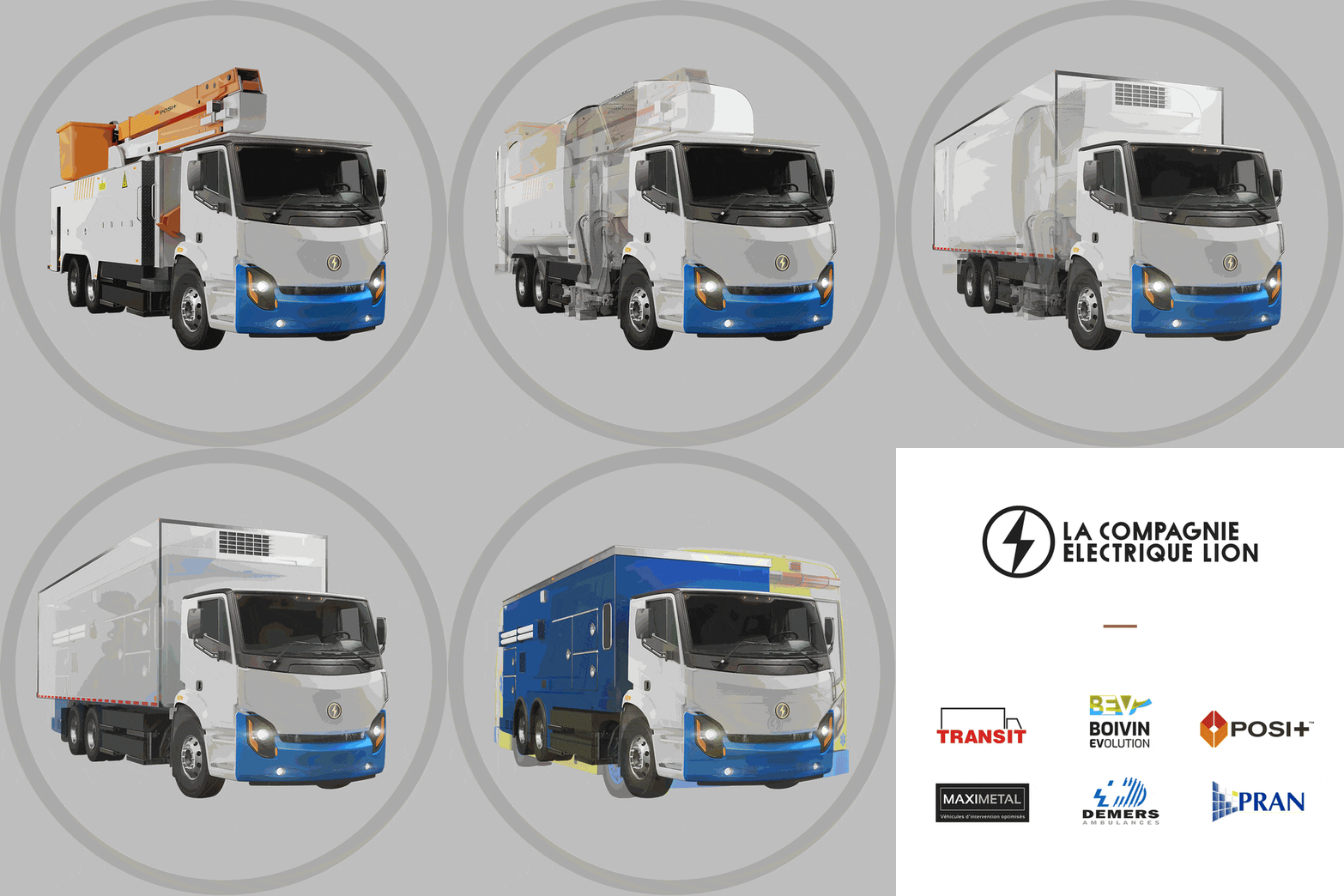
Six partners will work with Lion to develop, manufacture and integrate their respective technologies and specialized equipment on Lion electric vehicles.
Credit:
Courtesy Lion Electric
"Today, we are moving to a higher stage, at a level that has never been achieved until now anywhere in the world,” Bedard said. "The current project will integrate 100% electric, or mostly electrical equipment, on 100% electric trucks without any secondary energy sources. For the customers, this will allow to acquire a perfectly integrated vehicle, as if they were buying it from a single manufacturer.”
Louis Leclair, president of Fourgons Transit, explained in an interview that his company has set itself the challenge of designing a Class 6 truck body with the same load capacity as a Class 7. "We are going to make the body hyper lightweight and will redesign the Frio reefer body to optimize energy efficiency, but especially reduce the weight considerably. Thus, we will get more payload and maximize battery life.”
Asked about the number of bodies Fourgons Transit plans to manufacture for the Lion8, Leclair responded that it will depend on the price of the chassis, but that his company would be competitive in what it will develop. “This is a product that we will distribute throughout North America – we do not do that only for Quebec. All the design will be designed for a North American clientele.”
The specialized Lion8s are destined for both the Canadian market and the United States, said Patrick Gervais, vice president of marketing and communications for Lion. "There is a great demand from many industries for electrification, especially because of the lower maintenance costs.”
Lion sold its first all-electric refuse truck to the City of White Plains, New York.
The company is currently opening what it calls “experience centers” across the United States. It opened one in New York in October, will open another in Los Angeles in January, has tripled the capacity of its Sacramento center, and plans to open five new centers in the United States next year.
“Experience centers are places where people can come and see our products and try them out," Gervais explained. "There is also training and final assembly for certain vehicles. This is also where service teams are based. "
Right now, refuse and bucket trucks are the most promising markets for Lion in the United States, Gervais explained. “Starting next January, we will have a production capacity of 2,500 trucks per year. Our goal is to reach this capacity as quickly as possible and to increase it over time.”
Lion expects sales to be 80% in the United States and 20% in Canada.
Updated 12/3/19 to correct names of Demers Ambulance and Louis Leclair.
More Fuel Smarts

Why Diesel Price Relief Efforts May Fall Short
Diesel prices have eased from September’s record high, but doubts about additional Russian supply and limits on dyed-diesel tax relief mean trucking fleets still face expensive fuel. And prices could go higher.
Read More →
Why Small Fuel Savings Matter in Trucking
Can better fuel economy help pay for driver raises? In this podcast, GP Transco explains how small efficiency gains create room to reinvest in its people.
Read More →
How GP Transco Cuts Trucking Fuel Costs, a Tenth of a Gallon at a Time
What’s another tenth of a mile per gallon worth? GP Transco shares how equipment upgrades and driver coaching turn small gains into meaningful fuel savings.
Read More →
Electric Yard Tractors Move Beyond Pilots
Operating-cost savings have overtaken sustainability goals as the leading reason surveyed fleets are adopting battery-electric terminal tractors, according to new NACFE research.
Read More →
Geotab Links Fleet Card to Vehicle Data
The new card combines fuel discounts with telematics-based purchase controls. Geotab’s analysis also points to potential savings from choosing lower-priced fuel stops.
Read More →
Fleet Economics Shape Electric Truck Outlook
ACT Research expects costs, charging infrastructure, and technology improvements to drive zero-emission commercial vehicle adoption as federal regulations and incentives retreat.
Read More →
Wex Adds Cardless Fuel Payments for Over-the-Road Customers
A new fuel card feature for Wex customers offers convenience and security.
Read More →
New California Law Could Shed Light on Electric Truck Prices
Why do battery-electric Class 8 trucks remain so expensive? A California bill signed by Gov. Gavin Newsom would give fleets and state agencies more visibility into what manufacturers charge.
Read More →
How Volvo Updated Its D13 for EPA 2027 [Watch]
Volvo’s updated D13 promises lower emissions without sacrificing performance or fuel economy. Take a closer look at what changed inside the engine in this HDT Spotlight video.
Read More →
Diesel Price Spike Shortens Payback for Natural Gas Trucks, Report Says
Energy Vision estimates fleets could recover the higher purchase price of an RNG-fueled Class 8 tractor in 1.3 to 2.8 years under current fuel-price scenarios.
Read More →