





Related: Cummins Expands its Vehicle Electrification Business Unit
Cummins Showcases Hydrogen Fuel Cell Concept Truck
To demonstrate its capabilities as an electrification powertrain supplier, Cummins showed a concept Class 8 day cab, featuring a hybrid fuel cell-battery electric drivetrain.
October 31, 2019
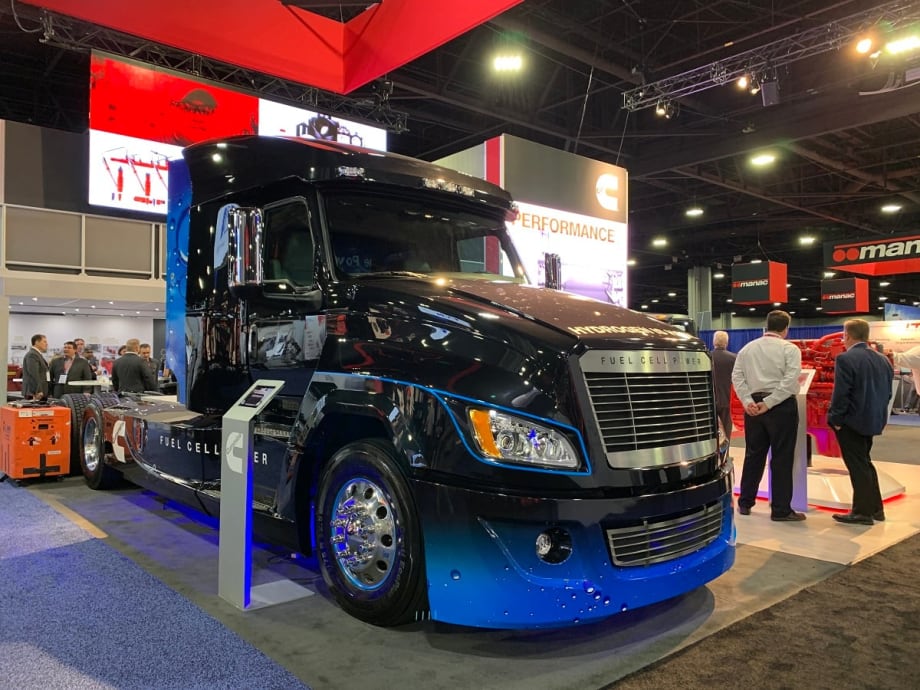
Cummins showed a concept Class 8 day cab at the North American Commercial Vehicle Show featuring a hybrid fuel cell-battery electric drivetrain.
Photo: Deborah Lockridge
3 min to read
Add Cummins to the growing list of top-tier OEMs aggressively ramping up their hydrogen fuel cell research and development efforts.
Citing its legacy as a “power company,” Thad Ewald, vice president, corporate strategy and head of the company’s Electrified Power business unit, said that the company’s founder was passionate about using whatever technology was at hand to efficiently power commercial vehicles. A century ago, diesel engines were the emerging technology showing the most promise to move freight. And today, Ewald noted, battery electric trucks and hydrogen fuel cells are shaping up to be trucking’s power choices in the future.
To drive that point home, a concept Class 8 truck with hybrid Cummins fuel cell and battery electric power was on prominent display in Atlanta at the Cummins booth on the North American Commercial Vehicle show floor. Ewald pointed to the new vehicle as proof positive that Cummins’ new strategy to provide fleet customers with a broad portfolio of power options, from diesel and natural gas, hybrids, to battery electric and hydrogen fuel cell solutions is already bearing fruit.
“Developing this cutting-edge hydrogen fuel cell truck as a technology demonstrator is an important step in gaining valuable insights that are critical to continue developing the right solutions for the market and preparing for the next 100 years,” Ewald told journalists at a press briefing on Oct. 29.
“In the long run, the customers we serve will likely need more than one type of power, depending on their specific markets, applications and use cases," he said. "We are uniquely positioned to help our customers select the right solution for their needs. Our deep technological expertise and global service and support network means we are able to help them transition from one technology to another at the time that’s best for their business.”
Ewald said the zero-emissions concept truck – a Class 8 day cab tractor with 6x4 drive axles-- shows promise for a variety of vocational applications, including regional haul, port drayage and terminal container handling as well as beverage, grocery and other urban delivery fleet operations.
Designed and built by Cummins engineers in Columbus, Indiana, the concept tractor features a new, proton exchange membrane (PEM) fuel cell that converts hydrogen into electricity, which is then used to power electric drive motors to move the vehicle.
The display truck features a 90 kW fuel cell. But the fuel cell system is scalable to meet both shorter and longer range fleet requirements, and can be spec’d with several other versions ranging from 30 kW up to 180 kW in addition to a 100 kWh lithium-ion battery capacity.
These combined propulsion systems give the concept truck a range of 150 to 250 miles before its hydrogen supply has to be replenished. But, Ewald noted, the truck’s range can be extended by adding additional hydrogen tanks, increasing tank storage pressure, or by adding additional fuel cells.
More Fuel Smarts

How Volvo Updated Its D13 for EPA 2027 [Watch]
Volvo’s updated D13 promises lower emissions without sacrificing performance or fuel economy. Take a closer look at what changed inside the engine in this HDT Spotlight video.
Read More →
Diesel Price Spike Shortens Payback for Natural Gas Trucks, Report Says
Energy Vision estimates fleets could recover the higher purchase price of an RNG-fueled Class 8 tractor in 1.3 to 2.8 years under current fuel-price scenarios.
Read More →
Calstart Becomes Catalyst Mobility, Reflecting Broader Focus
Calstart is now Catalyst Mobility, reflecting the nonprofit’s growing national role in clean transportation, including zero-emission trucks, infrastructure and incentive programs.
Read More →

Record Diesel Prices Squeeze Trucking Fleets
Average U.S. diesel prices have climbed to nearly $6 a gallon, surpassing the 2022 record as tight refinery capacity and Middle East disruptions keep fuel costs elevated.
Read More →
Sponsored•September 9, 2026
How Fuel Delivery Shapes Engine Performance
Fuel delivery depends on more than what happens at the injector. For fleet, maintenance and technical professionals, looking at the full path from pump to injector can provide useful context for understanding engine performance.
Read More →
East Coast Port Launches $45M Electric Truck Push
The Port Authority of New York and New Jersey announced millions in incentives for zero-emission drayage trucks, yard tractors, and new charging hubs near the port.
Read More →
California Bill Could Shed Light on Electric Truck Prices
Why do battery-electric Class 8 trucks remain so expensive? A California bill headed to Gov. Gavin Newsom would give fleets and state agencies more visibility into what manufacturers charge.
Read More →
Detroit Opens Orders for EPA 2027 Engines
Detroit isn’t starting from scratch to meet EPA 2027 diesel emissions standards. Its Gen 6 DD13 and DD15 engines keep much of today’s platform while updating the fuel and aftertreatment systems.
Read More →
Zero-Emission Truck Corridor Planned for West Coast
California, Oregon, Washington, British Columbia and Baja California are coordinating plans for truck charging and hydrogen fueling from Canada to Mexico.
Read More →
A Closer Look at Kenworth’s Electric T880E Vocational Truck [Video]
Learn more about Kenworth's T880E battery-electric vocational truck at the Paccar Technical Center, including its range, applications, upfitting considerations, and PTO options, in this HDT Spotlight video.
Read More →