




SAF-Holland Unveils Smar-te Tire Pressure Management System
SAF-Holland's new tire pressure management system uses suspension air pressure data to accurately adjust pressures based on actual trailer axle loads.

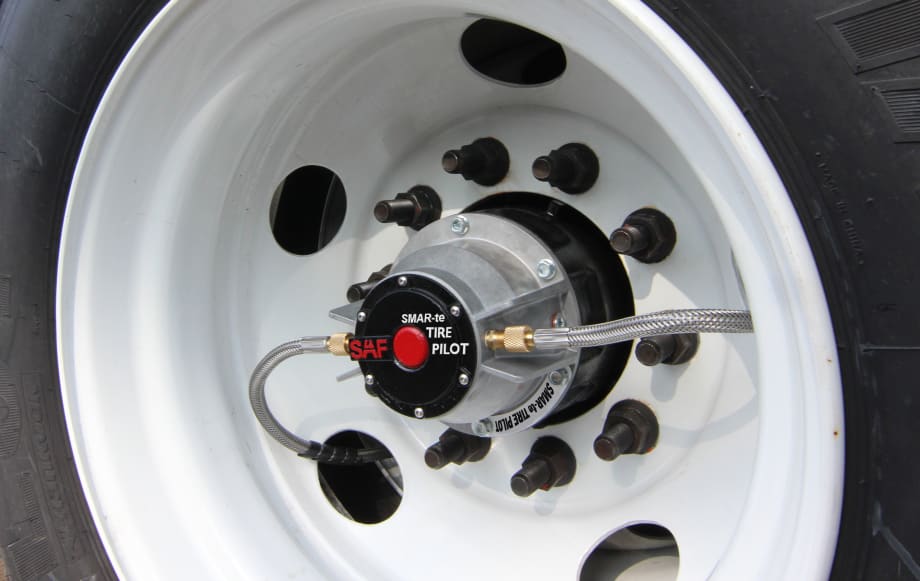
SAF-Holland's new SMAR-te TPMS technology dynamically adusts tire pressures based on actual trailer axle loads.
Photo: SAF-Holland
SAF-Holland took advantage of the North American Commercial Vehicle Show in Atlanta to formally introduce its new CEO Kent Jones, a industry veteran with more than 25 years’ experience in the trucking industry.
The company also launched a new, “intelligent” tire pressure management system called Smar-te (“Smart”) which Jones called an significant “evolution” in TPMS technology. The system does more than just monitor tires and issue alerts when there is a drop in pressure. The system is also an automatic tire inflation system.
Jones noted that tire pressure management is critical to a fleet’s efficient operation. Tires are the second-highest vehicle operating expense and improper tire pressure causes 80% of premature tire failures. Proper tire pressure is critical to tire life and yet according to SAF-Holland, 66% of fleets have tires operating at more than 5 PSI from the proper setting and 22% have at least one tire more than 20 PSI from the proper setting. ATA’s Technology & Maintenance Council’s Future Tire Durability and Reliability Task Force issued a position paper in December, 2018, highlighting the need to improve trailer tire inflation systems to include the ability to dynamically change tire pressure based on trailer axle load.
To help fleets better manage the tricky task of tire inflation, SAF-Holland has partnered with electro-pneumatic controls provider AKTV8 LLC, combining that tech company’s patented control systems with SAF’s Tire Pilot Plus wheel ends to deliver Smar-te Tire Pilot. This new take in TPMS uses the trailer’s own air suspension system data to:
Inflate, deflate, and equalize all tires to ensure tires wear evenly
Optimize tire pressure based on axle load to maximize tire sidewall and tread life
Fast, accurate tire pressure control, no regulators to wear out or recalibrate
Smart-Alerts provide real system status; no more nuisance alerts
On-board scale with overload alert features reduces citation potential, improves
CSA scoring
Improve cushioning of both the vehicle and cargo, especially when lightly loaded
Reduce tire and vehicle maintenance, ease of service and troubleshooting
Enhance fuel economy and reduce Greenhouse Gas (GHG) emissions
The key to Smar-te Tire Pilot, Jones said, is the incorporation of AKTV8’s iAir electro-pneumatic control module with integrated solenoid valves and sensors to dynamically measure and adjust tire pressure based on trailer axle load.
The Smart-Alert diagnostic LED light warns of minor tire leaks, severe leaks, and overload conditions. Bluetooth and CAN connectivity allow enhanced configurability and serviceability, with optional telemetry integration.
Unlike traditional mechanical tire inflation systems, Jones said, Smar-te Tire Pilot requires no maintenance or calibration. The ability to more accurately control the proper tire air pressure per the tire manufacturer’s load and inflation standards reduces tire stress, resulting in optimized tire tread and casing life and reduced rolling resistance.
Jones said he feels Smar-te Tire Pilot could revolutionize tire inflation by providing automatic adjustment of tire pressure based on trailer axle loads at a price point that makes sense for North American fleet operations.
More Fleet Management

Nomination Deadline Extended for HDT Emerging Leaders
Just a few more days to nominate accomplished trucking fleet professionals under 40 who are making an impact and helping lead the industry forward for the HDT Emerging Leaders award. Deadline extended to October 20!
Read More →
What Will ATA’s New Leader Bring to Trucking's Table?
Incoming President and CEO Mark Colson’s record in Alabama offers clues about his priorities and approach following Chris Spear’s abrupt departure as the head of the American Trucking Associations.
Read More →
Volvo, Waabi Start Commercial Autonomous Operations in Texas
Volvo VNL Autonomous trucks, powered by the Waabi Driver, are hauling freight directly to third-party facilities for a customer in Texas.
Read More →
Samsara Launches Custom AI Agent Builder
Agent Studio lets fleets create AI tools for hours-of-service monitoring, reporting and driver support, including agents that communicate by phone.
Read More →
Einride Driverless Electric Trucks Begin Daily Freight Operations in Ohio
Two cabless electric trucks are hauling freight between EASE Logistics facilities in Marysville, Ohio, as part of a multi-state truck automation project.
Read More →
Geotab Links Fleet Card to Vehicle Data
The new card combines fuel discounts with telematics-based purchase controls. Geotab’s analysis also points to potential savings from choosing lower-priced fuel stops.
Read More →
How MFA Helps Protect Trucking Fleets
Multi-factor authentication adds protection when passwords are stolen. Here’s how it works and where fleets should start.
Read More →
How Better Freight Data Helps Trucking Teams Get Ahead of Disruption
Trucking and logistics teams have plenty of data. The problem is getting the right information in front of the right people soon enough to act. Better-connected data can help teams spot trouble earlier and make smarter decisions before small problems become big ones.
Read More →
Trimble: Taking Artificial Intelligence in Trucking Beyond Faster Tasks
At Insight 2026, Trimble executives argued that fleets may need to redesign workflows to get more from AI as it introduced new products and enhancements. AI’s value will depend on how fleets combine automation with their people's knowledge.
Read More →
Build a bulletproof fleet: Uniting ELDs and dash cams for total compliance
An ELD can prove compliance, but it cannot always prove what happened on the road. Discover how uniting accurate ELD data with AI-powered dash cam video can help your fleet strengthen compliance, defend against liability, protect drivers and reduce operational costs.
Read More →