





New EPA Proposal Could Erase GHG Emissions Standards for Trucks
What Standards Apply? CARB Moves to Clarify Emissions Rules Amid Legal Limbo
California is issuing emergency rules reinstating prior emissions standards to ensure vehicles can still be sold in California amid unprecedented legal uncertainty.
September 16, 2025
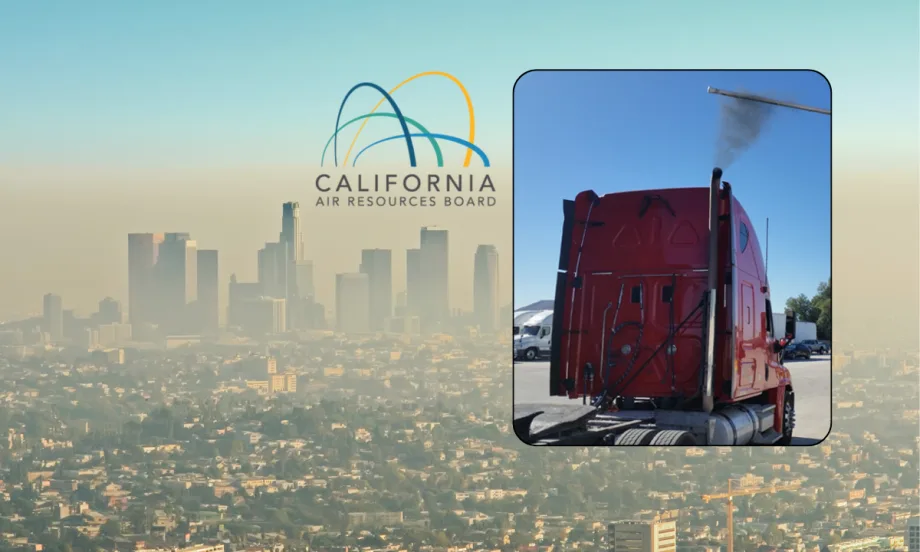
Are any California truck emissions rules still in effect? CARB proposes emergency regulations to clarify.
HDT Graphic
4 min to read
The California Air Resources Board has proposed emergency vehicle emissions regulations to clarify the situation as it challenges actions taken earlier this year to revoke previously issued Clean Air Act waivers for California’s Heavy Duty Low-NOx Omnibus and Advanced Clean Cars II emissions rules.
California believes that in taking the unprecedented action to revoke the emissions waivers that Congress unconstitutionally exceeded its powers and is challenging it in court.
However, while that litigation is being determined, the state wanted to make sure manufacturers can still sell vehicles and engines into California.
'Unprecedented Degree of Uncertainty' in California New-Vehicle Market
“The congressional resolutions have introduced an unprecedented degree of uncertainty into the California market for new motor vehicles,” the board said in its regulatory notice. Because the emissions regulations that were invalidated by Congress had superseded previous emissions regulations, that has left questions about which regulations apply.
These emergency amendments are reinstating the emissions regulations that were in effect prior to the Low-NOx Omnibus and Advanced Clean Cars II rules (LEV IV).
In the case of the Advanced Clean Cars II rules, CARB said, this means the criteria pollution provisions of the LEV III regulation (adopted as part of ACC I) and associated on-board diagnostic requirements remain operative.
The new emergency amendments include the caveat that CARB may enforce the Omnibus and Advanced Clean Cars II regulations, to the extent permitted by law, if it wins its challenge in court.
Are Any CARB Standards Still Legal?
In a court filing on September 4, CARB said, vehicle manufacturers argued that CARB’s earlier-adopted vehicle certification requirements — for which CARB received separate earlier waivers not affected by the congressional resolutions — are invalid because those requirements became “defunct” when the more recent, more stringent standards displaced them.
Thus, according to the vehicle manufacturer challengers, “amending state law” would be required to revive the earlier adopted standards even if the displacing standards are ultimately found to be unenforceable on account of Congress’s actions.
CARB disagrees.
"Nevertheless, in the event the vehicle manufacturer’s claim were to be deemed correct — that CARB must revive its earlier-adopted emissions requirements before it can resume enforcement of them — then CARB must take immediate action to maintain a stable vehicle market in the state and prevent the sale of vehicles into the state that would not be certified to either set of standards," it explained.
“Otherwise, in light of these unprecedented circumstances, there may remain questions — for the first time since CARB’s program began decades ago — as to whether any California standard is in effect.”
“This emergency regulation thus responds to an unprecedented and unanticipated set of circumstances: the suggestion by a regulated party that, for the first time in half a century, CARB has no operative emissions standards to which it can certify new motor vehicles to be sold in the state.”
Both Sets of Emissions Standards Will Be On the Books
CARB continues to accept and process certification applications for the LEV IV and Omnibus emission standards.
“Hence, both sets of standards will be present in the California Code of Regulations during this period of unprecedented uncertainty,” the agency explained in its regulatory notice.
“Regulated parties may choose to follow either the LEV IV or Omnibus standards or the antecedent LEV III and pre-Omnibus provisions.
“Regulated parties, however, assume the risk if they choose to certify only to the antecedent provisions, and the congressional resolutions disapproving the waivers of federal preemption under the Clean Air Act are declared invalid.”
CARB intends to submit the Emergency Vehicle Emissions Regulation to OAL on September 22. The submitted action will appear on the list of “Emergency Regulations Under Review” on OAL’s website at: https://oal.ca.gov/emergency_regulations/Emergency_Regulations_Under_Review/
Emergency rulemakings have a five-calendar-day comment period that begins when OAL posts the notice of the pending emergency action on the OAL website.
What About ZEVs?
The emergency rules do not appear to include California’s zero-emission truck regulations. Since the Congressional resolutions revoking the EPA waivers were signed in June, California has maintained that heavy-duty truck and engine makers were still bound to meet the Low-NOx and Advanced Clean Trucks standards under the Clean Truck Partnership.
But there has been pushback, with truck makers suing California over its attempt to still enforce the clean truck rules, and the Federal Trade Commission raising antitrust concerns regarding the Clean Truck Partnership.
More Fuel Smarts

Geotab Links Fleet Card to Vehicle Data
The new card combines fuel discounts with telematics-based purchase controls. Geotab’s analysis also points to potential savings from choosing lower-priced fuel stops.
Read More →
Fleet Economics Shape Electric Truck Outlook
ACT Research expects costs, charging infrastructure, and technology improvements to drive zero-emission commercial vehicle adoption as federal regulations and incentives retreat.
Read More →
Wex Adds Cardless Fuel Payments for Over-the-Road Customers
A new fuel card feature for Wex customers offers convenience and security.
Read More →

New California Law Could Shed Light on Electric Truck Prices
Why do battery-electric Class 8 trucks remain so expensive? A California bill signed by Gov. Gavin Newsom would give fleets and state agencies more visibility into what manufacturers charge.
Read More →
How Volvo Updated Its D13 for EPA 2027 [Watch]
Volvo’s updated D13 promises lower emissions without sacrificing performance or fuel economy. Take a closer look at what changed inside the engine in this HDT Spotlight video.
Read More →
Diesel Price Spike Shortens Payback for Natural Gas Trucks, Report Says
Energy Vision estimates fleets could recover the higher purchase price of an RNG-fueled Class 8 tractor in 1.3 to 2.8 years under current fuel-price scenarios.
Read More →
Calstart Becomes Catalyst Mobility, Reflecting Broader Focus
Calstart is now Catalyst Mobility, reflecting the nonprofit’s growing national role in clean transportation, including zero-emission trucks, infrastructure and incentive programs.
Read More →
Record Diesel Prices Squeeze Trucking Fleets
Average U.S. diesel prices have climbed to nearly $6 a gallon, surpassing the 2022 record as tight refinery capacity and Middle East disruptions keep fuel costs elevated.
Read More →
Sponsored•September 9, 2026
How Fuel Delivery Shapes Engine Performance
Fuel delivery depends on more than what happens at the injector. For fleet, maintenance and technical professionals, looking at the full path from pump to injector can provide useful context for understanding engine performance.
Read More →
East Coast Port Launches $45M Electric Truck Push
The Port Authority of New York and New Jersey announced millions in incentives for zero-emission drayage trucks, yard tractors, and new charging hubs near the port.
Read More →