





HDT Talks Trucking Podcast: The Future of Fuel Economy
California's New Low-NOx Rules Concern Truck, Engine Makers
The California Air Resources Board approved sweeping new emissions regulations affecting heavy-duty trucks sold in the state. Truck and engine makers decried the new rule.
August 28, 2020

Truck and engine makers will be dealing with the low-NOx rule at the same time as the new electric truck mandate from the state of California.
Credit:
HDT file image
4 min to read
The California Air Resources Board approved sweeping new emissions regulations affecting heavy-duty trucks sold in the state. An organization representing truck and engine makers decried the new rule.
The Omnibus Low-NOX Rule, approved by CARB on Aug. 28 will require engine NOx emissions to be cut to approximately 75% below current standards beginning in 2024, and 90% below current standards in 2027.
The rule also places nine additional regulatory requirements on new heavy-duty truck and engines. Those additional requirements include a 50% reduction in particulate matter emissions, stringent new low-load and idle standards, a new in-use testing protocol, extended deterioration requirements, a new California-only credit program, and extended mandatory warranty requirements.
“CARB’s far-reaching Omnibus Low-NOX Rule is not technologically feasible or cost-effective,” said Jed Mandel, president of the Truck and Engine Manufacturers Association. “In addition, the requirements starting in 2024 fail to provide the statutorily required minimum lead time for manufacturers to develop the technologies.”
The regulatory requirements in the Omnibus Low-NOX Rule will first become effective in 2024, at the same time as the Advanced Clean Trucks regulations that CARB approved on June 25 that mandates manufacturers convert increasing percentages of their heavy-duty trucks sold in California to zero-emission vehicles.
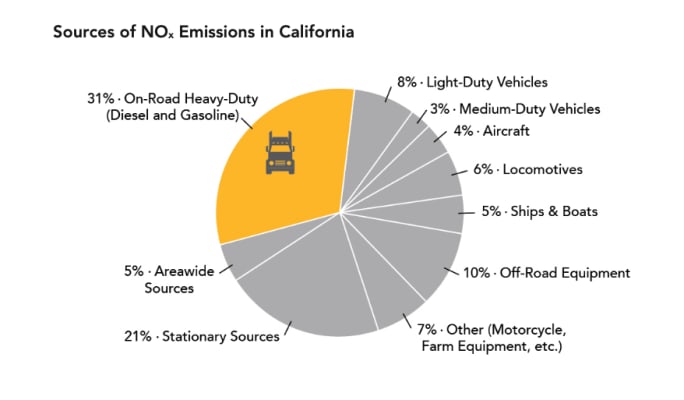
CARB says oxides of nitrogen, or NOx, is a precursor to smog, which can cause or exacerbate numerous respiratory and other health ailments and is associated with premature death.
Graph: CARB
This means truck and engine makers must implement the low-NOX regulations at the same time CARB is compelling them to displace those trucks with zero-emission vehicles.
“The compounding and overlapping nature of the two regulatory mandates that CARB approved this summer threatens California’s commercial truck market,” Mandel said. “Instead of purchasing expensive, complicated and unproven new vehicles in California, truck operators and freight shippers are likely to maintain old trucks longer and seek solutions outside the state.”
CARB Chair Mary D. Nichols said in a statement: “Even as California ramps up the numbers of zero-emission electric and fuel-cell trucks on our roads over the next decade and beyond, tens of thousands of new internal combustion trucks will still be sold in our state. This regulation ensures that conventional diesel trucks will run as cleanly as possible at every point in their duty cycle. It takes a significant bite out of smog-forming pollution in every region in the state, and will make a major contribution to cleaning the air in communities close to ports, railyards and distribution centers that are now most heavily impacted by pollution from heavy truck traffic.”
CARB expects that once it is fully phased in by 2031, the rule will reduce harmful NOx emissions in California by more than 23 tons per day – the equivalent of taking 16 million light-duty cars off the road. (For context, California currently has 26 million registered light-duty vehicles). This will also result in 3,900 avoided premature deaths and 3,150 avoided hospitalizations statewide over the life of the rule (2024 – 2050), CARB predicts, and lead to estimated statewide health benefits (savings from health care costs) of approximately $36.8 billion.
EMA contended that CARB has underestimated the costs associated with implementing the Omnibus Low-NOX Rule and overestimated the potential environmental benefits.
And, it said, the new rule will result in increased fuel consumption, placing the regulations in conflict with CARB’s greenhouse gas standards. We saw this in the early 2000s, when strict new federal regulations lowering NOx limits resulted in lower fuel economy.
At the same time, truck and engine makers are already working to meet more stringent fuel-economy standards as part of federal greenhouse gas reduction regulations.
Federal NOx rule?
Truck and engine makers would rather see a national rule instead of a state-specific one. The American Trucking Associations also has expressed support for “one national, harmonized NOx emissions standard.”
Early this year, the Environmental Protection Agency issued an advance notice of proposed rulemaking to establish more stringent heavy-duty diesel truck emission standards for oxides of nitrogen (NOx) and other pollutants, part of its Cleaner Trucks initiative announced in 2018.
At that time, Allen Schaeffer, executive director of the Diesel Technology Forum, which advocates for cleaner diesel, said the EPA move “follows support for a new low-NOx standard from truck and engine makers and petitions for rulemaking from a number of state and local air agencies.”
However, that comment period closed in February and there has not been a notice of proposed rulemaking resulting from it at this time. The Natural Resources Defense Council, which supports the new rule, notes that “the earliest that rule would come into effect is 2027 and is currently facing additional delays.”
“The Heavy-Duty Omnibus rule will push manufacturers to innovate and deploy technically feasible and cost-effective emission reduction technology sooner: charting a course for the U.S. EPA to follow,” NRDC said on its website.
One technology engine and component makers have already been exploring to meet anticipated low-NOx emissions rules is cylinder deactivation. Both Cummins and Jacobs have been developing and testing this technology.
More Equipment

Tesla Wants a Self-Driving Semi. Are Cameras Enough?
Could Tesla’s camera-only autonomous driving technology work on an 80,000-pound Semi? In this commentary, HDT's Deborah Lockridge takes a look at Tesla, Cybercab, and how autonomous trucks see the road.
Read More →
Kodiak: Driverless Long-Haul Truck Launch on Track for 2026
Kodiak AI says its driverless long-haul safety case is 93% complete and it remains on track to begin commercial operations by year-end 2026.
Read More →
What DOT’s Automated Vehicle Strategy Means for Trucking
The U.S. Department of Transportation issued a new automated-vehicle strategy that outlines plans for driverless-truck regulations, cross-state freight corridors, and federal safety standards.
Read More →
East Coast Port Launches $45M Electric Truck Push
The Port Authority of New York and New Jersey announced millions in incentives for zero-emission drayage trucks, yard tractors, and new charging hubs near the port.
Read More →
PlusAI Going Public to Fund Autonomous Truck Launch
A SPAC deal could provide PlusAI with up to $300 million as it works toward a 2027 commercial launch of factory-built autonomous trucks.
Read More →
NHTSA Moves to Rewrite Truck Fuel-Economy Rules
The National Highway Traffic Safety Administration says it lacks authority to regulate medium- and heavy-duty truck engines separately from complete vehicles, but the existing standards have not yet been eliminated.
Read More →
Detroit Opens Orders for EPA 2027 Engines
Detroit isn’t starting from scratch to meet EPA 2027 diesel emissions standards. Its Gen 6 DD13 and DD15 engines keep much of today’s platform while updating the fuel and aftertreatment systems.
Read More →
Carrier Transicold Adds All-Electric TRU for Stationary Cold Storage
Carrier Transicold’s new Vector 8200 all-electric transport refrigeration unit gives fleets a diesel-free option for temporary refrigerated and frozen trailer storage.
Read More →
A Closer Look at Kenworth’s Electric T880E Vocational Truck [Video]
Learn more about Kenworth's T880E battery-electric vocational truck at the Paccar Technical Center, including its range, applications, upfitting considerations, and PTO options, in this HDT Spotlight video.
Read More →
Kenworth T880E Brings EV Power to Vocational Trucks
A closer look at the Kenworth T880E’s range, charging, powertrain and upfit options — and where fleets are showing the most interest.
Read More →