




The Promise of Powered Trailers Part 2
The potential for smart, connected, power-generating trailers encompasses everything from power for TRUs, air systems and even electric drive axles that can extend range on battery-electric tractor-trailers or reduce fuel consumption and exhaust emissions on diesel-powered units.

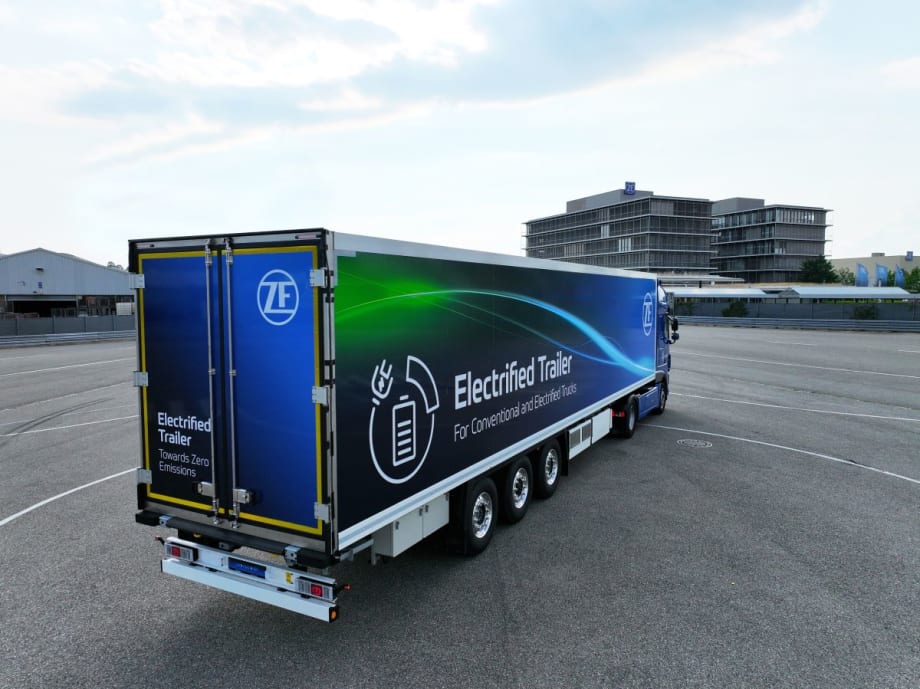
ZF has been developing power trailers in Europe for several years now and feels they could reduce both emissons and fuel consumption in long-haul trucking applications.
Photo: ZF
In Part 1 of this series on The Rise of Powered Trailers, HDT looked at the general trends driving more technology into trailers today and how they are leading to more powerful, efficient and productive tractor-trailers.
And although powered trailers haven’t entered the market in large numbers yet, Marc Trahand, vice president and general manager, says ConMet has been working on this technology since 2017.
“Our initial idea was to simply provide power to a trailer axle,” he says. “But the advances in both electric propulsion and intelligent power management in just the past few years have given us many more options. Like any technology, it is being rolled out in degrees. And there will be different levels of maturity and functionality as we go forward.”
But at its core, the powered trailer concept is pretty straightforward, Trahan adds. “The question is, how can we get more efficiency out of a tractor-trailer?”
Power For Multiple Vehicle Systems
And the answer, Trahan says, is to somehow alleviate the weight of the trailer behind the truck. “From there, the conversation turns to finding the optimal level of efficiency,” he explains. “Where do we want to place the motors on the trailer? Where is the best location for the battery? Do we need to change those configurations for diesel trucks versus electric trucks? That sort of thing. But no matter what, we want to be as light as possible. Which is why we opted for a small battery with power generation coming from the trailer’s wheel.”
Weight is always an issue, Ralph Dimenna, chief commercial officer, Aperia Technologies says. But the benefits of these systems far outweigh any additional weight on the trailer.
“With any battery solution weight is an important consideration that must be taken into account,” he notes. “And that has to comply with the vocational needs of the trailer. But once power has been generated from the rotational energy of the wheel, it can be used in many different ways. It can be converted into converted into propulsive power. It can also be converted into generative power or even air pressure, which can then be used to charge a battery, pump up a tire, power a TRU or any number of systems.”
Ali Javidan, founder and CEO of Range Energy, says Range trailers offer a proprietary and turn-key electrification system that includes a battery pack, e-axle, and patented smart kingpin, along with an integrated controls stack.
“The smart kingpin senses when the tow vehicle is accelerating or braking, and sends commands to the e-axle to provide propulsion support or regenerative braking – reducing the amount of work the tractor needs to do,” he says. “Overall, the simplicity of our trailer is what makes our technology such a foolproof investment for fleets – we’re not dependent on omnipresent megawatt charging infrastructure to deliver significant benefits and, even when uncharged, our trailers can be towed like a traditional trailer to get cargo to its destination.”
Range Energy trailers are compatible with existing diesel trucks and can immediately improve fuel efficiency as well as reduce NOx emissions, Javidan adds. “Range trailers also offer long-term applicability by extending the life cycle of today’s diesel tractors as well as doubling the range of future e-semis when being towed,” he says. “We’ve built our trailers so that there are no regulatory changes required nor operational disruptions, and our regenerative braking system enhances the driver experience and road safety by giving drivers more control over the truck.”
As for the weight question, Javidan says that while payload capacity is important for fleets, Range has also found that approximately 70% of trailer-loads are lighter than the legal limit.
“We’ve successfully run pilots with fleets in notoriously weight-sensitive industries like beverage and food distribution without significant impact to their load planning,” he says. “For any fleet that has additional weight capacity, or can create it through operational planning, our system can provide significant cost savings and environmental benefits. Importantly, the weight of the Range ePTS is less than the weight of the electric powertrain system on an EV tractor as well.”
Promising MPG Numbers
So, what are the real-world advantages of electric trailer propulsion systems? Will that add to fleets’ maintenance burdens? Will they give fleets a reasonable return on investment?
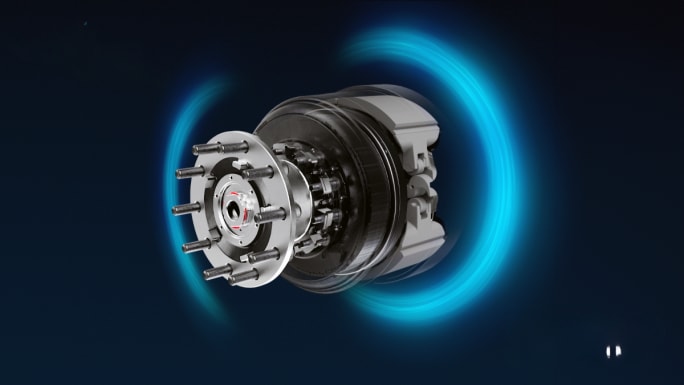
ConMet has pioneered the development of "smart" electric axles and believes the technlogy can transform tractor-trailers into truly optmized propulsion systems.
Image: ConMet
Obviously, these systems are still in the development stage. And Trahan says they will likely remain in that state until developers have a better understanding of what the emissions regulation landscape will look like after 2027. But the early data is promising.
It’s still a bit early to have concrete cost and ROI data, says Dimenna. But, he notes that prototype systems and pilot programs have shown performance improvement of up to 60% for fuel economy and emissions of a tractor-trailer combination with an electrified, smart trailer. And, the addition of a connected ATIS can contribute up to another 1-2% of fuel economy to that equation.
“Our next generation trailer, the RB-01, showed it can improve fleets’ miles-per-gallon by up to 67%,” Javidan says. “Significantly, the RB-01 yields 47-67% mpg improvements (equivalent to a 32-40% reduction in fuel costs).”
During its transit to the Advanced Clean Transportation Expo in Las Vegas in May of this year, Javidan says the tractor towing the RB-01 achieved 18.1 mpg during the final 281.6 miles between Bakersfield, CA and Las Vegas, NV. Moreover, those results included a 2,000-foot net elevation gain and 12,000 feet total of climbing with ambient temperatures as high as 105 degrees Fahrenheit.
Based on those numbers, Javidan says Range Energy calculates that the payback time for most fleets using its trailers is around five to six years. “Although we believe faster payback is possible with greater utilization and in areas where electricity is cheaper than diesel,” he adds.
And Javidan says maintenance costs will likely be a wash, as well. “The Range ePTS does not disrupt the existing preventative maintenance cycle for trailers’ he adds. “Our suppliers have a long track record of delivering robust and reliable components for the heavy trucking industry, and history has shown EV powertrains to have substantial maintenance advantages over combustion powertrains.”
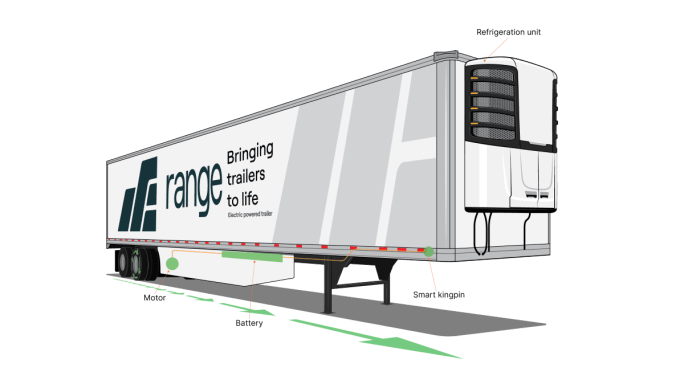
Powered trailers are about more than just propulsion. Range Energy believes its solutions can also be applied to any powered trailer system -- including TRUs.
Image: Range Energy
For those reasons and others, Javidan says Range trailers are expected to extend the service intervals for the tractor and trailer brakes due to regenerative braking and reduced friction brake usage.
“Furthermore, they lessen the amount of work or stress on the tractor engine and drivetrain,” he points out. “Installation is simple as well and leverages existing tools and capabilities available at heavy duty equipment dealerships, or at in-house fleet maintenance departments.”
“The trucking industry is finally starting to realize that trailers offer opportunities beyond merely hauling freight,” says Jason Paauwe, head of trailer sales, North American Group, ZF. “Today, we’re looking at trailers differently. They’re not just big boxes anymore. We can electrify them. We can add safety and communication systems. And now, we have our customers raising their hands asking us how we can apply technology to trailers to solve problems for them. All of this is going to fundamentally change how we spec and use trailers in the future.”
Despite naysayers, it looks like diesel engines will be a fixture in the trucking industry for many years to come – particularly in long-haul applications. Powered trailer technology could be a simple, elegant solution, that can extend the useful life of cleaner and greener diesel operations for fleets in coming years.And powered trailers will also offer many new solutions to virtually any trailer application on the road today, as well.
More Equipment

How Volvo Updated Its D13 for EPA 2027 [Watch]
Volvo’s updated D13 promises lower emissions without sacrificing performance or fuel economy. Take a closer look at what changed inside the engine in this HDT Spotlight video.
Read More →
Michelin Tire Improves Efficiency and Durability for Regional Fleets
The Michelin X Multi Energy D2 is a regional haul drive tire engineered to help fleets improve fuel efficiency, durability and traction in demanding stop-and-go operations.
Read More →
ZF Expands Commercial Vehicle Push in North America
ZF is expanding its North American commercial-vehicle presence with new transmission applications, electrification, trailer technology and autonomous-driving systems.
Read More →
Tesla Wants a Self-Driving Semi. Are Cameras Enough?
Could Tesla’s camera-only autonomous driving technology work on an 80,000-pound Semi? In this commentary, HDT's Deborah Lockridge takes a look at Tesla, Cybercab, and how autonomous trucks see the road.
Read More →
Kodiak: Driverless Long-Haul Truck Launch on Track for 2026
Kodiak AI says its driverless long-haul safety case is 93% complete and it remains on track to begin commercial operations by year-end 2026.
Read More →
What DOT’s Automated Vehicle Strategy Means for Trucking
The U.S. Department of Transportation issued a new automated-vehicle strategy that outlines plans for driverless-truck regulations, cross-state freight corridors, and federal safety standards.
Read More →
East Coast Port Launches $45M Electric Truck Push
The Port Authority of New York and New Jersey announced millions in incentives for zero-emission drayage trucks, yard tractors, and new charging hubs near the port.
Read More →
PlusAI Going Public to Fund Autonomous Truck Launch
A SPAC deal could provide PlusAI with up to $300 million as it works toward a 2027 commercial launch of factory-built autonomous trucks.
Read More →
NHTSA Moves to Rewrite Truck Fuel-Economy Rules
The National Highway Traffic Safety Administration says it lacks authority to regulate medium- and heavy-duty truck engines separately from complete vehicles, but the existing standards have not yet been eliminated.
Read More →
Detroit Opens Orders for EPA 2027 Engines
Detroit isn’t starting from scratch to meet EPA 2027 diesel emissions standards. Its Gen 6 DD13 and DD15 engines keep much of today’s platform while updating the fuel and aftertreatment systems.
Read More →