





Why ConMet's eHub Could be a Game-Changer for Cleaner Diesel Fleets
Penske Pairs Electric Tractor, Zero-Emission Refrigerated Trailer
ConMet eMobilility announced that Penske Logistics has pioneered zero-emissions refrigerated tractor-trailer transportation using its nMotion power-generation technology.
July 18, 2023
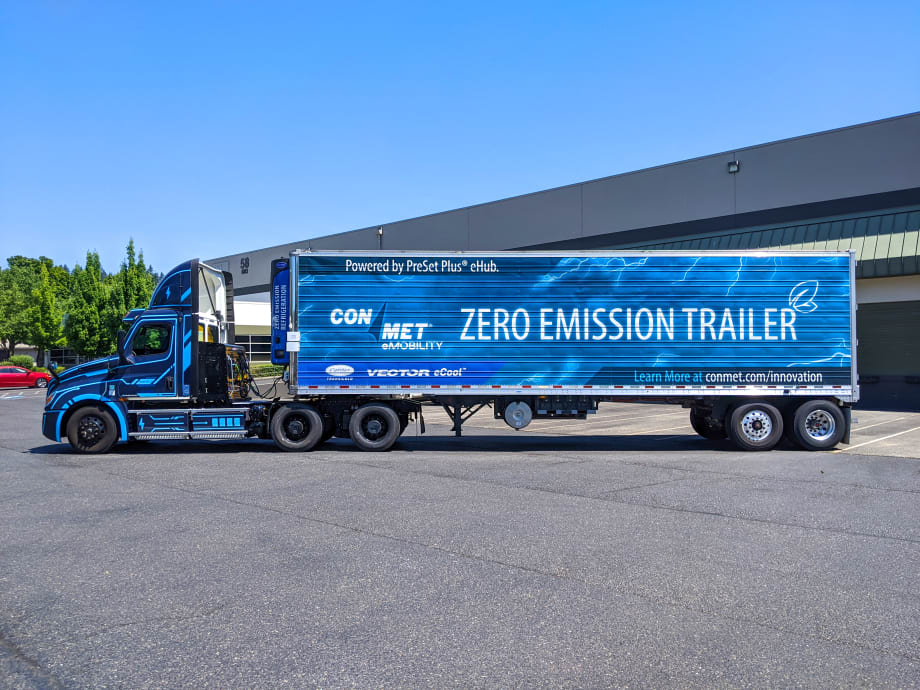
A Penske Logistics Freightliner eCascadia equipped with ConMet eMobility's nMotion reefer technology has logged over 20,000 miles and 2,500 TRU run hours of zero-emission refrigerated transport.
Photo: Penske Logistics
2 min to read
Penske Logistics has paired a battery-electric tractor with a zero-emissions trailer, hauling refrigerated freight for a California customer.
According to ConMet eMobility, Penske Logistics is he first third-party logistics provider to successfully pair an nMotion TR 160-45 equipped reefer trailer with a Freightliner eCascadia electric tractor.
The pairing enables zero-emission refrigerated transport by combining an all-electric tractor with a reefer trailer cooled by an electric standby trailer refrigeration unit that is powered by energy generated from in-wheel electric motors. Leveraging this in-wheel PreSet Plus eHub technology, the nMotion system generates power for the reefer whenever the vehicle is in motion to keep cargo cold during transport.
Penske Logistics first deployed this advanced solution on a quick service retail delivery route in Southern California in February. Covering over 160 miles each trip with eight delivery stops, the reefer has been able to consistently achieve 100% electric TRU run time.
Since first deployed, the fleet has completed more than 125 trips, covering over 20,000 miles and 2,500 TRU run hours, while maintaining cold cargo temperature and on-time deliveries.
Based on initial route performance, this reefer configuration could reduce annual TRU fuel consumption and decrease direct CO2 emissions from the TRU by more than 40,000 pounds per year, ConMet said.
“The pilot has been performing well, and our customer is excited about conducting direct store zero-emissions tailpipe deliveries on a daily basis,” said Jeff Jackson, executive vice president, dedicated contract carriage, Penske Logistics.
ConMet eMobility said it will be expanding its trailer delivery schedule with other fleets throughout the year.
More Fuel Smarts
Wex Adds Cardless Fuel Payments for Over-the-Road Customers
A new fuel card feature for Wex customers offers convenience and security.
Read More →
New California Law Could Shed Light on Electric Truck Prices
Why do battery-electric Class 8 trucks remain so expensive? A California bill signed by Gov. Gavin Newsom would give fleets and state agencies more visibility into what manufacturers charge.
Read More →
How Volvo Updated Its D13 for EPA 2027 [Watch]
Volvo’s updated D13 promises lower emissions without sacrificing performance or fuel economy. Take a closer look at what changed inside the engine in this HDT Spotlight video.
Read More →

Diesel Price Spike Shortens Payback for Natural Gas Trucks, Report Says
Energy Vision estimates fleets could recover the higher purchase price of an RNG-fueled Class 8 tractor in 1.3 to 2.8 years under current fuel-price scenarios.
Read More →
Calstart Becomes Catalyst Mobility, Reflecting Broader Focus
Calstart is now Catalyst Mobility, reflecting the nonprofit’s growing national role in clean transportation, including zero-emission trucks, infrastructure and incentive programs.
Read More →
Record Diesel Prices Squeeze Trucking Fleets
Average U.S. diesel prices have climbed to nearly $6 a gallon, surpassing the 2022 record as tight refinery capacity and Middle East disruptions keep fuel costs elevated.
Read More →
Sponsored•September 9, 2026
How Fuel Delivery Shapes Engine Performance
Fuel delivery depends on more than what happens at the injector. For fleet, maintenance and technical professionals, looking at the full path from pump to injector can provide useful context for understanding engine performance.
Read More →
East Coast Port Launches $45M Electric Truck Push
The Port Authority of New York and New Jersey announced millions in incentives for zero-emission drayage trucks, yard tractors, and new charging hubs near the port.
Read More →
Detroit Opens Orders for EPA 2027 Engines
Detroit isn’t starting from scratch to meet EPA 2027 diesel emissions standards. Its Gen 6 DD13 and DD15 engines keep much of today’s platform while updating the fuel and aftertreatment systems.
Read More →
Zero-Emission Truck Corridor Planned for West Coast
California, Oregon, Washington, British Columbia and Baja California are coordinating plans for truck charging and hydrogen fueling from Canada to Mexico.
Read More →