





How Cylinder Deactivation Can Help Meet 2027 Emissions Targets
Jacobs Says Cylinder Deactivation Delivers 2.76% MPG Boost
Cummins says fuel savings of 2.76% were returned in the first SAE J1321 (Society of Automotive Engineers) standardized fuel consumption testing of its new Jacobs cylinder deactivation technology for diesel truck engines.
July 17, 2024
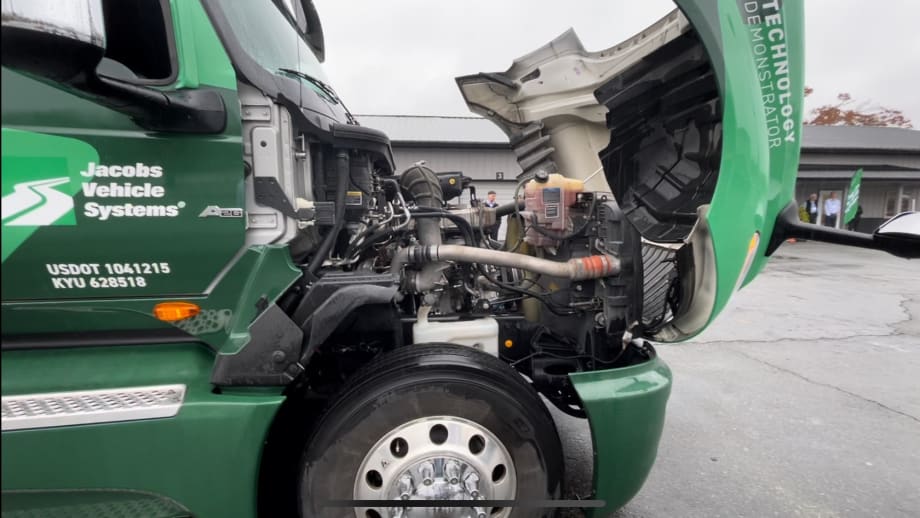
Cummins reports that its Jacobs cyinder deactivation system boosts heavy truck fuel economy by almost 3% in on-highway testing.
Photo: Jack Roberts
4 min to read
Cummins Valvetrain Technologies reports positive results from further on-road testing of its Jacobs cylinder deactivation (CDA) technology. CDA for diesel engines is a new powertrain technology. Cummins said its goal with CDA is to improve the environmental and economic performance of heavy-duty road vehicles.
Cummins says fuel savings of 2.76 percent were returned in the first SAE J1321 (Society of Automotive Engineers) standardized fuel consumption testing of Jacobs CDA. The test used fully loaded comparison trucks on a highway route in North America.
Similar tests on a distribution route returned fuel savings of 2%.
Emissions Reductions
Impending emissions legislation in North America (EPA 27) and Europe (Euro 7), which covers both NOx and CO2 emissions, are pushing engine designers harder than ever before in the search for greater efficiencies.
Working from a 2019 baseline, the EU will require a vehicle-by-vehicle 45% reduction in CO2 by 2030, a 56% reduction by 2035 and a 90% reduction by 2040.
The CDA system automatically shuts down selected cylinders in low engine load conditions. It does this by leaving cylinder inlet and exhaust valves closed throughout the four-stroke cycle, while their fuel injectors are deactivated. This reduces fuel consumption.
When additional engine braking is required, the same components that deactivate the cylinders are repurposed to provide vehicle retardation. This is done by using the latest 1.5-stroke High Power Density version of the Jake Brake compression release engine brake.
Toxic emissions are also reduced because CDA optimizes the efficiency of exhaust aftertreatment systems through thermal management. That’s because CDA increases exhaust temperatures at partial loads.
It also eliminates cooling during engine motoring, where tests also revealed a reduction in parasitic drag when the engine is in over-run, saving fuel. Shorter journey times were also reported.
How SAE Fuel-Economy Tests Were Conducted on the Truck
The tests were conducted using a 2018 International LT625 6x4 tractor unit. The truck was spec’d with a 13-liter Navistar A26 450 hp diesel engine and Eaton Endurant 12-speed overdrive automated manual gearbox, with a gross vehicle weight of 66,000lbs.
Tests were conducted over 12,000 miles in the fourth quarter of last year according to the SAE J1321 standard fuel economy protocol.
The truck was run multiple times both with and without CDA active via a dashboard switch. The truck recorded an average speed of 51 mph on the highway route, and 38 mph on the distribution route.
Every run saw the test truck accompanied by a comparable control vehicle with its fuel consumption also recorded, to provide a baseline to account for variations caused by external factors such as weather and traffic conditions.
The on-road, real-world results from a fully loaded truck follow the reporting by Jacobs of initial fuel economy improvements of up to 20% in dynamometer-based lab testing of an engine in idle mode in 2020. In that same lab test, 77% reduction in NOx was recorded on a low load cycle with a 2018 aftertreatment system.
While NOx emissions testing was not a focus for this latest road test, Cummins said, the test trucks had the same calibration compliance to EPA 2018 standards.
Cummins said it expects these results to further improve for future emissions requirements where the benefits of CDA thermal management are further utilized.
SCR Temperature Management
Cummins said CDA saves fuel by reducing the number of active cylinders to match the driver's real-time torque demand. The active cylinders have higher loads and temperatures, while the inactive cylinders have reduced parasitic losses.
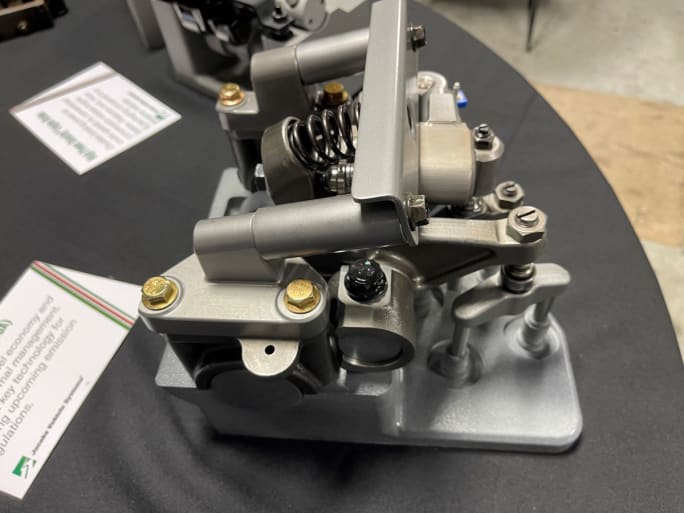
Cylinder deactivation technology saves fuel by reducing the number of active cylinders to match the driver's real-time torque demand.
Photo: Jack Roberts
The reduced airflow, and air-fuel ratio in the remaining active cylinders, help maintain exhaust system temperatures above the critical 250 degrees Celcius mark to allow efficient NOx conversion by the selective catalytic reduction module and continued passive regeneration of the exhaust PM filter.
On the highway tests without CDA, temperatures in the truck’s SCR unit fell below 250 degrees Celcius for over 15% of the journey time. But when CDA was used in concert with the Jacobs Engine Brake, Cummins said, SCR temperatures fell below 250 degrees Celcius only during the scheduled stops and trailer swaps.
On the distribution route, the mean temperature of the SCR unit was 243 degrees Celcius with CDA engaged; 16% above the figure recorded without cylinder deactivation.
Time spent with the SCR operating under 250 degrees Celcius was reduced by over 21% and SCR temperature with CDA only fell below 200 degrees Celcius for under two percent of the time compared to over 10% of the time in 6-cylinder mode.
Cummins’ on-road testing confirmed that, with optimized engine and cab mounts, noise vibration harshness levels were equivalent to the non-CDA-equipped standard engine and vehicle while at 600 rpm in idle, as measured at the driver’s seat.
Cummins Valvetrain Technologies has deployed CDA systems into over 20 development programs, with engines ranging from 2-liter to 16-liter. A number of programs have moved into the vehicle testing stage.
More Fuel Smarts
FlowBelow Redesigns Trailer AeroSlider to Cut Fuel Use
The lighter trailer aerodynamic system installs in less than 45 minutes, according to the company, with potential payback in under a year depending on fuel prices and trailer mileage.
Read More →
Why Diesel Price Relief Efforts May Fall Short
Diesel prices have eased from September’s record high, but doubts about additional Russian supply and limits on dyed-diesel tax relief mean trucking fleets still face expensive fuel. And prices could go higher.
Read More →
Why Small Fuel Savings Matter in Trucking
Can better fuel economy help pay for driver raises? In this podcast, GP Transco explains how small efficiency gains create room to reinvest in its people.
Read More →
How GP Transco Cuts Trucking Fuel Costs, a Tenth of a Gallon at a Time
What’s another tenth of a mile per gallon worth? GP Transco shares how equipment upgrades and driver coaching turn small gains into meaningful fuel savings.
Read More →
Electric Yard Tractors Move Beyond Pilots
Operating-cost savings have overtaken sustainability goals as the leading reason surveyed fleets are adopting battery-electric terminal tractors, according to new NACFE research.
Read More →
Geotab Links Fleet Card to Vehicle Data
The new card combines fuel discounts with telematics-based purchase controls. Geotab’s analysis also points to potential savings from choosing lower-priced fuel stops.
Read More →
Fleet Economics Shape Electric Truck Outlook
ACT Research expects costs, charging infrastructure, and technology improvements to drive zero-emission commercial vehicle adoption as federal regulations and incentives retreat.
Read More →
Wex Adds Cardless Fuel Payments for Over-the-Road Customers
A new fuel card feature for Wex customers offers convenience and security.
Read More →
New California Law Could Shed Light on Electric Truck Prices
Why do battery-electric Class 8 trucks remain so expensive? A California bill signed by Gov. Gavin Newsom would give fleets and state agencies more visibility into what manufacturers charge.
Read More →
How Volvo Updated Its D13 for EPA 2027 [Watch]
Volvo’s updated D13 promises lower emissions without sacrificing performance or fuel economy. Take a closer look at what changed inside the engine in this HDT Spotlight video.
Read More →