



More in this series:
Part 1: Understanding AI in Trucking
Part 2: The Ultimate 'Plug and Play' Technology for Trucking?
Part 3: Risks and Roadblocks Facing AI in Trucking
 MENU
MENU SEARCH
“Success in creating effective AI could be the biggest event in the history of our civilization — or the worst. We just don’t know.”
Will artificial intelligence destroy jobs in trucking?
Image: HDT Graphic
A decade ago, theoretical physicist Stephen Hawking told the BBC that “the development of full artificial intelligence could spell the end of the human race.” And this was before anyone had heard of ChatGPT.
Shortly before he died a few years later, Hawking had tempered that somewhat. He likened AI to a new technology revolution on par with the industrial revolution.
“Success in creating effective AI could be the biggest event in the history of our civilization — or the worst. We just don’t know.”
Some of the problems that have been identified with large-language-model AI such as ChatGPT include:
Whenever artificial intelligence is discussed, there’s always concern that it will take away peoples’ jobs.
Recent research from MIT found that while one type of AI, computer vision, might be able to perform a task, it may not make economic sense for companies to replace humans performing those tasks.
A study from OpenAI, makers of ChatGPT, estimated that 19% of U.S. workers could see 50% of their workplace tasks “impacted” by GPT-4 level systems.
But “impacted” doesn’t automatically mean “laid off.” Those in trucking who have been involved in implementing AI stress that these tools should free people from mundane and repetitive tasks and give them time to do the things that computers can’t.
“If you have someone just rubber-stamping something all day long, there are plenty of things not being done,” said Dwight Bassett, president of the Boyd Companies, during a panel discussion at a recent McLeod Software AI summit.
“Let’s repurpose that person somewhere else and automate that mundane, repetitive stuff.”
If AI can help manage incoming emails and insight into rates, brokers or fleet salespeople can spend more time dealing with exceptions and building relationships with customers instead of scrambling to cover last-minute loads.
Dispatchers can give truck drivers the personal touch they need to make them feel they’re not just a number, if AI is handling the complex tasks of matching drivers to loads and route optimization.
John Sutton, director of corporate strategy for broker Sunset Transportation, said in the McLeod panel discussion that while some very large shippers want high levels of automation, others are pushing back against using “bots” to totally automate the process.
Instead, he said, the goal of AI for his team is “to make your job as easy as possible so you are always there to pick up the phone for a client. A lot of our large competitors are hemorrhaging clients because they don’t do that anymore.”
For all the potential promise of AI in trucking, there are some real stumbling-blocks that may hamper its wider implementation in the industry.
“Transportation data sucks,” Sutton said bluntly.
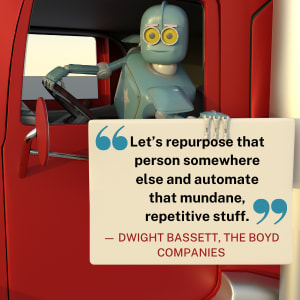
“We look at banking, healthcare and other industries; their data is very structured because it’s very regulated,” Sutton explained. “In other industries, like retail, their data is very vertical but very narrow.
“Our data is very wide, very ugly, and very polluted. So the learning models have a difficult time in our space. We’re not going to be able to coach our customer and carrier partners through providing better data, because they’ll work with someone who isn’t placing that arbitrary restriction on them.”
Boyd’s Bassett said, “Change is a big deal."
“I’ve looked at a lot of small and mid-sized carriers in the last 20 years, and I’m amazed at the differences in technology, how some people process transactions and how some people use automation.
“And a lot of it’s changed. It’s available and it’s affordable, but people just don’t want to do it, there’s that fear. So I think managing change is going to be a big obstacle.”

The new card combines fuel discounts with telematics-based purchase controls. Geotab’s analysis also points to potential savings from choosing lower-priced fuel stops.
Read More →
Multi-factor authentication adds protection when passwords are stolen. Here’s how it works and where fleets should start.
Read More →
Trucking and logistics teams have plenty of data. The problem is getting the right information in front of the right people soon enough to act. Better-connected data can help teams spot trouble earlier and make smarter decisions before small problems become big ones.
Read More →
At Insight 2026, Trimble executives argued that fleets may need to redesign workflows to get more from AI as it introduced new products and enhancements. AI’s value will depend on how fleets combine automation with their people's knowledge.
Read More →
An ELD can prove compliance, but it cannot always prove what happened on the road. Discover how uniting accurate ELD data with AI-powered dash cam video can help your fleet strengthen compliance, defend against liability, protect drivers and reduce operational costs.
Read More →
Heavy Duty Trucking is looking for accomplished trucking fleet professionals under 40 who are making an impact and helping lead the industry forward.
Read More →
Private fleets are putting their own trucks on demanding customers and high-cost lanes as companies seek greater control over service, costs, and capacity.
Read More →
For fleet managers and collision repair professionals keeping heavy-duty trucks on the road, getting the color right the first time isn't just about appearance — it's about efficiency, turnaround time, and bottom-line results. Discover how today's digital color tools are transforming the repair process from guesswork to precision.
Read More →
Carriers whose updates were due on or after June 1 have more time, while FMCSA works to stabilize its new registration system and warns of phishing sites impersonating its new carrier registration system, Motus.
Read More →
Cargo theft is no longer just the cost of doing business. It's a multi-billion-dollar criminal enterprise exploiting vulnerabilities across your fleet, drivers, and supply chain.
Read More →