More in this series:
Part 1: Understanding AI in Trucking
Part 2: The Ultimate 'Plug and Play' Technology for Trucking?
Part 3: Risks and Roadblocks Facing AI in Trucking
Part 4: What Can Artificial Intelligence Do For Trucking Fleets?
 MENU
MENU SEARCH
In Part 2 of HDT's "Rise of the Robots" series on artificial intelligence in trucking, we look at how easy AI is to use — in fact, you've probably already been using it for years.
You may already be using artificial intelligence in your trucking operations.
Image: HDT Graphic
Although artificial intelligence has been all the rage in the media and in headlines lately, the fact is, you've been using AI for years.
That's because the technology is incredibly easy to use. Moreover, because it "learns" what you need and want it to do, it very quickly anticipates those desires, and carries them out without any prompting from a human user.
“There is virtually no learning curve for engaging in AI, and most people are already engaging with the technology without even realizing it,” says Anar Mammadov, technical co-founder, last mile, supply chain and logistics, Senpex, which develops same-day and on-demand delivery solutions for e-commerce and wholesale businesses.
“If you have allowed your email program to make suggestions for you about how to draft messages, you have engaged with AI.”
AI has been working its way into our technology and our lives for years, and it has reached a point where it is capable of taking on an even bigger role in helping us work better.
But what does that look like in the fleet management world?
“Generally speaking, AI gives trucking software the ability to make valuable decisions without human involvement,” Mammadov says. “It also has the potential to increase its understanding of topics — and, consequently, improve the effectiveness of its decision-making — with each engagement."
For the most part, AI is very much a “plug and play” kind of technology, according to Stefan Heck, founder and CEO of Nauto, a developer of fleet software safety management systems.
“With most AI systems now, you just plug them in and let them run,” Heck says. “Using these programs is pretty straightforward.”
That’s because AI works behind the scenes in a computer program to analyze data and look for anomalies.
“Route optimization is a good example of that,” Heck says. “AI can gather data about traffic in an entire city in real time and warn you about hazards you don’t know anything about. And that’s the beauty of AI. You don’t have to do anything to reap those benefits.”
As an example, Alan McMillan, president of software developer Intangles, points to his company’s AI-powered diesel particulate filter management system. Using AI, the DPF management system relies on mathematical equations, or algorithms, designed and written by scientists and engineers, to leverage massive data at scale that can help to solve complex problems quickly and accurately.

“The better the algorithm(s) and the faster a computer system’s ability to perform and process calculations, the more accurate the results,” McMillan explains.
“As the speed of data processing, scale of data, quality of data and the accuracy of the algorithms developed by humans improves, we reach a point where we can actually predict outcomes," he says. "So, AI can help the trucking industry by predicting outcomes before they occur.”
One of the most widespread uses of artificial intelligence in trucking today is the latest generation of in-cab cameras. Forward-using cameras can use AI to help distinguish whether an "event" captured by on-board systems was the driver's fault. Inward-facing cameras are being used to detect drowsy and distracted driving.
Dwight Bassett, president of the Boyd Companies, comes from a deep technology background.
"We’ve had in-cab cameras five years. The latest wave is using AI technology to capture distracted driving," he says. With inward-facing cameras, the AI technology can figure out, for instance, "if guys are texting even if we can’t see the phone" in the camera's field of view.
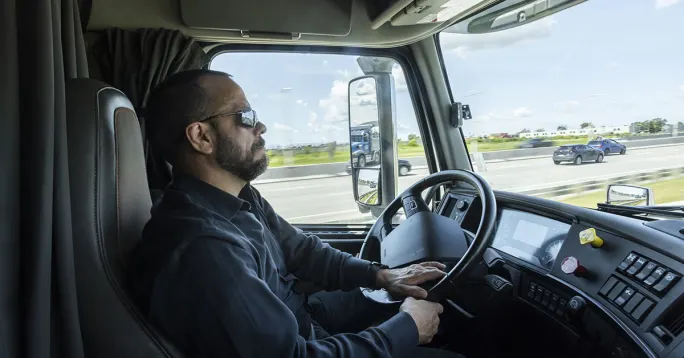
Artificial intelligence is bringing new capabilities to in-cab cameras.
Photo: Isaac
Thanks to highly capable telematics and management systems in use today, fleet maintenance is one of the easiest AI management capabilities for most trucking managers to grasp.
“Predictive maintenance” has been a goal of savvy maintenance managers for decades. With AI, we have the opportunity to crunch the huge amounts of data available today and give fleets real-time, actionable insights.
“By analyzing data provided by telematics, AI can determine what conditions were present when breakdowns or other failures occur and monitor for those conditions in the future,” says Mammadov.
Used this way, he says, AI can lead to the development of more effective maintenance schedules, which can improve component life. Predictive analytics can also support automated parts ordering, ensuring inventory is optimal based on ongoing patterns of repairs.
Traditionally, preventive maintenance has been largely limited to scheduled maintenance, McMillan says.
“This can be inefficient in the long run, as it doesn't account for real-world usage conditions of the asset,” he says. “Predictive AI driven by real-time telemetry streams can bridge this gap.”
Machine learning models can make articulate recommendations on component-level wear and tear for critical powertrain systems, he says. AI comments on this component degradation allows for corrective maintenance action to prevent catastrophic failure.
For instance, the ability to profile a derating coolant pump, a malfunctioning turbo wastegate or a particulate filter that doesn’t regenerate effectively can help prevent catastrophic engine block failure in the long run, McMillan says. This helps reduce maintenance costs and improve uptime.
Artificial intelligence has the abilty to handle repetitive tasks that humans just aren’t very good at doing.
“AI will do for paperwork what automation did for assembly lines years ago,” Heck says. “And eventually it will do the same for long-haul automated trucks.
“We often forget that humans don’t want any old job," he says. "They want a job that is interesting to do. An AI really does a lot of the behind the scenes for you. So, you can have a cup of coffee, mind the shop and focus on bigger things.”
HDT's Deborah Lockridge contributed to this story.

The new card combines fuel discounts with telematics-based purchase controls. Geotab’s analysis also points to potential savings from choosing lower-priced fuel stops.
Read More →
Multi-factor authentication adds protection when passwords are stolen. Here’s how it works and where fleets should start.
Read More →
Trucking and logistics teams have plenty of data. The problem is getting the right information in front of the right people soon enough to act. Better-connected data can help teams spot trouble earlier and make smarter decisions before small problems become big ones.
Read More →
At Insight 2026, Trimble executives argued that fleets may need to redesign workflows to get more from AI as it introduced new products and enhancements. AI’s value will depend on how fleets combine automation with their people's knowledge.
Read More →
An ELD can prove compliance, but it cannot always prove what happened on the road. Discover how uniting accurate ELD data with AI-powered dash cam video can help your fleet strengthen compliance, defend against liability, protect drivers and reduce operational costs.
Read More →
Heavy Duty Trucking is looking for accomplished trucking fleet professionals under 40 who are making an impact and helping lead the industry forward.
Read More →
Private fleets are putting their own trucks on demanding customers and high-cost lanes as companies seek greater control over service, costs, and capacity.
Read More →
For fleet managers and collision repair professionals keeping heavy-duty trucks on the road, getting the color right the first time isn't just about appearance — it's about efficiency, turnaround time, and bottom-line results. Discover how today's digital color tools are transforming the repair process from guesswork to precision.
Read More →
Carriers whose updates were due on or after June 1 have more time, while FMCSA works to stabilize its new registration system and warns of phishing sites impersonating its new carrier registration system, Motus.
Read More →
Cargo theft is no longer just the cost of doing business. It's a multi-billion-dollar criminal enterprise exploiting vulnerabilities across your fleet, drivers, and supply chain.
Read More →