




Truck Driver Charged in Texas School Bus Crash Was Prohibited from Driving for Drug Testing Violations
A truck driver who killed two people and injured dozens in a fatal head-on crash with a school bus has been arrested and charged with criminally negligent homicide, as well as ordered to cease operations by the Federal Motor Carrier Safety Administration following a history of illegal substance abuse.

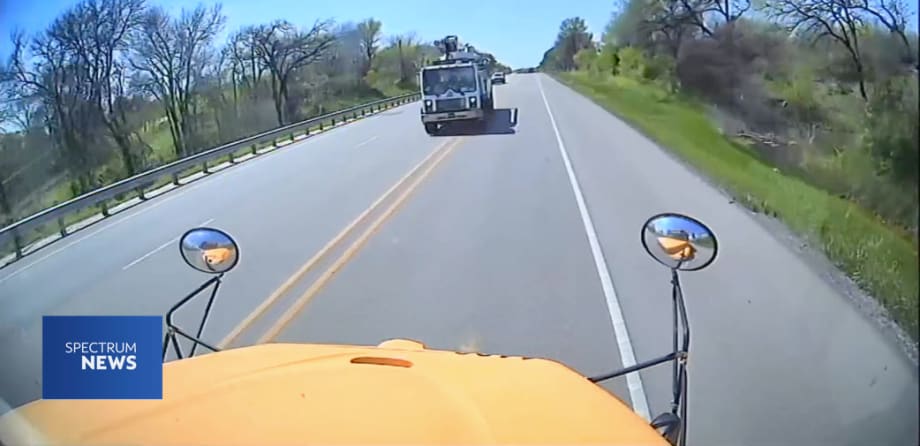
This screen shot from video released by the school district shows the concrete truck crossing the center line before the fatal crash.
School district video
A truck driver who killed two people and injured dozens in a fatal head-on crash with a school bus has been arrested and charged with criminally negligent homicide, as well as ordered to cease operations by the Federal Motor Carrier Safety Administration following a history of illegal substance abuse.
On March 22, Jerry Hernandez was driving a large concrete pumping truck for FJM Concrete Pumping LLC on State Highway 21 in Bastrop County, Texas, when he crossed the center line and hit an oncoming school bus. The bus was transporting dozens of children ages 4-6 and adults who were returning to school from a field trip. He also struck another vehicle that was following the school bus.
The school bus flipped over onto its side and came to rest in the opposite direction it had been traveling. A 5-year-old child was killed, the 33-year-old driver of the car behind the bus was killed, and dozens of passengers were injured. Some had to be airlifted by helicopter to the hospital.
Following the crash, Hernandez refused to consent to controlled substance testing. Later, a warrant to conduct controlled substance testing was issued. At that point he admitted to law enforcement that he had used marijuana the night before the crash, only got three hours of sleep, and used cocaine in the early morning hours the day of the crash.
While being questioned in the hospital, according to news reports, troopers say Hernandez seemed unaware of the magnitude of the crash and didn’t mention striking the school bus.
FMCSA: 'Blatant Violations'
FMCSA declared Texas-licensed commercial driver Jerry Hernandez to be an imminent hazard to public safety and ordered him to immediately cease operating any commercial motor vehicle in interstate or intrastate commerce, citing his “blatant violations of the FMCSRs and disregard for the safety of the motoring public.”
According to published reports, Hernandez also had a criminal history, including being arrested in 2006 for driving on a suspended license and was arrested twice in 2023 for domestic violence.
Hernandez Was Driving Illegally
Drivers with a commercial driver’s license are subject to a variety of prohibitions on use of controlled substances and must successfully complete a lengthy return-to-duty process following any positive drug test.
Prior to the crash, Hernandez had been prohibited from operating CMVs three times for drug use. At the time of the crash, he was prohibited from operating commercial motor vehicles based on an April 2023 positive drug test which revealed he had been using cocaine.
Hernandez was listed as “prohibited” in FMCSA’s Drug and Alcohol Clearinghouse. However, according to news reports, the owner of the company Hernandez was working for, FJM Concrete LLC, had not verified his status in the clearinghouse before hiring him.
It is unclear whether FJM verified the status of his CDL, but under a loophole, it is quite possible that the state reported that Hernandez had a valid license.
In 2021, FMCSA published a final rule designed to make sure commercial drivers who are prohibited from driving because of drug and alcohol program violations don’t get or keep their commercial driver’s license. The rule establishes requirements for state driver’s licensing agencies to use information through the federal Drug and Alcohol Clearinghouse.
Compliance with the rule is required by Nov. 18, 2024.
FMCSA is working with the state of Texas to disqualify Hernandez's commercial driver’s license.
History of Failed Drug Tests
In September 2020, Hernandez refused a required reasonable suspicion controlled substances test after having told his employer that he had recently used illegal drugs and would test positive. Afterward, he did seek treatment from a substance abuse professional.
But in December 2022, he tested positive for marijuana on a follow-up controlled substances test ordered by the substance abuse professional.
Subsequently, he sought treatment from a substance abuse professional again.
In April, 2023, Hernandez tested positive for cocaine on a follow-up controlled substances test ordered by the substance abuse professional. He sought treatment after testing positive, according to FMCSA, but he failed to complete a required treatment plan.
More Details on the FMCSA's Imminent Hazard Order
Before Hernandez may operate a commercial motor vehicle in intrastate or interstate commerce, he must complete the return-to-duty process outlined in the federal controlled substances regulations, and provide evidence to demonstrate compliance with the FMCSRs to the FMCSA Western Service Center Field Administrator.
Failing to comply with the provisions of the Federal Imminent Hazard Disqualification Order may result in civil penalties of up to $6,974. Knowing and/or willful violations may result in criminal penalties.
More Safety & Compliance

FMCSA Pauses Biennial-Update Enforcement Amid Motus Transition
Carriers whose updates were due on or after June 1 have more time, while FMCSA works to stabilize its new registration system and warns of phishing sites impersonating its new carrier registration system, Motus.
Read More →
ZF Expands Commercial Vehicle Push in North America
ZF is expanding its North American commercial-vehicle presence with new transmission applications, electrification, trailer technology and autonomous-driving systems.
Read More →
Truck Drivers Need More Than Another Alert
Fleets have more visibility into truck health, safety events, and driver activity than ever. The next challenge is turning all that information into useful guidance for the person who has to decide what to do next.
Read More →
Tesla Wants a Self-Driving Semi. Are Cameras Enough?
Could Tesla’s camera-only autonomous driving technology work on an 80,000-pound Semi? In this commentary, HDT's Deborah Lockridge takes a look at Tesla, Cybercab, and how autonomous trucks see the road.
Read More →
What DOT’s Automated Vehicle Strategy Means for Trucking
The U.S. Department of Transportation issued a new automated-vehicle strategy that outlines plans for driverless-truck regulations, cross-state freight corridors, and federal safety standards.
Read More →
NYC Expands Speed, Pedestrian Safety Tech Across Fleet
New York City is expanding intelligent speed assistance and pedestrian-alert systems across its municipal fleet, moving the technologies from pilot programs into vehicle procurement and retrofit requirements.
Read More →
FMCSA Removes 110 Truck Driver Training Schools from Certified ELDT List
Federal regulators also are targeting more than 160 additional training providers and launching a nationwide audit of third-party CDL skills testers as part of a broader crackdown on trucking fraud.
Read More →
Beyond DOT Compliance: What Makes a Trucking Fleet Truly Safe?
A trucking fleet can follow every rule and still make unsafe decisions. The real test comes when safety conflicts with freight, productivity, or cost.
Read More →
Hours of Service Pilot Programs: FMCSA Readies for 2027 Rollout
Two pilot programs could eventually reshape hours-of-service rules, giving truck drivers options to pause their 14-hour clock or use longer split sleeper rest periods.
Read More →
New Guide Offers Pet Safety Tips for Truck Drivers
Hundreds of thousands of pets travel in truck cabs. A new safety guide from Volvo Trucks and the Center for Pet Safety offers practical advice for truck drivers who bring dogs and cats along for the ride.
Read More →