





Listen: Can We Prevent Another Lakewood, Colorado Mountain Crash?
Q&A: Road-Aware's Bullock on Ending Truck Rollovers, Downhill Runaway Trucks
Brian Bullock, founder of Road-Aware Safety Systems, believes better training and new technology could end truck rollovers forever.
March 13, 2024
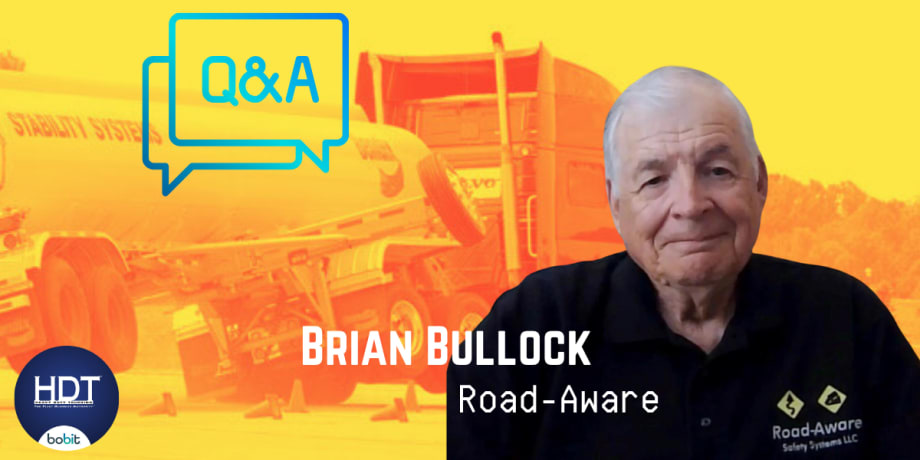
Brian Bullock and his company, Road-Aware, have developed an in-cab tool to help alert drivers to threats that exist in tricky driving situations.
Photo: Jim Park
8 min to read
Can more be done to reduce the number of truck rollovers and truck runaway incidents? Both kinds of incidents are related to vehicle dynamics. In the case of rollovers, drivers probably exceed the tip threshold of the truck because they are unaware of the effects of high centers of gravity in turn. With downhill runaway trucks, drivers seem to be unaware of how to safely manage descent speed to prevent overheating their brakes.
There's a training component to both of these, but Brian Bullock and his company, Road-Aware, have developed an in-cab tool to help alert drivers to the threats that exist in this tricking driving situations.
Using 3-D mapping, precise GPS geolocation, and the characteristics of the actual vehicle being drive, Road-Aware can alert drivers to potential roll-over or run-away before they even hit the curve or the hill.
I spoke with Brian Bullock, the founder of Road-Aware Safety Systems, on a recent episode of HDT Talks Trucking. This Q&A features highlights from that interview. You can listen to the full episode on our website or on watch it on YouTube.
HDT: We'll talk about the rollover incidents in a minute, Brian. Let's start with downhill runaway incidents. Why are they still happening with all our advanced equipment? Do drivers fundamentally not understand how to descend long grades with heavy loads?
Bullock: I recently attended a safety meeting in Colorado where they do find that the majority of their mountain crashes are happening with out-of-state drivers. So, part of the problem is, drivers that have had not had experience in severe terrain come into mountains the first time and they don't recall their CDL training.
And most of them have probably not taken a high school physics class, so they don't understand how much kinetic energy has to be dissipated by their brakes on a long descent. An 80,000-pound truck making a 1,000-foot descent has to dissipate 10 times more energy than a truck has traveling at 60 mph. And you've got to dissipate that carefully. Otherwise, you absolutely will burn your brakes out.
HDT: In your opinion, is mountain driving taught well enough in CDL school? Should new drivers be taught the basic physics of vehicle dynamics?
Bullock: It's not, unfortunately. A friend just completed CDL school here in Arizona. He had a 20-year career in law enforcement and wanted to have another career driving. He approached it with a bias towards safety, because he'd seen so many crashes on the highways during his years in law enforcement.
Unfortunately, there was no instruction about safe driving in mountains. They were not taken even for half a day, even though there are mountains right here next to Phoenix. I think there's a real disconnect there.
I don't think drivers are taught that not only is there a huge amount of energy that needs to be dissipated, but as you heat up your brake pads, you get expansion of the brake drums and so on. This decreases the brake effectiveness.
Drivers probably aren't aware of the relationship between brake temperature and brake effectiveness. At some point, usually around 600 or 700 degrees, depending on the make or brake lining composition, effectiveness plummets 70 or 80% to 10 or 15%. Just another 50 degrees can make all the difference.
HDT: You mentioned Arizona; what about Colorado? Do they offer comprehensive mountain training in their schools?
Bullock: They do not. That's mind-boggling. I think part of the problem is drivers are trying to get qualified, get their CDL and get on the road so they can start making money. And trucking companies are not insisting on any kind specific training before they put them on the road. As a result, it gets overlooked.
Almost every driver I've talked to say they either figured it out for themselves after listening to other drivers talk about it. Or they've had that gut-wrenching moment where they're going down a hill too fast and all sudden their brakes were not effective.
HDT: How does Road-Aware work? How does that help a driver during a long descent?
Bullock:Right now, it's an app that you can use on a smartphone or a tablet, but we hope to be able to release that as part of an ELD ecosystem early this year. You need a separate device, it'll just run in the background on an ELD.
It uses a 3-D road set, not a 2-D road set. It knows the elevations and slopes. In addition to that, we insert the braking horsepower of the engine and the weight of the truck, because those are the two factors that have to be in the system in order for it to calculate the safest descent speed.
When we get Road-Aware integrated, it will be able to detect weight and engine parameters, but for now, the driver is asked for simple inputs: the tractor, the engine brake setting, and the load. Everything else is calculated for him.
The driver sees a green, yellow, red sequence starting about 1,000 feet before the hill. It will alert the driver that he's approaching a descent and show a recommended speed specific to that truck at that location. And then as he gets closer, it'll turn yellow, and he'll get an audible warning. If the recommended safe speed is, say, 32 mph, if it doesn't slow down to that speed, it'll turn red.
Meanwhile, it's recording the speeds and so he'll get an upload to the cloud and a trip summary at the end of the trip, like many other systems do now. But what's unique about our system is that it's not comparing posted speeds. It is comparing against a recommended safe speed for that very truck on that grade and descent.
HDT: Now, let's talk about rollovers. This is a situation where the vehicle stability threshold is exceeded for one reason or another. Can you give us a bit of background on how rollovers occur and why we see so many of them around the country every year?
Bullock: Rollovers are much more common than runaways. Most often you'll see them on connector ramps, exits, and roundabouts, and sometimes even on gentle curves with unstable loads, like a livestock trailer or a tanker for example.
They are usually single-vehicle crashes, but the concerning thing is that rollovers are often fatal for the driver. So, drivers have a vested interest in managing their vehicles in curves, on connector ramps and other geometries where the side force on the trailer is going to put the vehicle at risk.
HDT: Again, we have what I would call a driver training or driver awareness issue. Every load is different. So, you really can't get into the physics for every load you're hauling. But do drivers understand, generally, that taller loads with higher centers of gravity are more susceptible to this kind of behavior? Or does that come as a surprise to them?
Bullock: I think they do, Jim, but I don't think they understand the magnitude. The fact that the overturning force varies as the square of the speed — not directly with speed. So, a doubling of speed on the same curve is four times the overturning force. I don't think they're aware of that.
They don't also know that their tractor is about twice as stable as the trailer. In other words, with an average load, most tractors can take 0.7 to 0.8 G's laterally in the corner and not roll. Trailers, on the other hand, will roll at 0.3 Gs.
And the other thing they don't realize is that a driver feels fairly comfortable at 0.2 to 0.3 Gs.
So, if you go into the mountains and watch people driving their passenger cars, they'll drive them in curves at speeds that produce 0.3 to 0.35 Gs. After that, it gets a little uncomfortable and they start getting pushed around a little.
That means that the truck driver is not getting much seat-of-the-pants feel when the trailer is already unstable. By the time he does gets some seat-of-the-pants feel, it's probably beyond recovery.
Road-Aware provides an advanced warning to have the driver slow down before he gets to the curve. We also provide enough headroom in the calculated safe speed to make an adjustment or maneuver during the curve.
HDT: You don't know you're rolling until you're past the point of no return.
Bullock: Exactly right. And the margins are really small.
There's a set of roundabouts on U.S. Route 93 near Phoenix in a town called Wickenburg. The safe drivers go through those roundabouts at 15 mph, while the risky drivers are going through at 20. It's only 5 mph, but it's enough to tip you over. The tip-over threshold speed is 23 mph, so at that point, you're right on the edge.
We've coached a number of drivers where we asked them, do you really want to be driving within 2 mph at the tip-over threshold? And none of them do. But they were totally unaware that they were that close. Once we explain it to them, it's really heartwarming to see them slow down.
HDT: How does the Road-Aware App work in curves?
Bullock: With curve speeds, it has less to do with the weight of the trailer and more to do with the height of the center of gravity. That's the variable we have to insert. We input the type of trailer. If it's flatbed hauling rebar, you can go through at 0.4 or 0.5 Gs. If it's a dry van loaded with something tall and heavy, a load of soda for example, where the center of gravity is halfway between the deck and the top of that vehicle, the tip-over threshold in G forces is about 0.25 or 0.22. That's where you really have to be careful.
I saw a rollover recently on Interstate 15 in Utah, which I've driven many times and I thought man, there's no curve there sharp enough to cause a rollover, and the curve radius was 1,200 feet. But sure enough, for a livestock load the tipover speed was 57 mph. He was travelling at probably 65, and he rolled that thing right on top of a Nissan driving right behind him.
There were three guys in the Nissan. Fortunately, they all ducked, and they avoided being hurt. But they're trapped under a bunch of panicky cows for an hour. Nobody was more surprised than that driver was, but properly calibrated, the Road-Aware app would have warned him to slow down for even that shallow curve.
Subscribe to Our Newsletter
More Safety & Compliance
Sponsored•October 6, 2026
A Camera Isn't a Safety Program. Here's What Brokers Are Screening for Now
Footage alone may not be enough to pass broker vetting processes. Here's what counts as a defensible safety program now.
Read More →
Marijuana and Trucking’s Drug-Testing Dilemma
Marijuana is getting stronger, laws are changing, and drug tests still can’t reliably establish impairment. What does that mean for truck drivers and the fleets that employ them?
Read More →
PrePass, Kodiak Connect Driverless Trucks to Roadside Enforcement
The system will allow enforcement agencies to verify Enhanced Inspection information and decide whether Kodiak’s autonomous trucks can bypass roadside screening sites.
Read More →

From One Generation to the Next: How Mentorship Builds Safer Truck Drivers
After three decades in trucking, Harold Perry shares what he's learned about driver safety, mentorship, and helping the next generation build confidence behind the wheel.
Read More →
FMCSA Pauses Biennial-Update Enforcement Amid Motus Transition
Carriers whose updates were due on or after June 1 have more time, while FMCSA works to stabilize its new registration system and warns of phishing sites impersonating its new carrier registration system, Motus.
Read More →
ZF Expands Commercial Vehicle Push in North America
ZF is expanding its North American commercial-vehicle presence with new transmission applications, electrification, trailer technology and autonomous-driving systems.
Read More →
Truck Drivers Need More Than Another Alert
Fleets have more visibility into truck health, safety events, and driver activity than ever. The next challenge is turning all that information into useful guidance for the person who has to decide what to do next.
Read More →
Tesla Wants a Self-Driving Semi. Are Cameras Enough?
Could Tesla’s camera-only autonomous driving technology work on an 80,000-pound Semi? In this commentary, HDT's Deborah Lockridge takes a look at Tesla, Cybercab, and how autonomous trucks see the road.
Read More →
What DOT’s Automated Vehicle Strategy Means for Trucking
The U.S. Department of Transportation issued a new automated-vehicle strategy that outlines plans for driverless-truck regulations, cross-state freight corridors, and federal safety standards.
Read More →
NYC Expands Speed, Pedestrian Safety Tech Across Fleet
New York City is expanding intelligent speed assistance and pedestrian-alert systems across its municipal fleet, moving the technologies from pilot programs into vehicle procurement and retrofit requirements.
Read More →