




Mesilla Valley Says Range Energy Trailers Deliver 36% Fuel Economy Boost
Range Energy said preliminary third-party testing conducted by Mesilla Valley Transportation Solutions showed its electric-powered trailers can boost tractor-trailer fuel economy by more than 3 mpg.

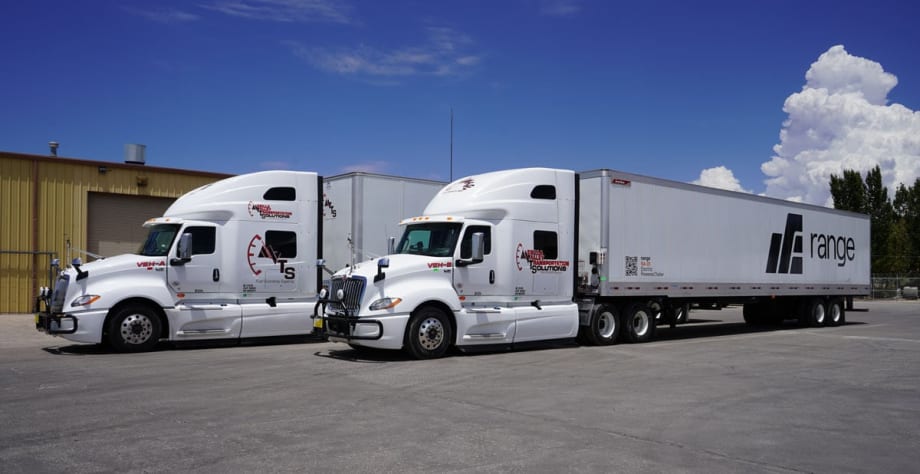
Mesilla Valley Testing Solutions said Range Energy electrified trailers enabled a 36% boost in fuel economy compared to semis pulling non-powered trailers.
Photo: Range Energy
Range Energy, a developer and manufacturer of electric-powered trailers, said third-party testing showed that its technology boosts semi-truck fuel economy by more than 3 mpg.
The company cited preliminary testing that showed its technology enables up to 36.9% fuel efficiency gains (+3.25 mpg) for semi-trucks.
In May, Range unveiled a 53-foot full-scale electric trailer, RA-01, which it called the first of Range’s RA Series of vehicles. The trailer’s electrification platform and equipment set — an e-axle, battery pack, and smart kingpin — provides power to auxiliary devices, enables zero-emission precooling for transportation refrigeration units, and provides the ability to move trailers with reduced emissions.
Technology Can Reduce Fuel Use or Extend EV Range
The fuel economy testing was conducted by Mesilla Valley Transportation Solutions, a company that provides testing and design and development services for the trucking industry.
The testing was conducted on a 25.5-mile urban/highway loop at approximately 59,000 lbs. GVW and 60 mph top speeds across multiple scenarios, including stop/go and steady-speed portions.
Daryl Bear, COO, MVT Solutions, said the technology demonstrates meaningful progress toward rapidly reducing the emissions of the commercial trucking sector. He said the trailers can also help fleet operators meet emerging emissions reductions targets and bring down their cost-per-mile regardless of their duty cycle.
“Achieving 36.3% efficiency improvements proves to the trucking industry how important and overlooked trailers are to enhancing efficiency and lowering emissions for our industry,” said Ali Javidan, CEO and Founder, Range Energy. “We anticipate these numbers will only improve as we begin testing with production quality parts versus prototype components,”
“We were impressed with the Range trailer,” added Bear. “Whether a fleet wants to reduce fuel usage or increase BEV range, this system provides unique opportunities over a traditional trailer – and by a large amount when considering it achieved 36.3% fuel savings. Our drivers also liked the Range trailer; reporting it pulled easier and felt lighter.
"Naturally, there is a trade-off with electric charging and additional weight, so it may not suit every fleet, but for those considering the EV direction, Range is worth talking to.”
Range Energy was founded in 2021 and is led by a team with deep EV industry expertise from Tesla, Zoox, Honda, and others. The company is backed by investors such as UP Partners, R7, and Yamaha Motor Ventures.
More Fuel Smarts

New California Law Could Shed Light on Electric Truck Prices
Why do battery-electric Class 8 trucks remain so expensive? A California bill signed by Gov. Gavin Newsom would give fleets and state agencies more visibility into what manufacturers charge.
Read More →
How Volvo Updated Its D13 for EPA 2027 [Watch]
Volvo’s updated D13 promises lower emissions without sacrificing performance or fuel economy. Take a closer look at what changed inside the engine in this HDT Spotlight video.
Read More →
Diesel Price Spike Shortens Payback for Natural Gas Trucks, Report Says
Energy Vision estimates fleets could recover the higher purchase price of an RNG-fueled Class 8 tractor in 1.3 to 2.8 years under current fuel-price scenarios.
Read More →

Calstart Becomes Catalyst Mobility, Reflecting Broader Focus
Calstart is now Catalyst Mobility, reflecting the nonprofit’s growing national role in clean transportation, including zero-emission trucks, infrastructure and incentive programs.
Read More →
Record Diesel Prices Squeeze Trucking Fleets
Average U.S. diesel prices have climbed to nearly $6 a gallon, surpassing the 2022 record as tight refinery capacity and Middle East disruptions keep fuel costs elevated.
Read More →
How Fuel Delivery Shapes Engine Performance
Fuel delivery depends on more than what happens at the injector. For fleet, maintenance and technical professionals, looking at the full path from pump to injector can provide useful context for understanding engine performance.
Read More →
East Coast Port Launches $45M Electric Truck Push
The Port Authority of New York and New Jersey announced millions in incentives for zero-emission drayage trucks, yard tractors, and new charging hubs near the port.
Read More →
Detroit Opens Orders for EPA 2027 Engines
Detroit isn’t starting from scratch to meet EPA 2027 diesel emissions standards. Its Gen 6 DD13 and DD15 engines keep much of today’s platform while updating the fuel and aftertreatment systems.
Read More →
Zero-Emission Truck Corridor Planned for West Coast
California, Oregon, Washington, British Columbia and Baja California are coordinating plans for truck charging and hydrogen fueling from Canada to Mexico.
Read More →
A Closer Look at Kenworth’s Electric T880E Vocational Truck [Video]
Learn more about Kenworth's T880E battery-electric vocational truck at the Paccar Technical Center, including its range, applications, upfitting considerations, and PTO options, in this HDT Spotlight video.
Read More →