




Coca-Cola Bottler Gets First Heavy-Duty EVs for California Trucking Fleet
Daimler Truck North America has delivered 20 zero-emission, battery-electric Freightliner eCascadia Class 8 tractors to Reyes Coca-Cola Bottling,

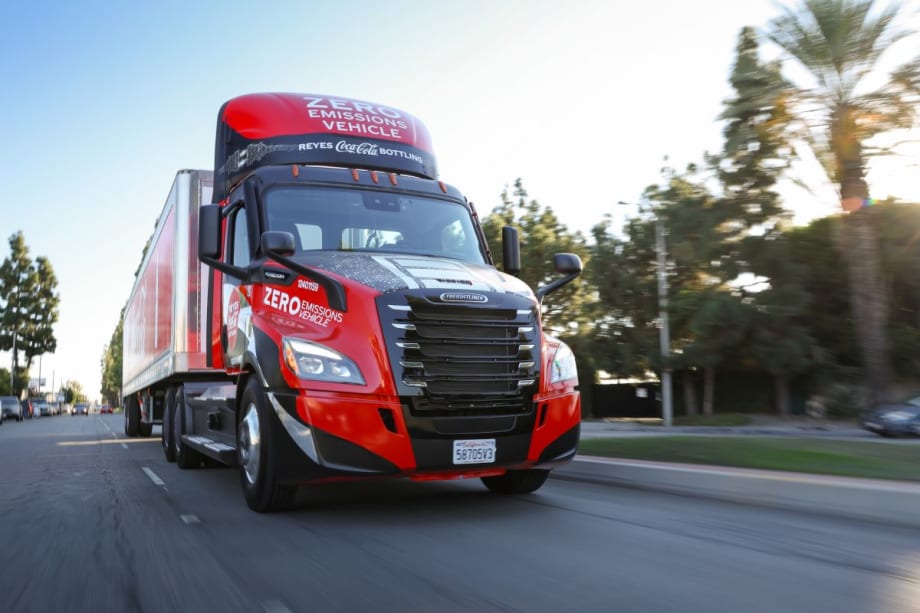
Reyes Bottling's 20 new eCascadia tractors are the first zero-emission heavy-duty tractors added to their California fleet.
Photo: Daimler Truck North America
Daimler Truck North America has delivered 20 zero-emission, battery-electric Freightliner eCascadia Class 8 tractors to Reyes Coca-Cola Bottling, a West Coast and Midwest bottler and distributor of Coca-Cola brands.
According to Daimler, these electric vehicles will join RCCB's fleet of delivery trucks in Downey, California. They represent the bottler’s first zero-emission heavy-duty tractors added to its California fleet.
RCCB’s eCascadias will rely solely on 20 Detroit eFill commercial charging stations that have been installed at the Downey facility. To complement the charging stations, RCCB is using the Detroit Charger Management System, a software solution providing a comprehensive view of their electric fleet, which enables efficient energy management to ultimately reduce operational costs.
Working closely with Detroit eConsulting, a team of emobility experts dedicated to helping fleets electrify, RCCB found the best site design and ways to integrate the eCascadias into its fleet.
“Our collaboration with Reyes Coca-Cola Bottling marks a significant milestone in promoting sustainable transportation,” said David Carson, senior vice president, sales and marketing, DTNA. “The integration of Freightliner eCascadias into RCCB's fleet showcases that business and environmental responsibility can go hand-in-hand, all while fostering innovation and efficiency.”
40,000 Gallons of Diesel a Year Unburned
RCCB expects deploying the trucks will result in the reduced use of 40,000 gallons of diesel fuel per year, and special graphics to underscore the trucks' all-electric operation.
The company has a goal of reducing carbon emissions in its operations by 30% by 2030.
The electric fleet for Downey, which now includes electric semi-trucks and electric customer care vehicles, will serve customers throughout Southern California.
More About the Battery-Electric Freightliner eCascadias
The eCascadia offers various battery and drive axle options, delivering a typical range of 155, 220, or 230 miles, depending on the specific setup. The multiple configurations offered are ideal for short and regional haul routes that involve depot-based charging, including tasks such as last mile logistics, local and regional distribution, drayage, and warehouse-to-warehouse operations.
Daimler said recharging takes as little as two and a half to three hours to reach 80% capacity, fostering enhanced efficiency.
Developed in-house and fully integrated, the Detroit ePowertrain prioritizes power, efficiency and reliability. For enhanced safety on the road, the eCascadia also comes standard with the Detroit Assurance suite of safety systems, including Active Brake Assist 5.
More Equipment

How Volvo Updated Its D13 for EPA 2027 [Watch]
Volvo’s updated D13 promises lower emissions without sacrificing performance or fuel economy. Take a closer look at what changed inside the engine in this HDT Spotlight video.
Read More →
Michelin Tire Improves Efficiency and Durability for Regional Fleets
The Michelin X Multi Energy D2 is a regional haul drive tire engineered to help fleets improve fuel efficiency, durability and traction in demanding stop-and-go operations.
Read More →
ZF Expands Commercial Vehicle Push in North America
ZF is expanding its North American commercial-vehicle presence with new transmission applications, electrification, trailer technology and autonomous-driving systems.
Read More →
Tesla Wants a Self-Driving Semi. Are Cameras Enough?
Could Tesla’s camera-only autonomous driving technology work on an 80,000-pound Semi? In this commentary, HDT's Deborah Lockridge takes a look at Tesla, Cybercab, and how autonomous trucks see the road.
Read More →
Kodiak: Driverless Long-Haul Truck Launch on Track for 2026
Kodiak AI says its driverless long-haul safety case is 93% complete and it remains on track to begin commercial operations by year-end 2026.
Read More →
What DOT’s Automated Vehicle Strategy Means for Trucking
The U.S. Department of Transportation issued a new automated-vehicle strategy that outlines plans for driverless-truck regulations, cross-state freight corridors, and federal safety standards.
Read More →
East Coast Port Launches $45M Electric Truck Push
The Port Authority of New York and New Jersey announced millions in incentives for zero-emission drayage trucks, yard tractors, and new charging hubs near the port.
Read More →
PlusAI Going Public to Fund Autonomous Truck Launch
A SPAC deal could provide PlusAI with up to $300 million as it works toward a 2027 commercial launch of factory-built autonomous trucks.
Read More →
NHTSA Moves to Rewrite Truck Fuel-Economy Rules
The National Highway Traffic Safety Administration says it lacks authority to regulate medium- and heavy-duty truck engines separately from complete vehicles, but the existing standards have not yet been eliminated.
Read More →
Detroit Opens Orders for EPA 2027 Engines
Detroit isn’t starting from scratch to meet EPA 2027 diesel emissions standards. Its Gen 6 DD13 and DD15 engines keep much of today’s platform while updating the fuel and aftertreatment systems.
Read More →