





What's it Like Behind the Wheel of a Plus Self-Driving Truck?
Smart Highways for Autonomous Trucks Down Under
Transurban and Plus collaborate to advance Level 4 Autonomous Trucks in Australia by developing high-tech roadways to improve freight efficiency, traffic congestion, and road safety while reducing carbon emissions.
August 24, 2023
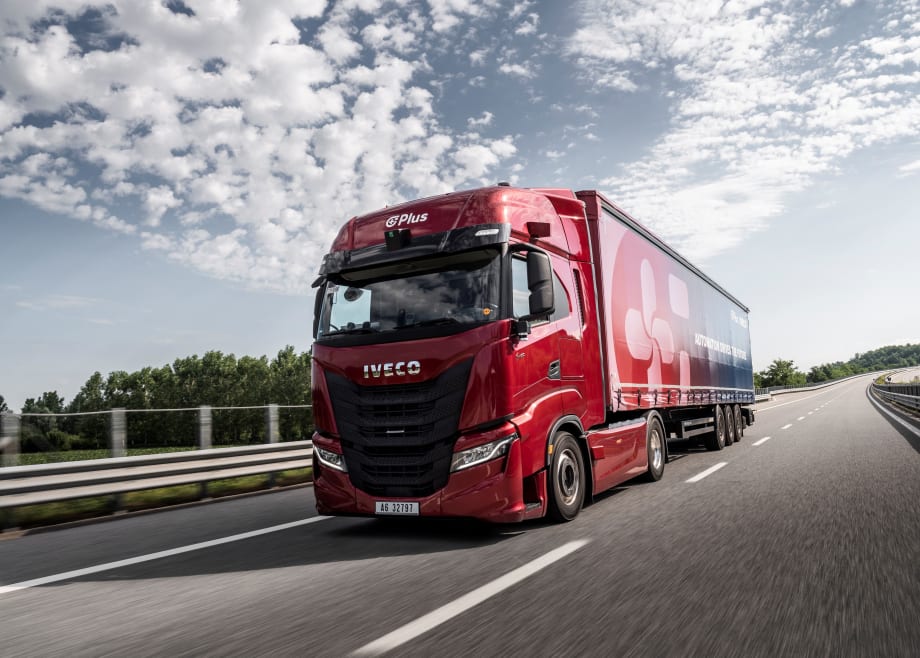
Cabovers equipped with Plus autonomous control systems, like this Iveco model seen in Germany, will soon be delivering freight on regular routes in Australia.
Photo: Plus
2 min to read
Transurban and autonomous truck developer Plus have announced a partnership aimed at boosting automated-freight efficiency in Australia.
Transurban is an Australian-owned company that builds and operates toll roads in Melbourne, Sydney, and Brisbane, as well as in Washington, D.C., and Montreal, Canada.
The partnership will build on Transurban’s first self-driving truck trial on CityLink and the Monash Freeway last year to explore how Plus’s Level 4 autonomous driving technology, combined with smart road infrastructure, could help make trucking safer, more efficient, and more sustainable in Australia.
Smart Roads and Self-Driving Trucks
Countries around the world are starting to explore the benefits of self-driving trucks on public motorways, the two companies noted.
With road freight projected to grow steadily in the coming decades, self-driving trucks have the potential to transform the freight industry by moving more goods, more quickly, and more sustainably, according to Plus. This will also deliver positive economic and social outcomes for consumers, motorists, and governments by reducing congestion and improving road safety while helping address the shortage of truck drivers.
Starting in 2017, Transurban’s comprehensive commercial automated vehicle testing program has worked with governments and industry to roll out 11 successful trials of fully and partially automated vehicles on motorways across Australia and North America to test how they respond to road infrastructure.
Transurban’s 2022 trial was the first time in Australia that a highly automated self-driving truck was tested in live traffic conditions on public motorways.
Iveco Trucks Take the Lead
The partnership between Transurban and Plus will leverage Plus’s autonomous driving software and global commercial deployment experience, which includes the cooperation with Iveco, the global commercial vehicle brand of Iveco Group, in co-developing self-driving trucks for Europe. Highly automated trucks enabled by Plus’s technology are already delivering freight in the U.S. for world-class fleets and being tested on public roads in Germany with Iveco.
Plus’s autonomous driving software uses generative AI, machine learning, computer vision, and other algorithms. Integrated with advanced lidar, radar, and camera sensors, Plus’s software can detect and precisely track objects, predict their movement, and then safely maneuver the vehicle.
“Transurban roads are some of the most technologically sophisticated in the world, and we’re excited to combine our infrastructure and operational expertise with Plus’s innovative technology to bring the benefits of automated freight one step closer,” said Tien-Ti Mak, general manager for strategic innovation at Transurban.
“The adoption of self-driving trucks in specific environments can have positive outcomes for Victoria by improving road safety, increasing productivity, reducing congestion and importantly, creating jobs for the future.”
More Fleet Management

Sponsored•September 16, 2026
Color Match Smarter: Tools That Restore & Perform
For fleet managers and collision repair professionals keeping heavy-duty trucks on the road, getting the color right the first time isn't just about appearance — it's about efficiency, turnaround time, and bottom-line results. Discover how today's digital color tools are transforming the repair process from guesswork to precision.
Read More →
FMCSA Pauses Biennial-Update Enforcement Amid Motus Transition
Carriers whose updates were due on or after June 1 have more time, while FMCSA works to stabilize its new registration system and warns of phishing sites impersonating its new carrier registration system, Motus.
Read More →
Sponsored•September 14, 2026
2026 Blueprint for Countering Smarter Supply Chain Theft
Cargo theft is no longer just the cost of doing business. It's a multi-billion-dollar criminal enterprise exploiting vulnerabilities across your fleet, drivers, and supply chain.
Read More →


Sponsored•September 1, 2026
How Telematics Improves Visibility, Control, and Performance in Refrigerated Fleets
Explore how telematics help refrigerated fleets improve visibility, uptime, efficiency, compliance, and cargo protection across connected cold chain operations.
Read More →
What the U.S.-Canada Trade War Means for Trucking
Escalating U.S.-Canada tariffs could disrupt cross-border freight, reduce truck volumes, raise costs, and create new uncertainty for carriers on both sides of the border.
Read More →
What Are Trucking’s Top Concerns for 2026?
The American Transportation Research Institute wants to know what's worrying trucking fleet managers, drivers, and other stakeholders in its annual Industry Issues survey.
Read More →
American Trucking Associations Looks for a New Leader
ATA President and CEO Chris Spear abruptly left his job at the association on August 21, at a pivotal time for the trucking industry.
Read More →
Public Wi-Fi Cybersecurity Risks: How Truck Drivers and Fleets Can Protect Their Data
Public Wi-Fi can expose truck drivers and fleets to credential theft, malware, and other cyber threats. Here’s how to reduce the risk on the road.
Read More →
For Nicky Cupp, Fleet Innovation Starts With Frustration
HDT Truck Fleet Innovator Nicky Cupp turns everyday pain points at Fraley & Schilling into opportunities for better technology and smarter processes.
Read More →
Adam Buttgenbach’s Approach to Electric Trucks: Start With Where They Fit
HDT Truck Fleet Innovator Adam Buttgenbach helped PepsiCo build one of North America’s largest EV fleets by focusing on where electric trucks make operational sense.
Read More →