



Building an autonomous truck driver
To drive as well as humans, robotic trucks must be able to see as well as humans and make the right decisions all the time. How does that work?
 MENU
MENU SEARCH
In the future, you may have your choice of two different versions of a Level-4 autonomous Freightliner Cascadia.
Screenshot from Daimler Strategy Day virtual event
In the future, you may have your choice of two different versions of a Level-4 autonomous Freightliner Cascadia.
“Autonomous is one of the holy grails out there,” said Daimler Trucks head Martin Daum In a virtual event May 20 outlining Daimler Truck AG’s plans as it spins off into a separate company from Mercedes-Benz.
It is following a dual track of development on autonomous truck technology, working with both Waymo and Torc Robotics.
Daimler announced in 2019 it would acquire Torc Robotics, and in 2020 announced a partnership with Waymo.
With its subsidiary Torc, Daum explained, Daimler is developing its own virtual driver, optimized for hub-to-hub trucking. Torc CEO Michael Fleming explained that the result will be a Level 4 autonomous truck built from the factory with seamless hardware and software integration, adding, “The pure play in trucking positions us to establish industry standards.”
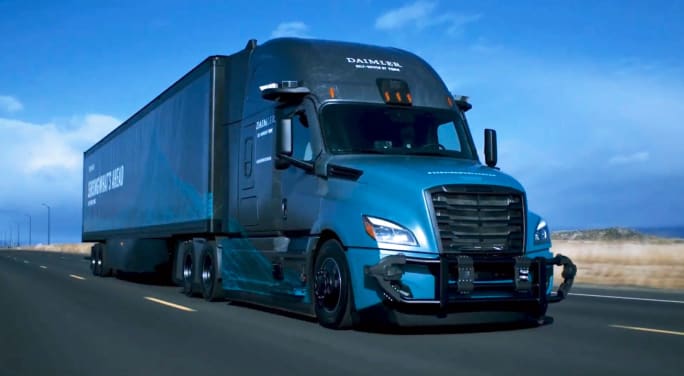
Working with subsidiary Torc Robotics, Daimler is developing its own Level 4 autonomous "driver."
Screenshot from Daimler Strategy Day virtual event
The Waymo partnership will see a unique version of the Cascadia designed specifically to work with the Waymo Driver, according to Tekedra Mawakana, co-CEO of Waymo.
“We saw the potential of Level 4 autonomous trucks early on,” Daum said. “Through powerful partnerships, we are developing the best-in-class Level 4 autonomous trucks.”
He said Daimler Trucks is targeting industry-leading autonomous technology with this dual-track strategy.
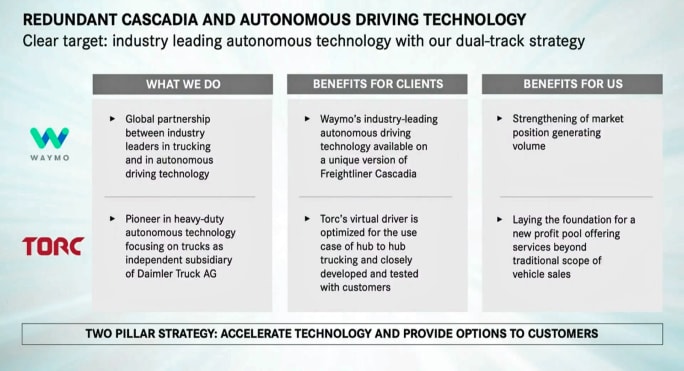
Daimler Trucks says it's pursuing a dual-track strategy for autonomous truck development.
Screenshot from Daimler Strategy Day virtual event
Globally, autonomy will be one of many new services Daimler Truck is focusing on as it moves forward, along with electrification services such as battery management and digitization.
One of the things making autonomy and many other of the company’s goals possible is digitization, explained Andreas Gorbach, head of truck technology for Daimler Trucks. Focusing on the electronic architecture of the truck and its software, he said, with more powerful yet fewer computing units in the truck, will help the company be “ready for the next generation of human-machine interface, the next generation of safety systems, the next generation of predictive intelligence, the next generation of electric and fuel cell trucks, and ready for the next generation of autonomous driving.”

Volvo’s updated D13 promises lower emissions without sacrificing performance or fuel economy. Take a closer look at what changed inside the engine in this HDT Spotlight video.
Read More →
The Michelin X Multi Energy D2 is a regional haul drive tire engineered to help fleets improve fuel efficiency, durability and traction in demanding stop-and-go operations.
Read More →
ZF is expanding its North American commercial-vehicle presence with new transmission applications, electrification, trailer technology and autonomous-driving systems.
Read More →
Could Tesla’s camera-only autonomous driving technology work on an 80,000-pound Semi? In this commentary, HDT's Deborah Lockridge takes a look at Tesla, Cybercab, and how autonomous trucks see the road.
Read More →
Kodiak AI says its driverless long-haul safety case is 93% complete and it remains on track to begin commercial operations by year-end 2026.
Read More →
The U.S. Department of Transportation issued a new automated-vehicle strategy that outlines plans for driverless-truck regulations, cross-state freight corridors, and federal safety standards.
Read More →
The Port Authority of New York and New Jersey announced millions in incentives for zero-emission drayage trucks, yard tractors, and new charging hubs near the port.
Read More →
A SPAC deal could provide PlusAI with up to $300 million as it works toward a 2027 commercial launch of factory-built autonomous trucks.
Read More →
The National Highway Traffic Safety Administration says it lacks authority to regulate medium- and heavy-duty truck engines separately from complete vehicles, but the existing standards have not yet been eliminated.
Read More →
Detroit isn’t starting from scratch to meet EPA 2027 diesel emissions standards. Its Gen 6 DD13 and DD15 engines keep much of today’s platform while updating the fuel and aftertreatment systems.
Read More →