





Trimble's Next-Generation TMS Powered by Artificial Intelligence
Trimble: Taking Artificial Intelligence in Trucking Beyond Faster Tasks
At Insight 2026, Trimble executives argued that fleets may need to redesign workflows to get more from AI as it introduced new products and enhancements. AI’s value will depend on how fleets combine automation with their people's knowledge.
September 28, 2026

Trimble President and CEO Rob Painter talking about artificial intelligence at the opening session of Trimble's Insight conference: “What is in front of us is as much of a human problem as a technology problem, because technology is fundamentally changing how people work.”
Credit:
Trimble
6 min to read
- Trimble executives highlighted the potential necessity for trucking fleets to redesign workflows to maximize the benefits of artificial intelligence.
- Insight 2026 served as the platform for Trimble to introduce new AI-driven products and enhancements.
- The presentation emphasized the role of AI beyond just accelerating tasks, suggesting a comprehensive integration into fleet operations.
*Summarized by AI
When factories first adopted electric motors, many owners replaced their steam engines with one large motor and kept running the same complex system of belts, shafts, and pulleys. According to Trimble President and CEO Rob Painter, the bigger productivity gains came later, when factories put smaller motors on individual machines and rearranged the work around them.
“Today, AI is our electric motor,” Painter told attendees at the 2026 Trimble Insight Conference in San Diego.
His point for trucking fleets: AI can make existing tasks faster. Getting more from it may mean rethinking how work moves between people and systems.
“The trap that every company faces today is the same: bolting a new power source onto an old operational architecture, using AI to speed up the same tasks and the same legacy processes, and wondering why the gains are marginal,” Painter said.
AI Can't Replace Decades of Experience
That is a tall order in trucking. A dispatcher’s plan reflects more than the information entered into a transportation management system. It may depend on a customer’s delivery preferences, a driver’s experience with a particular location, or what the team has learned from previous disruptions.
Michael Kornhauser, Trimble Transportation & Logistics sector vice president, said that experience remains essential even as AI changes what software can do.
“AI cannot replace the context, the judgment, the decades of experience,” he said. “What AI has is infinite execution power.”
Kornhauser described the combination as “you plus AI”: People bring the knowledge of how their business works, and AI can put that knowledge to work across more tasks. He said fleets repeatedly tell Trimble they want to spend less time on manual processes, control costs, and have more freedom to pursue growth.
“You bring the experience, and AI brings the speed and scale.”
The phrase “infinite execution power” is an ambitious one. In practice, a fleet still has to decide which rules an AI tool should follow, what information it can use, and when an exception needs a person’s attention.
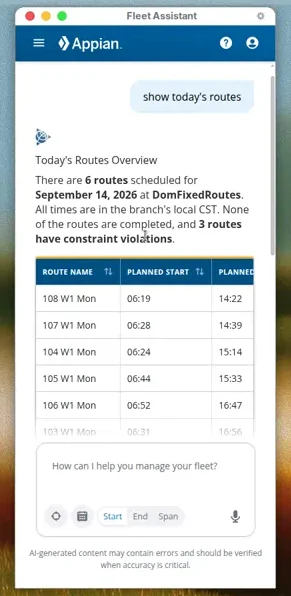
Trimble's Appian Fleet Assistant with autonomous planning acts as a virtual dispatcher.
Credit:
Trimble
Painter acknowledged the human side of that transition. He asked attendees to show how prepared they felt personally for the AI era, then whether their organizations were as prepared. He called the responses “honest and also pretty humbling.”
“What is in front of us is as much of a human problem as a technology problem,” he said, “because technology is fundamentally changing how people work.”
Putting Fleet Knowledge Into the Route
Kornhauser gave a specific example of the experience that can be hard to capture in software: a veteran private-fleet planner who knows that one customer’s store accepts deliveries only through an alley, before 7 a.m.
If that planner is absent or retires, it may be hard for someone else to put that knowledge into practice.
Trimble’s Appian Fleet Assistant with autonomous planning is designed to use a private or dedicated fleet’s rules about customers, drivers and equipment to build multistop routes.
It acts as a virtual dispatcher, capturing operational rules to generate multi-stop route plans in seconds. Planners can review its recommendations or allow it to create plans autonomously, Kornhauser said.
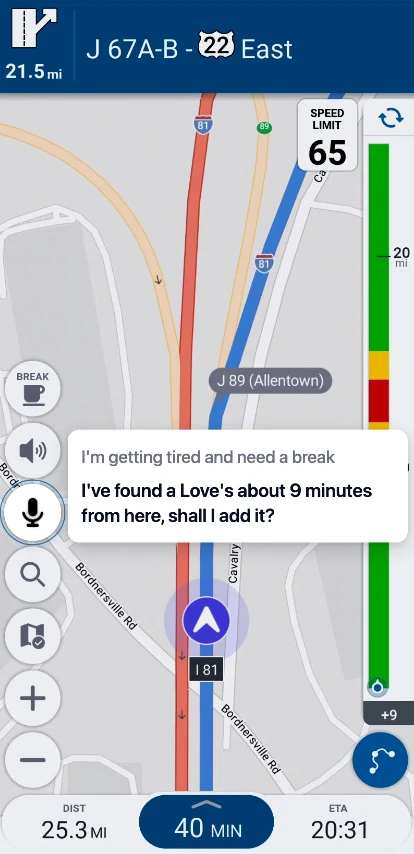
Drivers can use natural language to interact hands-free with the CoPilot Driver Assistant.
Credit:
Trimble
Trimble also announced Route Orchestration for PC*Miler and CoPilot. It unifies planning, execution, visibility and settlement into a single workflow — balancing safety, tolls and delivery constraints — to optimize outcomes across the entire route lifecycle.
It lets a fleet select and save a preferred route based on factors such as time, distance, tolls, cost, or safety, then send that route to the driver through CoPilot.
Kornhauser’s point was that a route chosen with the operation’s priorities in mind should carry through from planning to execution, rather than remain with one planner or driver.
A new CoPilot Driver Assistant brings a conversational interface into the cab. It provides hands-free, natural-language in-cab navigation to locate fuel and parking and manage HOS limits.
Kornhauser gave the example of a tired driver asking the assistant to find a place to stop. Trimble says the assistant considers the route and hours-of-service limits when finding an option.
The company also described ways for drivers to find and reserve parking or lodging through partners.
From Shop Invoices to Yard Visits
In the shop, Trimble has expanded TMT AI Invoice Scanning, which reads vendor PDF invoices and enters information into the maintenance system.
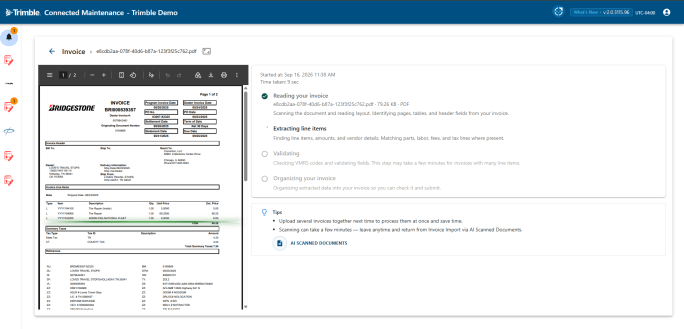
Reduce time spent inputting invoices in TMT's maintenance software.
Credit:
Trimble
It can now process batches of up to 100 invoices and help map parts and repairs to VMRS codes, Kornhauser said. That could reduce the time spent entering repair paperwork, although fleets would still need to check how well it handles their vendors’ invoices.
Trimble Dock & Yard addresses a different handoff: what happens as a truck approaches and moves through a facility.
Its Advanced Trailer Orchestration connects appointments, updated arrival times, and trailer moves so carrier, transportation, and warehouse teams can work from the same information. It's designed to eliminate blind spots between the road and the facility and create a single shared record for every trailer — from gate to dock
Kornhauser described the aim as “a shared version of what’s actually happening when the truck reaches the yard.”
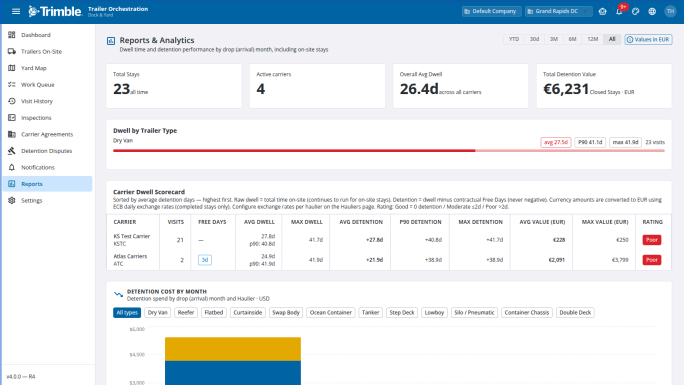
Advanced Trailer Orchestration connects appointments, updated arrival times, and trailer moves
Credit:
Trimble
Updating the Systems Fleets Already Use
Trimble is also updating its TMW.Suite, TruckMate, Innovative and Fuel Dispatchtransportation management systems. Trimble said the cloud-hosted architectures preserve decades of operational logic while providing cleaner, browser-accessible interfaces that enable collaboration between people and AI agents.
The changes include browser-based workflows, more ways to connect with other software, and a way for AI agents to access permitted tools and information within the TMS.
Kornhauser said the products are at different points in that work. He showed examples ranging from a modernized customer service workflow in TruckMate to billing screens in TMW.Suite and dispatch workflows in Fuel Dispatch.
The keynote also highlighted Trimble TMS, its native cloud solution built for growing North American full-truckload carriers and small and medium-sized enterprises.
Trimble’s pitch to existing customers is that they can gain new capabilities while keeping the configurations and processes built into their systems over the years.
Trimble Arc Agent, launched in August, is designed to work across such processes.
The company describes it as an "AI digital colleague" that automates repetitive, multi-step operational tasks through one conversational interface. Arc Agent automates core workflows — such as Order Entry, Contract Intake, and the new Intelligent RFQ Builder skill.
Its built-in skills include preparing orders for entry into a TMS, pulling terms from rate contracts for review, and organizing shipment data for a request for quotes. Fleets can also use its custom skill-building feature to digitize and automate complex processes like payroll reconciliation.
Trimble says Arc Agent operates within permissions and business rules set by the customer. Its actions are recorded, and exceptions go back to a person. Those controls matter if an agent is going to do more than suggest the next step.
The announcements give fleets a range of tasks to examine, from an invoice that needs entering to a route that needs rebuilding.
Painter’s electric motor analogy asks a larger question of each one: Will AI simply help someone complete the existing process faster, or prompt the fleet to change the process?
More Fleet Management
How Better Freight Data Helps Trucking Teams Get Ahead of Disruption
Trucking and logistics teams have plenty of data. The problem is getting the right information in front of the right people soon enough to act. Better-connected data can help teams spot trouble earlier and make smarter decisions before small problems become big ones.
Read More →
Nominations Open for HDT Emerging Leaders
Heavy Duty Trucking is looking for accomplished trucking fleet professionals under 40 who are making an impact and helping lead the industry forward.
Read More →
Why Private Fleets Are Taking More Freight
Private fleets are putting their own trucks on demanding customers and high-cost lanes as companies seek greater control over service, costs, and capacity.
Read More →


Sponsored•September 16, 2026
Color Match Smarter: Tools That Restore & Perform
For fleet managers and collision repair professionals keeping heavy-duty trucks on the road, getting the color right the first time isn't just about appearance — it's about efficiency, turnaround time, and bottom-line results. Discover how today's digital color tools are transforming the repair process from guesswork to precision.
Read More →
FMCSA Pauses Biennial-Update Enforcement Amid Motus Transition
Carriers whose updates were due on or after June 1 have more time, while FMCSA works to stabilize its new registration system and warns of phishing sites impersonating its new carrier registration system, Motus.
Read More →
Sponsored•September 14, 2026
2026 Blueprint for Countering Smarter Supply Chain Theft
Cargo theft is no longer just the cost of doing business. It's a multi-billion-dollar criminal enterprise exploiting vulnerabilities across your fleet, drivers, and supply chain.
Read More →
Sponsored•September 1, 2026
How Telematics Improves Visibility, Control, and Performance in Refrigerated Fleets
Explore how telematics help refrigerated fleets improve visibility, uptime, efficiency, compliance, and cargo protection across connected cold chain operations.
Read More →
What the U.S.-Canada Trade War Means for Trucking
Escalating U.S.-Canada tariffs could disrupt cross-border freight, reduce truck volumes, raise costs, and create new uncertainty for carriers on both sides of the border.
Read More →
What Are Trucking’s Top Concerns for 2026?
The American Transportation Research Institute wants to know what's worrying trucking fleet managers, drivers, and other stakeholders in its annual Industry Issues survey.
Read More →
American Trucking Associations Looks for a New Leader
ATA President and CEO Chris Spear abruptly left his job at the association on August 21, at a pivotal time for the trucking industry.
Read More →