





AI Can Optimize a Fleet. Can It Replace Human Judgment?
Trimble’s New AI Agent Takes Aim at Fleet Back-Office Busywork
Arc Agent works across Trimble TMS products to automate repetitive tasks such as freight orders, maintenance, invoices, fuel costs and more.
August 14, 2026

Trimble's Arc Agent is intended to provide a single agent that can use different skills while retaining and consistently applying an organization’s operational knowledge.
Credit:
Trimble
3 min to read
- Arc Agent is an AI-powered tool designed to automate routine tasks in Trimble TMS products.
- It streamlines operations by handling freight orders, maintenance, invoices, and fuel costs.
- This automation aims to reduce back-office workloads associated with managing fleets.
*Summarized by AI
Trimble is rolling out a new artificial intelligence tool designed to take some of the repetitive work out of fleet back offices, from entering freight orders into the TMS to handling maintenance notifications and scanning invoices.
The new Trimble Arc Agent is an AI agent that connects with Trimble transportation management systems and common business applications such as Gmail and Outlook.
Rather than requiring employees to move information manually from emails, PDFs, spreadsheets, and other sources into fleet systems, the Trimble Arc Agent can extract and validate that information and put it into the appropriate system.
For motor carriers, Arc Agent works across Trimble’s carrier TMS products, including Trimble TMS, TMW.Suite and TruckMate.
The company says the goal is to automate repetitive processes that still consume significant staff time despite fleets’ investments in transportation management and other software.
What Can Trimble Arc Agent Do for Fleets?
One of the most straightforward examples of motor carrier use of the Trimble Arc Agent is freight order entry.
Arc Agent can extract freight-order information from PDF or text files and submit that information directly into TMW.Suite, eliminating the need for someone to read the document and manually enter the fields into the TMS.
But Trimble sees the technology extending into other areas of fleet operations as well.
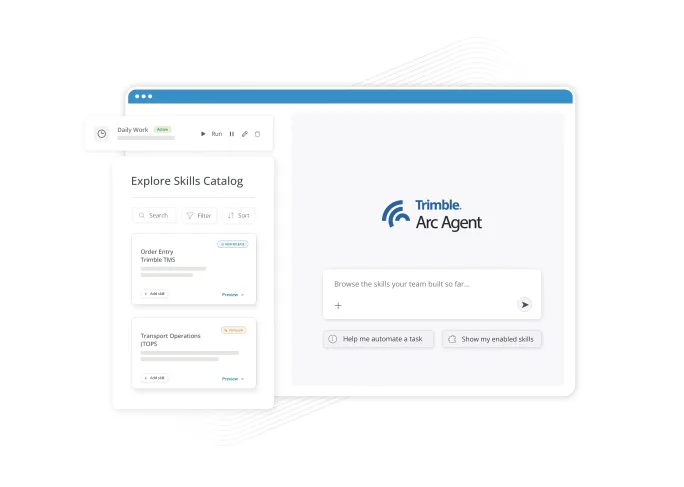
Instead of deploying separate AI agents for different jobs, Arc Agent uses a catalog of skills that allow the same agent to perform different types of work.
Credit:
Trimble
On the maintenance side, Arc Agent can work with TMT Connected Maintenance to automate maintenance notifications, road calls, vendor interactions and invoice scanning.
It also can provide how-to information and create support tickets for Trimble products including TMW.Suite, TMT, TruckMate and CoPilot.
Other potential fleet applications include assistance with fuel strategy, pricing guidance, and cost optimization. For tanker fleets, for instance, Arc Agent can recommend wash facilities and provide lane-pricing information.
The agent also can pull together information from emails, calendars, messages, and project-management applications and turn it into a prioritized list.
One AI Agent, Multiple 'Skills'
The “skills” concept is central to how Trimble is positioning Arc Agent.
Instead of deploying separate AI agents for different jobs, Arc Agent uses a catalog of skills that allow the same agent to perform different types of work. Initial skills include order entry and contract intake, business-term negotiations, support-ticket creation, and the personal-assistant function.
That could allow a carrier to automate processes specific to its own operation rather than being limited to the workflows Trimble has developed.
“The market is flooded with disconnected AI tools that require constant babysitting and manual management,” said Jonah McIntire, chief product and technology officer for transportation and logistics at Trimble.
He said Arc Agent is intended to provide a single agent that can use different skills while retaining and consistently applying an organization’s operational knowledge.
Keeping Humans in the Loop
As fleets experiment with AI that does more than answer questions or summarize information, the reliability of autonomous actions becomes more important.
Fleets also can adapt existing skills or build their own through a conversational interface without engineering resources, according to Trimble. The company said several fleets and carriers are currently piloting custom skills.
Trimble says Arc Agent includes enterprise AI guardrails and human-in-the-loop controls intended to make its actions explainable and auditable and to reduce the risk of AI hallucinations.
That distinction matters when an AI system is entering information into a TMS, handling maintenance workflows, or performing other tasks that can affect actual fleet operations.
Arc Agent is offered as a software-as-a-service subscription and is available to Trimble customers worldwide. The subscription has no seat limits or feature gates and includes 10 hours of agent working time, with additional hours available. Customers automatically receive new skills and features as Trimble adds them to the Arc Agent catalog.
More Fleet Management

How Better Freight Data Helps Trucking Teams Get Ahead of Disruption
Trucking and logistics teams have plenty of data. The problem is getting the right information in front of the right people soon enough to act. Better-connected data can help teams spot trouble earlier and make smarter decisions before small problems become big ones.
Read More →
Trimble: Taking Artificial Intelligence in Trucking Beyond Faster Tasks
At Insight 2026, Trimble executives argued that fleets may need to redesign workflows to get more from AI as it introduced new products and enhancements. AI’s value will depend on how fleets combine automation with their people's knowledge.
Read More →
Nominations Open for HDT Emerging Leaders
Heavy Duty Trucking is looking for accomplished trucking fleet professionals under 40 who are making an impact and helping lead the industry forward.
Read More →


Why Private Fleets Are Taking More Freight
Private fleets are putting their own trucks on demanding customers and high-cost lanes as companies seek greater control over service, costs, and capacity.
Read More →
Sponsored•September 16, 2026
Color Match Smarter: Tools That Restore & Perform
For fleet managers and collision repair professionals keeping heavy-duty trucks on the road, getting the color right the first time isn't just about appearance — it's about efficiency, turnaround time, and bottom-line results. Discover how today's digital color tools are transforming the repair process from guesswork to precision.
Read More →
FMCSA Pauses Biennial-Update Enforcement Amid Motus Transition
Carriers whose updates were due on or after June 1 have more time, while FMCSA works to stabilize its new registration system and warns of phishing sites impersonating its new carrier registration system, Motus.
Read More →
Sponsored•September 14, 2026
2026 Blueprint for Countering Smarter Supply Chain Theft
Cargo theft is no longer just the cost of doing business. It's a multi-billion-dollar criminal enterprise exploiting vulnerabilities across your fleet, drivers, and supply chain.
Read More →
Sponsored•September 1, 2026
How Telematics Improves Visibility, Control, and Performance in Refrigerated Fleets
Explore how telematics help refrigerated fleets improve visibility, uptime, efficiency, compliance, and cargo protection across connected cold chain operations.
Read More →
What the U.S.-Canada Trade War Means for Trucking
Escalating U.S.-Canada tariffs could disrupt cross-border freight, reduce truck volumes, raise costs, and create new uncertainty for carriers on both sides of the border.
Read More →
What Are Trucking’s Top Concerns for 2026?
The American Transportation Research Institute wants to know what's worrying trucking fleet managers, drivers, and other stakeholders in its annual Industry Issues survey.
Read More →