




Why VMRS Is the Natural Link Between AI, Predictive Analytics, and Vehicle Repairs [Commentary]
Jon White was a leading figure in the development of VMRS. Now, after five decades of service, White says VMRS is becoming essential to the AI-driven future of truck maintenance.
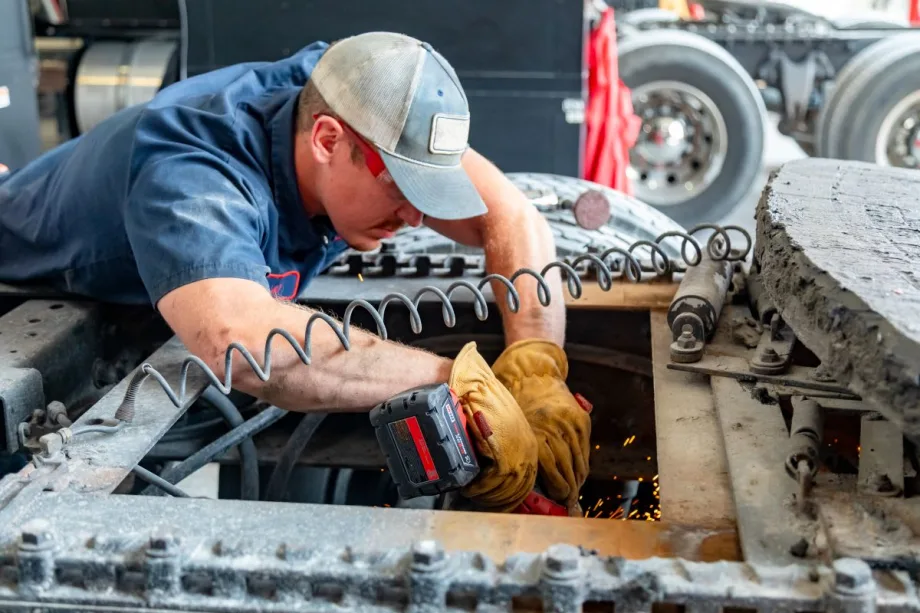
AI has tremendous potential to help fleets with faster, more effective maintenance. But so far, that has not happened, argues VMRS pioneer Jon White.
Huff and Puff Trucking
- Jon White, a pivotal developer of VMRS, highlights its growing importance in the future of AI-driven truck maintenance.
- VMRS, with five decades of evolving utility, is now considered vital for integrating AI and predictive analytics in vehicle repairs.
- The system's role is increasingly significant as the truck maintenance industry shifts towards technological advancements.
*Summarized by AI
The Vehicle Maintenance Reporting Standards, managed by the American Trucking Associations’ Technology & Maintenance Council, have survived and evolved for nearly five decades. And while that longevity alone is remarkable, VMRS may be more important to trucking today than at any point in its history.
I had the opportunity to work with VMRS during its pioneering years, and I strongly believe the system still has not fully hit its stride. In fact, the rise of artificial intelligence and predictive analytics is revealing just how essential VMRS has become.
At its core, VMRS provides the standardized language that connects maintenance data across systems. That common structure enables meaningful, quantifiable feedback between a repair event and the predictive technologies that attempt to forecast it.
Regardless of where predictive analytics originates — whether from a maintenance management software, telematics, onboard diagnostics, or AI-driven software platforms — fleets ultimately need to answer one critical question after a repair is completed: How accurate was the prediction, and how can the predictive process learn from the repair event?
VMRS provides the foundation common denominator for answering that question.
AI Is Only as Valuable as the Problems It Solves
For purposes of this discussion, predictive analytics and AI are closely related. The degree to which a predictive platform truly operates as “AI” depends on the depth of analysis, cross-correlation, and learning occurring behind the scenes.
But the real value of these systems is not in producing mountains of data or another dashboard filled with alerts. The value lies in solving maintenance problems more intelligently: In other words, determining which data do we act on?
Too often in trucking, fleets are overwhelmed by disconnected dashboards — one for telematics, another for diagnostics, another for maintenance software, and still another for analytics. Sometimes there are dashboards for each component OEM.
Data exists everywhere, but the focal point of homogenized focus is missing.
To maximize the effectiveness of predictive maintenance, fleets must excel in three critical activities:
- Documenting the prediction and its AI/predictive source
- Documenting the repair or corrective action performed by the technician
- Sharing information effectively between systems to minimize downtime and repair costs.
VMRS is the common denominator that makes this possible.
Diagnostic and Repair Platforms
These systems guide technicians through troubleshooting procedures and corrective repair processes.
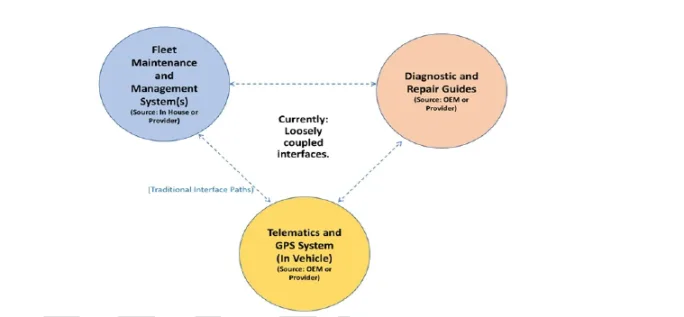
For most fleets, these three systems operate independently, often with only loosely connected interfaces. That fragmentation limits the effectiveness of predictive analytics.
Consider a common scenario facing fleet maintenance management today: A component issue is beginning to emerge across multiple vehicles.
Jon White
To proactively address the problem, fleets typically rely on three separate systems:
- Telematics Systems: These systems determine where the truck is operating, who is driving it, what mission it is performing, and under what conditions. They also monitor in-vehicle data from J1939 or OBD-II networks, including fault codes and component health data. The system may identify a fault, estimate its severity, and even suggest a probable root cause.
- Diagnostic and Repair Platforms: These systems guide technicians through troubleshooting procedures and corrective repair processes. For most fleets, these three systems operate independently, often with only loosely connected interfaces. That fragmentation limits the effectiveness of predictive analytics.
- Fleet Maintenance Systems: These systems manage the repair workflow itself. Is there an open work order? Has the repair been assigned? Does the shop have capacity? Once repairs are complete, what parts and labor were used? Thinking in terms of the “Three C’s” (Complaint/Cause/Correction), what was the root cause and correction?
Where Predictive Analytics Fits
The objective of AI and predictive analytics is straightforward: Identify a potential issue early, establish its severity as regards the vehicle's ability to safely complete its mission, connect it to a probable root cause, and guide the fleet toward an effective repair strategy.
But for predictive analytics to continuously improve, the system must receive feedback after the repair occurs.
That is where VMRS becomes indispensable.
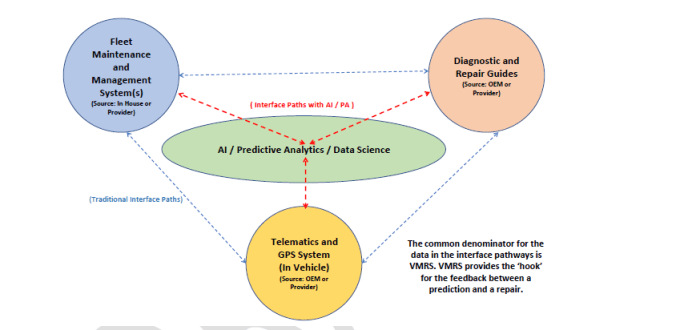
Predictive analytics is evolving both as a standalone technology platform and as functionality embedded within telematics, maintenance software, and diagnostic tools. Across all of those systems, VMRS provides the standardized “data hook” linking the prediction to the actual repair outcome.
Jon White
A Real-World Example: NOx Sensor Failures
Suppose a diagnostic trouble code repeatedly appears for a NOx sensor within an after-treatment system:
DTC: P23AD — NOx Sensor Circuit Range/Performance Bank 1 Sensor 3
Under VMRS, that issue can be associated with the code: 043-007-071 — Sensor, Nitrogen Oxide (NOx), Diesel Exhaust System
Now suppose a work order is opened and the repair is completed using VMRS-coded parts and labor entries tied to that component category.
With that feedback loop in place, AI and predictive systems can learn from the actual repair outcome. Over time, the algorithms become increasingly accurate as they are trained on real-world maintenance events.
Again, VMRS is the common denominator.
Why Standardization Matters More Than Ever
VMRS enables fleets to correlate telematics data and work-order data across large populations of vehicles — even across multiple fleets.
Using VMRS as the standard allows organizations to analyze trends such as:
- Frequency of component failures
- Associated parts and labor costs
- Reductions in technician diagnostic time
- Vehicle downtime
- Percentage of repairs requiring roadside service or towing.
Without a common language, that level of analysis becomes inconsistent and fragmented.
With VMRS, the industry gains the ability to share meaningful operational intelligence across maintenance systems, telematics providers, repair platforms, and predictive analytics tools.
The Industry’s Opportunity
Since the early 1970s, VMRS has offered trucking a common language for maintenance management. Today, that role is expanding dramatically.
Fleet maintenance systems, telematics providers, diagnostic platforms, and AI developers now have an opportunity to build truly connected ecosystems around VMRS standards.
As predictive maintenance technologies mature, the fleets that succeed will not simply be the ones collecting the most data. They will be the fleet's best equipped to connect predictions, repairs, and operational outcomes into a continuous learning loop.
VMRS was built for exactly that purpose. And after nearly 50 years, its most important contribution to trucking may still lie ahead.

Jon White
Jon White
About the Author: Jon White began his career forecasting component failures on nuclear submarines and quickly moved to the transportation industry. He was the author and designer of the Ryder MARS system, which forecasted maintenance costs.
He later co-founded TMT software, now part of Trimble. and founded Microflex Software, acquired by Eaton. White is an active partner with Wade & Partners and CST Fleet Services.
White has spent his career focusing on cost savings initiatives for the transportation industry and fleets of North America, with emphasis on asset life cycle costs as well as the technologies that support and achieve minimal costs and downtime.
Jon White can be reached at jwhite@jonwhiteinc.com, 336.416.2181.
This article was authored and edited according to Heavy Duty Trucking’s editorial standards and style to provide useful information to our readers. Opinions expressed may not reflect those of HDT.
More Maintenance

Color Match Smarter: Tools That Restore & Perform
For fleet managers and collision repair professionals keeping heavy-duty trucks on the road, getting the color right the first time isn't just about appearance — it's about efficiency, turnaround time, and bottom-line results. Discover how today's digital color tools are transforming the repair process from guesswork to precision.
Read More →
Wrong Repair Prompts Recall of Freightliner, Western Star 4x2 Trucks
DTNA is recalling more than 2,400 trucks that received an incompatible software fix instead of the hardware repair required to address brake valve corrosion.
Read More →
Truck Drivers Need More Than Another Alert
Fleets have more visibility into truck health, safety events, and driver activity than ever. The next challenge is turning all that information into useful guidance for the person who has to decide what to do next.
Read More →
The Maintenance Checks Trucking Fleets Should Prioritize Before Fall Freight Picks Up
Making it through August isn’t the same as being ready for the next several months of operation. Find out what systems may have suffered from summer heat and need to be checked out before fall.
Read More →
What Three Fleets Are Doing Differently When Buying Truck Parts in 2026
With freight improving but costs still climbing, fleet maintenance executives explain how they're balancing price, quality, and supplier relationships.
Read More →
Paccar Recalls 2027 Trucks Built This Summer for Possible Electrical Problem
The nearly 6,000 Kenworth and Peterbilt trucks in the recall could potentially lose engine power, among other things.
Read More →
Could New Engine Oils Mean Longer Drain Intervals?
Foodliner already goes 90,000 miles between some oil changes. PC-12, the next generation of engine oils, could change that calculation. But first the fleet wants proof.
Read More →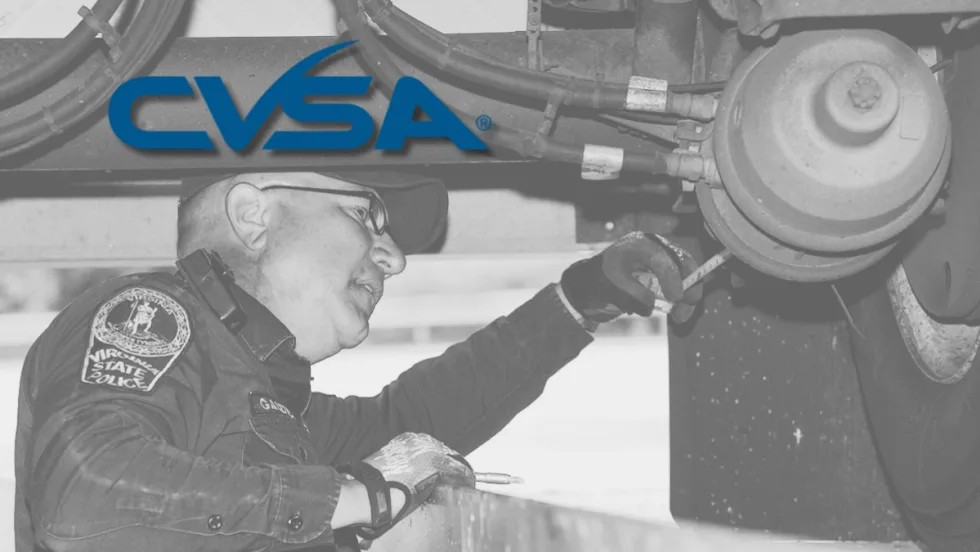
Brake Safety Week to Focus on Drums and Rotors
Commercial vehicle inspectors are focusing on truck brakes during CVSA's Brake Safety Week, August 23-29.
Read More →
Possible Battery-Cable Fires Prompt Recall of 15,000+ International MV and HV Trucks
On the recalled vehicles, manufacturing variations can cause the battery interconnect cable to contact the auxiliary stud and hold down the bracket.
Read More →
Rush, MCT Team Up to Grow Refrigeration Service Network
The joint venture will operate MCT's network of Carrier Transicold dealerships and mobile service locations, with the companies promising greater service capacity and uptime for refrigerated fleets.
Read More →