




The Biggest Gap in Driverless Trucking Isn’t Tech. It’s Safety Validation
Nauto’s Stefan Heck says autonomous trucks are advancing quickly but proving they’re safe enough for large-scale deployment may be the industry’s hardest challenge.

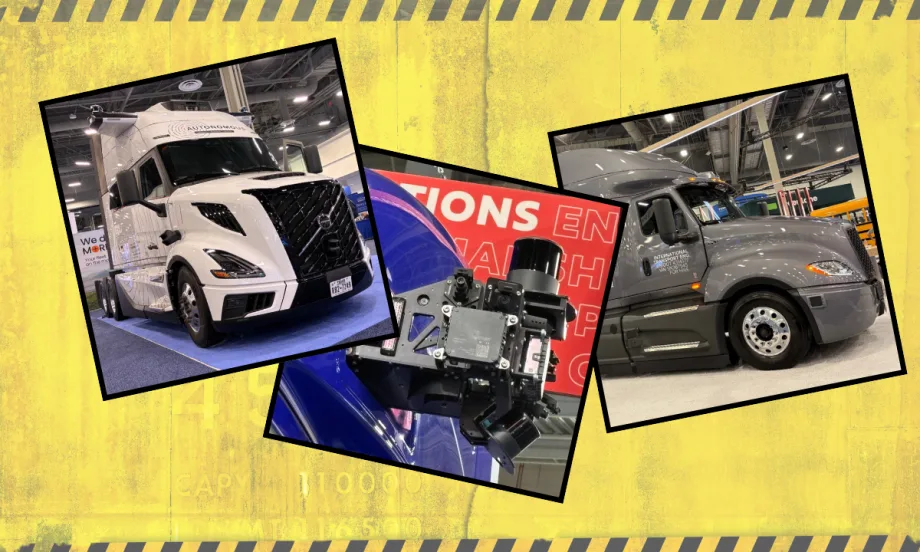
Although autonomous trucks were prevalent on the show floor at the recent ACT Expo, the technology faces a new hurdle, according to Stefan Heck at Nauto: Proving they can deal with rare and unpredictable "edge case" roadway incidents that human drivers often take in stride.
HDT Graphic/Deborah Lockridge Photos
- Autonomous trucks are rapidly advancing in technology according to Stefan Heck of Nauto.
- The industry's main challenge is validating the safety of these vehicles for widespread use.
- Proving safety standards for driverless trucks is crucial for their large-scale deployment.
*Summarized by AI
Autonomous trucking is no longer a question of “if.” It’s becoming a question of how fast fleets, regulators and technology developers can solve one stubborn issue: proving the trucks are safe enough to scale nationwide.
According to Stefan Heck, CEO of Nauto, much of the public conversation around autonomous vehicles still focuses on sensors, artificial intelligence and remote operations.
But, Heck argues, the industry’s biggest challenge is something less flashy: validating safety in the real world.
“The last 3% of autonomous driving is a thousand times more difficult than the first 50%,” Heck said. “People talk about 99% reliability, but if you look at truly safety-critical systems like airplanes or nuclear reactors, they operate at seven nines of reliability.”
Autonomous Trucks Are Advancing Faster Than Many Realize
Heck believes the industry has reached an inflection point. Major autonomous developers now have manufacturing partnerships in place, including Aurora’s work with Continental and Waymo’s expansion with Hyundai platforms. That means deployment numbers could rise quickly over the next two years.
“We’re going to see tens of thousands — collectively maybe 100,000 to 200,000 self-driving vehicles — on the road within the next two years,” Heck said.
But he cautioned against confusing early growth with widespread adoption.
Compared to the roughly 12 million trucks operating in the U.S., autonomous systems will still represent only a small fraction of the market for years.
Initial deployments will remain concentrated in highly controlled freight corridors such as Interstate 10 through the Sun Belt, where weather conditions, traffic patterns and regulatory environments are more predictable.
“It’s not going to be loosey-goosey,” Heck said of the coming autonomous technology rollout. “It’s going to be highly controlled.”
Safety Validation Requires Massive Real-World Data
The biggest hurdle, according to Heck, is proving autonomous systems can safely handle rare and unpredictable edge cases.

Stefan Heck argues that autonomous developers need much larger data sets before driverless trucks will be able to safely operate in less-than-ideal roadway conditions.
Nauto
Simulation has become a core development tool across the AV industry. But Heck argues simulations alone cannot solve many edge case problems because engineers can only model situations they have already imagined or observed.
“You can only simulate things that you’ve thought of,” he said. “The need really is to get much, much larger data sets. We’re talking hundreds of billions of miles.”
That reality helps explain why autonomous trucking development has progressed more slowly than many early forecasts predicted.
In the mid-2010s, some industry observers predicted fully autonomous trucks would be commonplace within five years. Instead, the industry discovered that achieving high reliability in difficult operating conditions is exponentially harder than handling straightforward highway.
Everyday incidents such as driving, heavy rain, flooded roads, construction zones, pedestrian interactions and unexpected vehicle behavior can create situations that autonomous vehicles are not yet capable of handling in a safe manner.
Waymo’s recent recall activity and Cruise’s widely publicized pedestrian-dragging incident illustrate the problem, he said. In both cases, the systems encountered scenarios they had not sufficiently modeled or validated beforehand.
In the Waymo incident, an autonomous taxi was not programmed to handle heavy floodwaters that drenched the Southwest in May. The car was eventually washed away in a creek because it was not programmed to avoid floodwaters on the roadway.
In the 2023 Cruise incident, a self-driving vehicle was not programmed to stop after hitting a pedestrian. The vehicle was programmed to pull over to the side of the road when it encountered a new situation it did not know how to deal with. A solution, Heck noted, that was less than ideal for the pedestrian trapped underneath the vehicle.
Human Oversight Still Plays a Major Role
Despite marketing around “driverless” vehicles, Heck noted that today’s AV systems still depend heavily on human involvement behind the scenes.
That includes remote reviewers monitoring unusual situations, technicians servicing sensors and cameras, and maintenance personnel ensuring vehicles remain compliant and operational throughout long-haul trips.
“There’s a lot of labor hidden behind AVs that are supposedly driving all themselves today,” Heck said.
Many of those responsibilities will eventually become automated. Heck pointed to aviation maintenance systems as a likely model, where every critical component is tracked, monitored and serviced according to strict operational cycles.
Nauto already uses AI systems capable of detecting dirty or misaligned safety cameras in commercial fleet vehicles, technology Heck expects will become standard across autonomous trucking systems.
Still, he warned that human oversight itself can introduce errors if not carefully integrated with AI systems. In some mature detection systems, Nauto has found its algorithms now outperform human reviewers in accuracy.
Economic Pressure Will Accelerate Adoption
While safety validation remains the key challenge, Heck said economics will continue pushing fleets toward autonomous operations.
An autonomous truck capable of operating nearly nonstop between refueling or charging stops dramatically increases equipment utilization while offering more predictable delivery schedules for time-sensitive freight.
“You can double the use of the asset right out of the box,” Heck said.
That advantage, combined with persistent driver shortages, makes some level of autonomous deployment almost inevitable, he added.
But large-scale adoption will require more than technology improvements. Heck said regulators eventually will need to establish harmonized national standards governing autonomous operations, safety validation and testing requirements.
“We need to recognize there is no 100% safe,” he said. “These things are going to have collisions. The goal is dramatically reducing the number of people that get hurt.”
Even so, Heck remains optimistic about the long-term trajectory.
“We are definitely at the takeoff point,” he said. “But reaching full scale? We’re still probably 15 years away from that.”
More Safety & Compliance
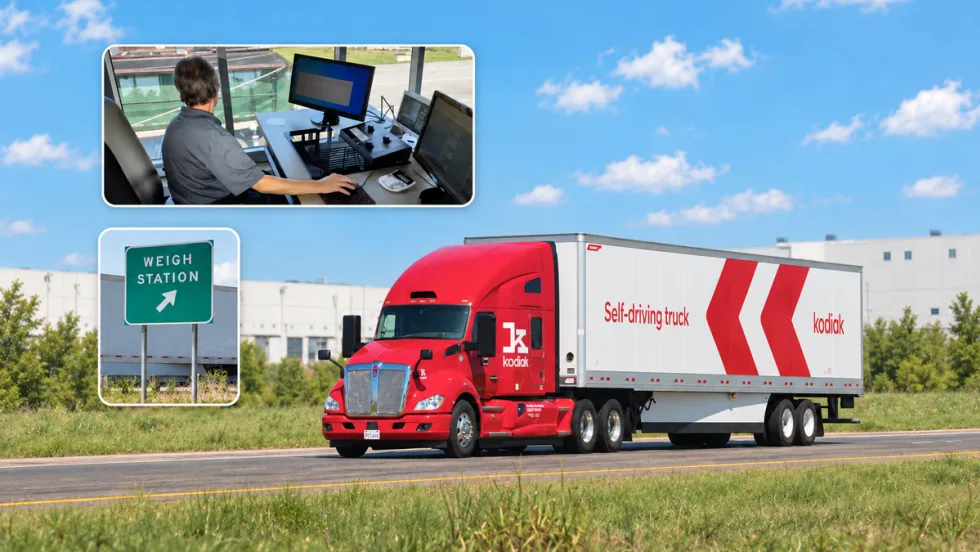
PrePass, Kodiak Connect Driverless Trucks to Roadside Enforcement
The system will allow enforcement agencies to verify Enhanced Inspection information and decide whether Kodiak’s autonomous trucks can bypass roadside screening sites.
Read More →
From One Generation to the Next: How Mentorship Builds Safer Truck Drivers
After three decades in trucking, Harold Perry shares what he's learned about driver safety, mentorship, and helping the next generation build confidence behind the wheel.
Read More →
FMCSA Pauses Biennial-Update Enforcement Amid Motus Transition
Carriers whose updates were due on or after June 1 have more time, while FMCSA works to stabilize its new registration system and warns of phishing sites impersonating its new carrier registration system, Motus.
Read More →
ZF Expands Commercial Vehicle Push in North America
ZF is expanding its North American commercial-vehicle presence with new transmission applications, electrification, trailer technology and autonomous-driving systems.
Read More →
Truck Drivers Need More Than Another Alert
Fleets have more visibility into truck health, safety events, and driver activity than ever. The next challenge is turning all that information into useful guidance for the person who has to decide what to do next.
Read More →
Tesla Wants a Self-Driving Semi. Are Cameras Enough?
Could Tesla’s camera-only autonomous driving technology work on an 80,000-pound Semi? In this commentary, HDT's Deborah Lockridge takes a look at Tesla, Cybercab, and how autonomous trucks see the road.
Read More →
What DOT’s Automated Vehicle Strategy Means for Trucking
The U.S. Department of Transportation issued a new automated-vehicle strategy that outlines plans for driverless-truck regulations, cross-state freight corridors, and federal safety standards.
Read More →
NYC Expands Speed, Pedestrian Safety Tech Across Fleet
New York City is expanding intelligent speed assistance and pedestrian-alert systems across its municipal fleet, moving the technologies from pilot programs into vehicle procurement and retrofit requirements.
Read More →
FMCSA Removes 110 Truck Driver Training Schools from Certified ELDT List
Federal regulators also are targeting more than 160 additional training providers and launching a nationwide audit of third-party CDL skills testers as part of a broader crackdown on trucking fraud.
Read More →
Beyond DOT Compliance: What Makes a Trucking Fleet Truly Safe?
A trucking fleet can follow every rule and still make unsafe decisions. The real test comes when safety conflicts with freight, productivity, or cost.
Read More →