




How Kodiak and Bosch Plan to Scale Autonomous Trucks
Kodiak Robotics and Bosch announced a new strategic partnership at CES 2026 aimed at accelerating scale and deployment of self-driving trucks in North America.

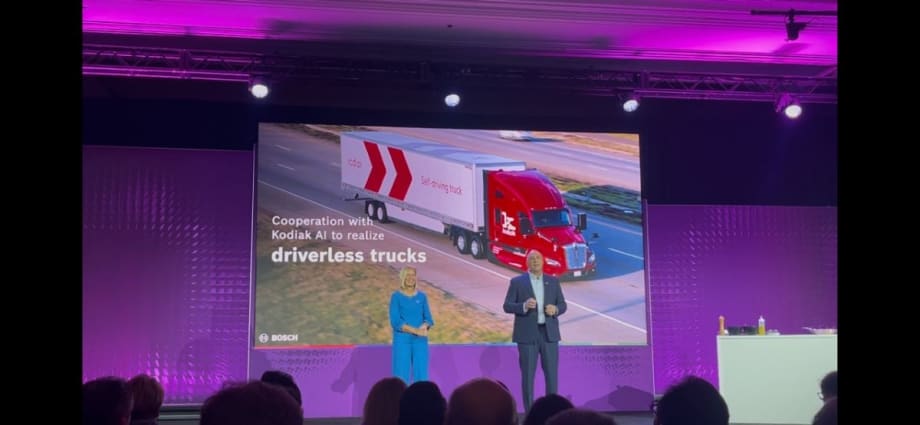
Bosch announced a new, long-term partnership with Kodiak Robotics at CES 2026.
Photo: Jack Roberts
How do you move from a handful of driverless trucks to fleets measured in the thousands—or more? For Kodiak Robotics, a partnership with Bosch is the answer to that challenge.
At the 2026 CES electronics show in Las Vegas, Bosch and Kodiak announced a new strategic partnership aimed at expediting the development, scaling, and widespread deployment of autonomous trucks.
On the tail-end of a Bosch press conference announcing the new alliance, Kodiak Robotics CEO Don Burnette sat down with trucking journalists to provide further details on the partnership.
The Kodiak–Bosch partnership is not a single off-the-shelf “autonomy kit,” nor is it a turnkey system being rolled out tomorrow. Instead, it’s a multi-year collaboration focused on developing and validating a range of components that will ultimately support autonomy-ready trucks at scale.
From a Few Autonomous Trucks to Thousands
Bosch, the world’s largest automotive supplier, brings decades of experience in sensors, braking, steering, embedded systems, and safety-critical hardware — which Burnette said is exactly the expertise Kodiak needs to autonomous technology to scale quickly.
“For us, 2025 was a real pivotal year,” Burnette said. "That was the year we got our first fully driverless trucks out there on the road in the hands of customers. But the big question has always been: How do you scale this?”
While autonomous truck developers routinely talk about the promise of driverless freight, Burnette noted that most autonomous deployments remain limited in size and scope.
“We’re past the ‘onesie-twosies’ phase,” Burnette said. “The real challenge is moving from five trucks to 10, then to 100, and eventually into the thousands and tens of thousands.”
That kind of growth, he said, requires more than good AI software.
It requires industrial-grade hardware, redundancy, manufacturing discipline, and suppliers that understand automotive-scale production.
“That’s where Bosch comes in,” Burnette said. “There really is no better partner when it comes to the technologies we need under the hood.”
“We’re specialists in AI software,” he explained. “We’re not a hardware company. This partnership brings together experienced, proven hardware with cutting-edge physical AI.”
Burnette said Bosch will contribute across multiple layers of the autonomous stack, including sensors such as radar and cameras, embedded computing systems, and the redundancy platforms that underpin safe braking and steering.
“These are the components OEMs and autonomy developers will need for the autonomous vehicles of tomorrow,” Burnette said. “Bosch is helping shape that future.”
Those components, once validated, will be available both to truck manufacturers integrating autonomy-ready platforms and to Kodiak for use in its own deployments.
But, Burnette said, Kodiak’s current driverless trucks are still built using a mix of Tier 1 suppliers, contract manufacturers, and final integration partners such as Roush Industries.
The Bosch-based platform is in its early stages of development.
“This is not something that’s deployed in production today,” Burnette emphasized. “This is the start of the journey.”
Real-World Driverless Trucks Today
While the Bosch collaboration points toward the future, Kodiak is already operating 10 fully driverless trucks today — meaning no safety driver in the cab — through its work with Atlas Energy Solutions in the Permian Basin of West Texas.

Kodiak CEO Don Burnette speaks to trucking media following the Bosch press announcement at CES 2026.
Photo: Jack Roberts
“When we say driverless, we mean nobody in the cab,” Burnette said. “These trucks are truly empty.”
Atlas’ initial contract covers 100 trucks, which Burnette said Kodiak plans to fulfill in 2026.
At the same time, Kodiak continues to operate autonomous trucks on public highways, running routes such as Dallas to Atlanta, Dallas to Houston, and Dallas to Oklahoma City.
Those trucks currently operate with safety observers onboard, but Burnette said the company remains on track to remove the safety driver in the second half of 2026.
“The driving phase is pretty dialed in,” he said. “The real learnings are at the endpoints.”
Kodiak’s experience with Atlas has exposed what Burnette calls the “third pillar” of autonomy: the product experience.
Why Autonomous Trucks Must Fit Into Existing Fleet Operations
Beyond technology and safety, Burnette stressed that autonomous trucks must fit seamlessly into existing fleet operations.
“You don’t really learn those lessons until the truck is empty and a customer is paying you to make it work,” he said.
That includes navigating yards, managing queues, coordinating pickups and drop-offs, and dealing with the variability of real-world operations—challenges many autonomy developers initially tried to sidestep with tightly controlled hub-to-hub models.
“The real world doesn’t work that way,” Burnette said. “Every fleet does things differently.”
Kodiak’s solution relies heavily on assisted autonomy and teleoperations, allowing human operators to intervene remotely when necessary—particularly at low speeds in complex environments.
Burnette also reiterated Kodiak’s commitment to an end-to-end operating model rather than limiting autonomy to specialized hubs.
“We believe in dock-to-dock operations,” he said.
That approach still requires humans on the ground for tasks such as inspections, trailer hookups, and fueling, but Kodiak is aligning its strategy with emerging industry standards, including enhanced inspection programs designed specifically for autonomous vehicles.
“The goal is to meet customers where they are,” Burnette said. “That’s how you scale.”
Taking the Long View on Autonomous Technology
I asked Burnette about asset utilization with autonomous trucks. He said driverless trucks could realistically double — or more — the productive hours of a vehicle compared to today’s human-driven operations.
“We’ve said around 18 hours a day,” he said. “Some trucks will run longer, some shorter, but the economics change dramatically.”
Whether autonomy becomes a premium service in its early days remains an open question.
Burnette acknowledged the reality that early deployments are often clunky, even as the long-term vision points toward faster, more reliable, and potentially lower-cost freight movement.
“If it’s seamless, it’s absolutely a premium service,” he said. “But in the early days, there’s going to be a learning curve.”
For Kodiak, the partnership with Bosch is less about what autonomous trucks can do, Burnette added. It's really about how many of them can actually be built.
More Equipment

How Volvo Updated Its D13 for EPA 2027 [Watch]
Volvo’s updated D13 promises lower emissions without sacrificing performance or fuel economy. Take a closer look at what changed inside the engine in this HDT Spotlight video.
Read More →
Michelin Tire Improves Efficiency and Durability for Regional Fleets
The Michelin X Multi Energy D2 is a regional haul drive tire engineered to help fleets improve fuel efficiency, durability and traction in demanding stop-and-go operations.
Read More →
ZF Expands Commercial Vehicle Push in North America
ZF is expanding its North American commercial-vehicle presence with new transmission applications, electrification, trailer technology and autonomous-driving systems.
Read More →
Tesla Wants a Self-Driving Semi. Are Cameras Enough?
Could Tesla’s camera-only autonomous driving technology work on an 80,000-pound Semi? In this commentary, HDT's Deborah Lockridge takes a look at Tesla, Cybercab, and how autonomous trucks see the road.
Read More →
Kodiak: Driverless Long-Haul Truck Launch on Track for 2026
Kodiak AI says its driverless long-haul safety case is 93% complete and it remains on track to begin commercial operations by year-end 2026.
Read More →
What DOT’s Automated Vehicle Strategy Means for Trucking
The U.S. Department of Transportation issued a new automated-vehicle strategy that outlines plans for driverless-truck regulations, cross-state freight corridors, and federal safety standards.
Read More →
East Coast Port Launches $45M Electric Truck Push
The Port Authority of New York and New Jersey announced millions in incentives for zero-emission drayage trucks, yard tractors, and new charging hubs near the port.
Read More →
PlusAI Going Public to Fund Autonomous Truck Launch
A SPAC deal could provide PlusAI with up to $300 million as it works toward a 2027 commercial launch of factory-built autonomous trucks.
Read More →
NHTSA Moves to Rewrite Truck Fuel-Economy Rules
The National Highway Traffic Safety Administration says it lacks authority to regulate medium- and heavy-duty truck engines separately from complete vehicles, but the existing standards have not yet been eliminated.
Read More →
Detroit Opens Orders for EPA 2027 Engines
Detroit isn’t starting from scratch to meet EPA 2027 diesel emissions standards. Its Gen 6 DD13 and DD15 engines keep much of today’s platform while updating the fuel and aftertreatment systems.
Read More →