



This is the first in a three-part report on a panel discussion and research on autonomous trucks presented by ACT Research.
Part 2: ACT Research Looks at Fleets, Drivers and Autonomous Technology
 MENU
MENU SEARCH
Experts predict that autonomous truck operations will begin in earnest soon. ACT Research convened a panel of industry experts to explore when and how self-driving trucks will enter the North American trucking industry.
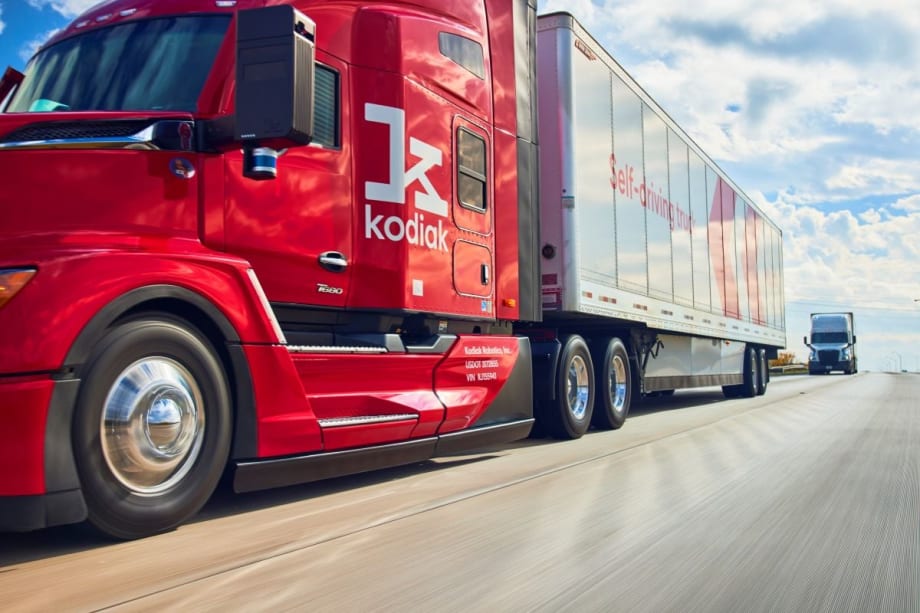
Safe autonomous trucks are a monumental technological challenge that appear to be coming soon to fleets in North America.
Photo: Kodiak AI
After a decade of predictions, promises, and postponements, autonomous trucks are poised to enter the North American trucking industry en masse.
But a great many questions remain about this new, transformative technology.
To add some clarity to this fast-moving issue, ACT Research hosted a video roundtable to discuss where this technology stands at the end of 2025.
Hosting the discussion were ACT Research analysts Lydia Vieth and Ann Rundle.
Their panel included:
The panel represented fleets, autonomous technology developers, and OEMs, providing insight from each aspect of the effort to deploy self-driving trucks.
To kick the discussion off, Vieth asked the panel what they felt were the biggest changes in autonomous technology in the past four years.
I think greater transparency and the greater trust that it builds. There has been a buildup of transparency inside of the safety case conversation. And so how we measure safety, how folks are validating it, how we continuously work toward improving it.
We've moved from the hypothetical to what's actually going on and what's going on inside that safety case, so that there's a comfort level for us as a carrier, there's a comfort level when a customer engages us, how we can go speak to that safety case and how it translates to an operational execution.

ACT Research hosted a panel discussion focused on the near-term deployment of autonomous trucks.
Screen capture: ACT Research
When I started at Kodiak and told people I work for a little company that’s building trucks to drive themselves, people, people generally looked at me as if I were completely insane.
And I think over the last few years, that’s really shifted.
I think that, first of all, autonomous vehicles in general have come from being at the edges of things that people weren't really paying attention to. Now, they are something that people recognize is not just kind of the future, but in the present.
It seems like something that is sort of an inevitability. That this is going to end up part of our freight ecosystem. And I think the progress in trucking has made a huge difference.
A year ago, there were zero driverless trucks in the world. And today, Kodiak has a fleet of 10 driverless trucks that are actually delivering freight every day for customers in the West Texas oil country.
So we're operating around the clock with those trucks and solving real business problems and real business needs.
So this is a technology that's here. And that makes a big difference in terms of how people look at it and look at adopting the technology.
I'll compare today to late 2019 early 2020. Because that was when there was a spate of deals that was announced. Every major OEM announced partnerships, Paccar included.
And at that point, there was no redundant platform. In order to put an autonomous driver safely onto a truck, you really need a purpose-built platform with all of the proper redundancy for, of course, brakes and steering and power, along with a list of about of about 20 other things.
The key point is you just can't have a truck on a public road until you have all of this special redundancy and engineering. And in 2020 that just wasn't a thing in trucking.
Now, in 2025 you have several platforms, from at least three of the four major OEMs, that are in late stages of development.
And so in 2020, autonomous trucks were more of a idea. And now it's more of a soon-to-be-completed R&D project.
Next, Veith asked the panelists what they think needs to happen next in order for autonomous truck technology to scale into mass production.
We tend to focus on the OEMs when we’re talking about autonomous trucks. But the OEM is really just sort of the quarterback for the autonomy case in trucking.
We have to remember that there are dozens of suppliers working with us: brake, steering, power, sensors, sensor-cleaning and so on.
And all of these companies are working very hard side by side with us to make this happen, and so we need to give them a ton of credit as well for coming with us on the journey.

Daniel Goff of Kodiak AI thinks autonomous trucks must deliver on the utility front for fleets.
Screen capture: ACT Research
The Tier One part of this effort is really critical. And this has been core to Kodiak’s approach. And the approach for most folks in the industry is that this really only works as an ecosystem.
You know, Kodiak, we know how to build an autonomous system and an autonomous driver. But there are many, many parts of this system that are not our area of expertise.
That's why working with our ecosystem on the supplier side, on the tier one side, the OEM side, is so critical to the deployment of this technology. The technology cannot work without those pieces.
What, Vieth then asked, did the panelists see as the greatest current challenges for deploying autonomous truck technology into fleet operations?
I think the biggest challenge is there's a lot of complexity to orchestrate and a lot of work still to do.
None of this is easy.
And there are three technology pillars we need to perfect to make autonomous driving a reality: Software and hardware are one leg of that stool.
You need safety. And people think that safety is part of the technology equation. But it's actually a totally different kind of skill set and idea.
In fact, we have a totally different team that is separate from our core engineering team that works on safety, evaluating the safety, being able to communicate the safety, and the safety case to folks like Josh and Paul. That’s so that they understand both that we can very definitively say we believe this product to be safe.
And we walk them through the extensive evaluation of our safety case that we have done to look at this problem from as many different angles as possible.
And the third piece of it is the product itself. And how do you actually make technology useful for fleets?
Just because the technology can drive from point A to point B doesn't mean you have a utility part that delivers for fleets. So we work really closely with our partners to pressure-test the technology.
Things like how to stage the trucks the right way. Because, believe it or not, the first and last 100 feet in a yard is really challenging from an autonomous truck perspective. How do we work through that? And how do we integrate those solutions with companies?
These are sort of the blocking and tackling things we are working on, that are actually the difference between autonomous vehicles being some sort of a curiosity, and something useful.
And I think that's where we're going to see the most work over the next few years is in building out that product case to expand, kind of the business case for where these, these pieces make sense, and where, where this can actually add value and not just be kind of a fun thing to watch.

Josh Hankins at J.B. Hunt says autonomous trucks must have a value proposition at every point in the supply chain to be successful.
Screen capture: ACT Research
Short term, long term, and throughout the life of the evolution of this technology, we've got to define what the value proposition is.
Paul made a great point: There has be value from an OEM perspective. There's got to be value or value from a carrier perspective. And there has to be value from an end customer, receiver, or shipper perspective.
So that's where autonomous technology has to make its way into cost models. It has to make its way into efficiency and engineering models.
But in the long term, how do you find that fit? How do you create that value proposition that fits inside the entire supply chain and demonstrate that value to every single person along the way? I think that is one of the biggest long-term challenges we face.
And there are many layers in all of that. Autonomous trucks are going to have to coexist with 4 million professional drivers on the roads.
How do you integrate manual driving with autonomous driving? And how do those solutions coexist? Dan and the Kodiak team are doing a great job of figuring that out in the panhandle of Texas.
There is also a public perception aspect to all of this. And I think that we're knocking that down a little bit over time.
But I like to compare this to the aviation industry: If a plane could get up and take off by itself, would everybody be comfortable with that?
And so we're going to have to make sure that the public is comfortable with the safety cases we state and the data that we put out there in order to insert this as a solution into the supply chain long term.
Watch for the panelists to discuss the question, "Will autonomous trucks take driving jobs away from humans?" in Part 2.

Volvo’s updated D13 promises lower emissions without sacrificing performance or fuel economy. Take a closer look at what changed inside the engine in this HDT Spotlight video.
Read More →
The Michelin X Multi Energy D2 is a regional haul drive tire engineered to help fleets improve fuel efficiency, durability and traction in demanding stop-and-go operations.
Read More →
ZF is expanding its North American commercial-vehicle presence with new transmission applications, electrification, trailer technology and autonomous-driving systems.
Read More →
Could Tesla’s camera-only autonomous driving technology work on an 80,000-pound Semi? In this commentary, HDT's Deborah Lockridge takes a look at Tesla, Cybercab, and how autonomous trucks see the road.
Read More →
Kodiak AI says its driverless long-haul safety case is 93% complete and it remains on track to begin commercial operations by year-end 2026.
Read More →
The U.S. Department of Transportation issued a new automated-vehicle strategy that outlines plans for driverless-truck regulations, cross-state freight corridors, and federal safety standards.
Read More →
The Port Authority of New York and New Jersey announced millions in incentives for zero-emission drayage trucks, yard tractors, and new charging hubs near the port.
Read More →
A SPAC deal could provide PlusAI with up to $300 million as it works toward a 2027 commercial launch of factory-built autonomous trucks.
Read More →
The National Highway Traffic Safety Administration says it lacks authority to regulate medium- and heavy-duty truck engines separately from complete vehicles, but the existing standards have not yet been eliminated.
Read More →
Detroit isn’t starting from scratch to meet EPA 2027 diesel emissions standards. Its Gen 6 DD13 and DD15 engines keep much of today’s platform while updating the fuel and aftertreatment systems.
Read More →