




Paccar Makes Major Move into Global Autonomous Truck Market
Paccar announced a global alliance with autonomous truck technology start-up Aurora to develop, test and commercialize autonomous Kenworth and Peterbilt trucks.

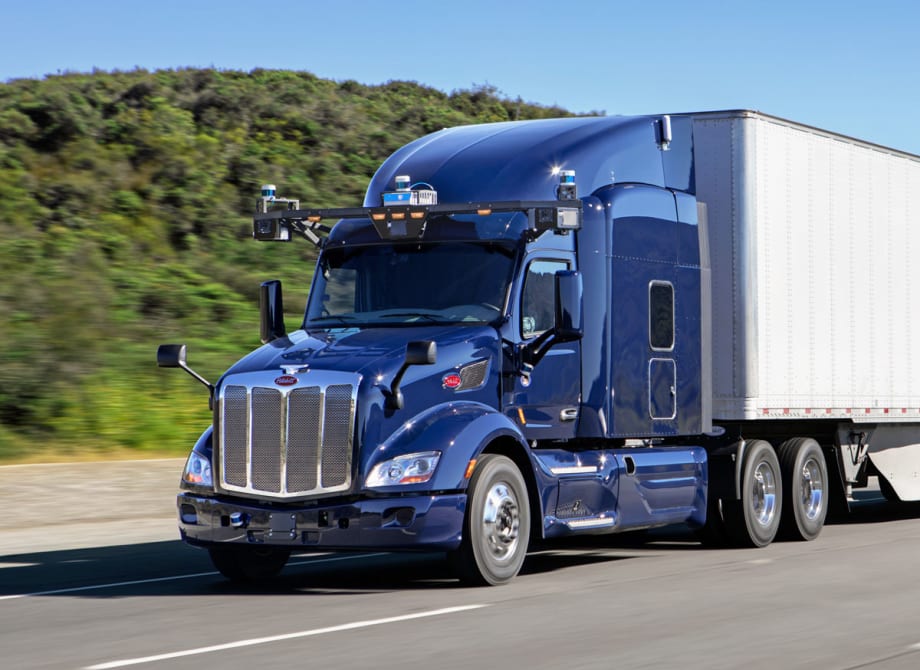
A Peterbilt Model 579 fitted with Aurora-developed autonomous guidance system during road tests.
Photo: Paccar
Paccar is the latest truck maker to team up with a technology startup in the quest to develop autonomous technology for heavy-duty trucks.
Paccar and autonomous technology development company Aurora signed a global, strategic agreement to develop, test and commercialize autonomous Peterbilt and Kenworth trucks. This collaboration will integrate Paccar’s autonomous vehicle platform with the Aurora Driver software to enhance the safety and operational efficiency of Paccar’s customers, the OEM said in a statement.
In the strategic partnership, Paccar will provide autonomous-enabled vehicles with durability and reliability based on its decades of engineering and manufacturing investments and expertise, as well as aftermarket parts distribution, finance and other transportation solutions, Paccar said.
It's not that Paccar hasn't been working on autonomous technology on its own. Peterbilt demonstrated the "cruise control of the future" back in 2015, when the term "advanced driver assistance system" was not in trucking's general vocabulary. And in 2018, it showed reporters the Paccar Innovation Center in Sunnyvale, California, where one of its development projects was a Level 4 autonomous truck. It also has collaborated with Embark and on platooning with Peloton.
Aurora (which last month announced it was buying Uber's self-driving vehicle business) will provide self-driving technology, including hardware, software and operational services. Both partners will work closely together on all aspects of the collaboration, from component sourcing and vehicle technology to the integration of the Peterbilt and Kenworth vehicles with the Aurora Driver. The partnership also includes vehicle validation at the Paccar Technical Center and production support in Paccar factories.
Paccar said in its press statement that the goal of this collaboration is to improve freight efficiency and safety for its customers. Kenworth T680 and Peterbilt 579 trucks using the Aurora Driver are expected to be deployed in North America in the next several years.
“Aurora is excited to take this next step in our collaboration with Paccar," said Chris Urmson, Aurora co-founder and CEO, in the news release. "Working together, we’ve been impressed with Paccar’s product engineering, manufacturing capabilities, and commitment to enhancing its customers’ operational safety and efficiency. This partnership brings us one step closer to unlocking the autonomous freight market and delivering goods to those who need them.”
The announcement comes on the heels of Aurora's announcement that it was buying Uber's self-driving vehicle business, and that its first market-ready product would be an autonomous truck. In that announcement, Aurora noted that Uber Advanced Technologies Group's team and technology would accelerate its mission to develop autonomous vehicles and deliver its first market-ready products in a quick, safe manner that will be “broadly” available in North America.
The Paccar-Aurora announcement is the latest in a string of strategic alliances between commercial vehicle OEMs and autonomous vehicle technology developers, including Daimler Trucks and Torc Robotics, in addition to another agreement between Daimler and Waymo. Additionally, Traton and Navistar have announced partnerships with TuSimple.
More Equipment

How Volvo Updated Its D13 for EPA 2027 [Watch]
Volvo’s updated D13 promises lower emissions without sacrificing performance or fuel economy. Take a closer look at what changed inside the engine in this HDT Spotlight video.
Read More →
Michelin Tire Improves Efficiency and Durability for Regional Fleets
The Michelin X Multi Energy D2 is a regional haul drive tire engineered to help fleets improve fuel efficiency, durability and traction in demanding stop-and-go operations.
Read More →
ZF Expands Commercial Vehicle Push in North America
ZF is expanding its North American commercial-vehicle presence with new transmission applications, electrification, trailer technology and autonomous-driving systems.
Read More →
Tesla Wants a Self-Driving Semi. Are Cameras Enough?
Could Tesla’s camera-only autonomous driving technology work on an 80,000-pound Semi? In this commentary, HDT's Deborah Lockridge takes a look at Tesla, Cybercab, and how autonomous trucks see the road.
Read More →
Kodiak: Driverless Long-Haul Truck Launch on Track for 2026
Kodiak AI says its driverless long-haul safety case is 93% complete and it remains on track to begin commercial operations by year-end 2026.
Read More →
What DOT’s Automated Vehicle Strategy Means for Trucking
The U.S. Department of Transportation issued a new automated-vehicle strategy that outlines plans for driverless-truck regulations, cross-state freight corridors, and federal safety standards.
Read More →
East Coast Port Launches $45M Electric Truck Push
The Port Authority of New York and New Jersey announced millions in incentives for zero-emission drayage trucks, yard tractors, and new charging hubs near the port.
Read More →
PlusAI Going Public to Fund Autonomous Truck Launch
A SPAC deal could provide PlusAI with up to $300 million as it works toward a 2027 commercial launch of factory-built autonomous trucks.
Read More →
NHTSA Moves to Rewrite Truck Fuel-Economy Rules
The National Highway Traffic Safety Administration says it lacks authority to regulate medium- and heavy-duty truck engines separately from complete vehicles, but the existing standards have not yet been eliminated.
Read More →
Detroit Opens Orders for EPA 2027 Engines
Detroit isn’t starting from scratch to meet EPA 2027 diesel emissions standards. Its Gen 6 DD13 and DD15 engines keep much of today’s platform while updating the fuel and aftertreatment systems.
Read More →