




Embark's Self-Driving Truck Goes L.A. to Florida in Latest Journey
Autonomous vehicle technology company Embark has completed a 2,400-mile, coast-to-coast journey in one of its self-driving trucks.
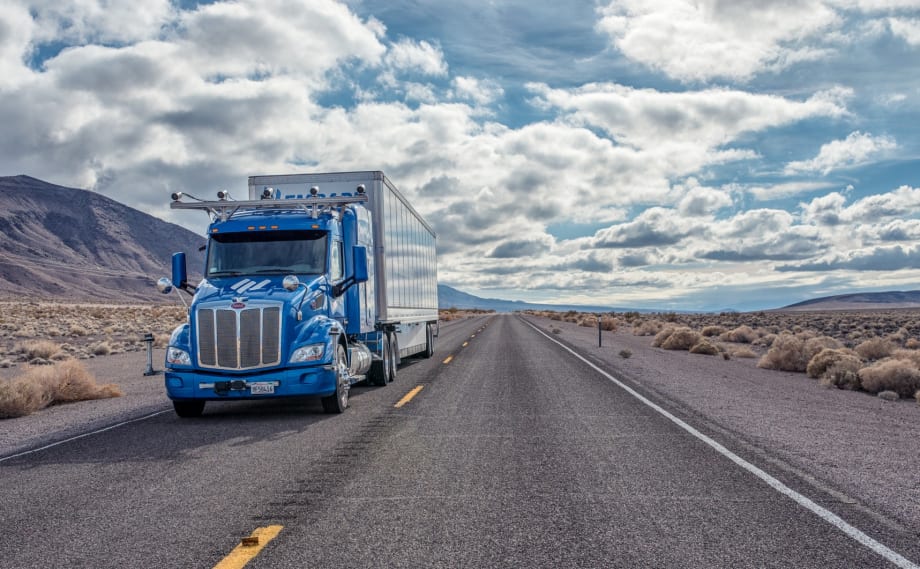
Embark's self-driving truck just completed a five-day, 2,400-mile journey across the U.S. Photo: Embark
Embark's self-driving truck just completed a five-day, 2,400-mile journey across the U.S.Photo: Embark
Autonomous vehicle technology company Embark has completed a 2,400-mile, coast-to-coast journey in one of its self-driving trucks.
The journey began in Los Angeles, with the truck traveling along Interstate 10, one of the country’s busiest freight corridors. It ended five days later in Jacksonville, Florida. The company said the journey helps prove that mapping out long-distance trips is not a barrier for self-driving trucks.
Since last year, the San Francisco-based startup has been running its self-driving Class 8 trucks on routes between Los Angeles and El Paso, transporting products on a limited basis for the manufacturing company Electrolux. But this latest journey is much longer, a significant milestone for the company, which envisions future where autonomous trucks can increase efficiency by running long-haul routes 24 hours a day.
“When we announced our Los Angeles to El Paso route we promised that was the just first stage of a much larger expansion,” said Alex Rodrigues, Embark CEO. “The coast-to-coast demonstration we completed today is four times longer than our El Paso route, which was already the longest in the world.”
Currently, Embark’s trucks have a professional driver in the cab as a safety measure, actively monitoring the road, supervising the system and ready to take over control when needed. Because the driver was constricted by hours-of-service rules, the trip took longer than it would have had it been able to run without those limitations.
Once Embark’s tech is ready and cleared to run on its own, Embark expects the trip to take only two days in total, according to TechCrunch, which also reported that the truck went "hours at a time with no disengagements, and when they did occur they were usually only a few seconds," according to Embark CEO Alex Rodrigues.
“One of the most exciting aspects of this technology to our partners, like Electrolux, is being able to shrink their supply chains and take advantage of just-in-time manufacturing strategies.” Rodrigues explained. “Similarly, the growing e-commerce industry requires these sorts of two-day routes to get products to consumers in an acceptable time frame.”
Embark’s system doesn’t rely on high-resolution maps of the road that some of its competitors use, meaning that the company didn’t have to map out the route inch-by-inch before the journey, according to the company. Embark’s system instead uses machine learning to reconstruct a model of the world using its sensors in real time.
Embark’s fleet has been growing in recent months, increasing from two trucks to five, Rodrigues said the company plans to purchase a total of 40 trucks by the end of the year.
Related: Embark's New Road to Autonomous
More Drivers

Truck Drivers Need More Than Another Alert
Fleets have more visibility into truck health, safety events, and driver activity than ever. The next challenge is turning all that information into useful guidance for the person who has to decide what to do next.
Read More →
FMCSA Removes 110 Truck Driver Training Schools from Certified ELDT List
Federal regulators also are targeting more than 160 additional training providers and launching a nationwide audit of third-party CDL skills testers as part of a broader crackdown on trucking fraud.
Read More →
Hours of Service Pilot Programs: FMCSA Readies for 2027 Rollout
Two pilot programs could eventually reshape hours-of-service rules, giving truck drivers options to pause their 14-hour clock or use longer split sleeper rest periods.
Read More →
Medical Cards, English Proficiency Reshape Roadcheck Violations
Medical-card violations jumped to the top of the driver out-of-service list during CVSA’s 2026 International Roadcheck, while English-language proficiency violations appeared among the leading violations for the first time.
Read More →
Driver Trust Can Make or Break the Success of Fleet Safety Technology
New Teletrac Navman research suggests that onboarding, transparency about driver data, and positive feedback can play a significant role in how commercial drivers respond to safety and coaching technology.
Read More →
EEOC Sues KLLM Over Alleged Sex Discrimination in Driver Training
KLLM is facing a federal sex-discrimination lawsuit over policies the EEOC alleges put female truck driver trainees at a disadvantage.
Read More →
FMCSA Moves to Codify English Language Requirements for Commercial Drivers
By changing regulations on English-language proficiency requirements for commercial drivers, rather than relying on a guidance memo, the FMCSA said future administrations won't be able to walk back the Trump administration's stricter enforcement with just a memo.
Read More →
Drivers Put Western Star Trucks to the Test at Star Nation Experience
Watch to get an inside look at the Western Star trucks, technology, and community behind the Star Nation Experience 2026!
Read More →
Trump Administration Looks to Put More Veterans Behind the Wheel
The Freedom Haulers program pulls together existing and expanded programs at several federal agencies to recruit veterans to drive commercial heavy-duty trucks and cut the red tape for them to get a CDL, training, and employment.
Read More →
Putting Mack’s Command Steer to the Test
A test drive of Mack’s Command Steer active steering system evaluates how it can make truck driving easier and less tiring.
Read More →