




Navistar Hits 16 MPG with SuperTruck II
Navistar said its SuperTruck II project truck achieved a 170% improvement in freight efficiency in road tests.

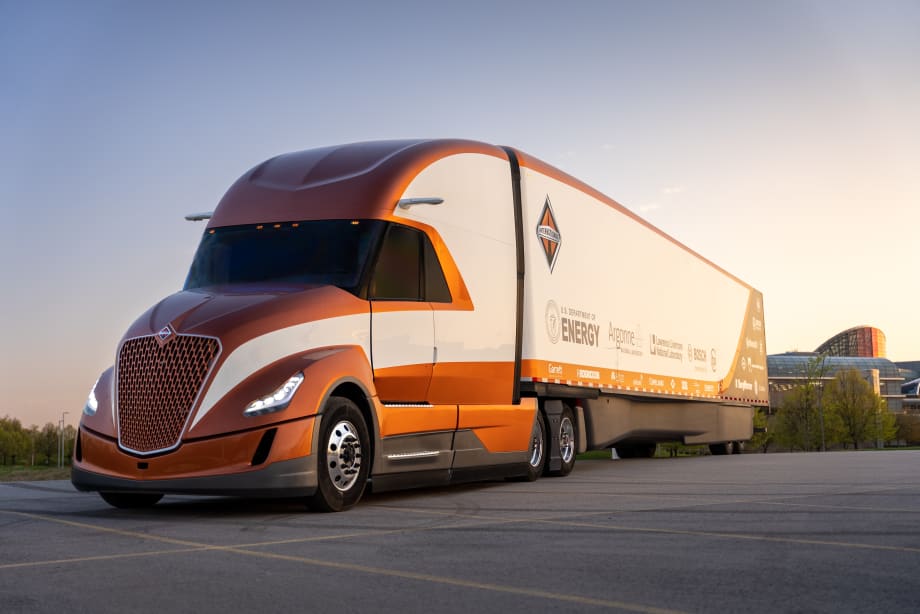
Navistar's SuperTruck II recently logged 16 MPG in testing.
Photo: Navistar
Navistar announced that its SuperTruck II evaluation truck obtained 16 mpg during recent evaluation test runs, thanks to hybridization, aerodynamics, and other technologies.
Overall, the OEM said, SuperTruck II registered a 170% improvement in freight efficiency, among other advancements, over the 2009 baseline vehicle. It also achieved 55% engine brake thermal efficiency.
The International SuperTruck II project is a partnership between the truck maker and the U.S. Department of Energy. The ongoing SuperTruck vehicle evaluations are a joint project between several commercial vehicle manufacturers and DOE. The goal is to explore emerging technologies that can be used on future Class 8 trucks to reduce greenhouse gas emissions while increasing both fuel economy and freight efficiency. In SuperTruck 1, Navistar's SuperTruck beat DOE efficiency goals and attained 13 mpg.
The Interational SuperTruck II uses electric motors in conjunction with a conventional truck powertrain to provide additional torque when needed to reduce the amount of fuel the engine burns.
In addition to hybridization, the International SuperTruck II concept truck also proved innovative technical approaches to weight reduction, including rolling resistance technologies, aerodynamic improvements, and powertrain technologies, the OEM said.
Hybridization Path Toward Full Truck Electrification
“With co-funding by the DOE, Navistar engineers experimented with prospective technologies not currently available in the Class 8 truck market to accelerate the impact of sustainable mobility," said Russ Zukouski, chief engineer, global innovation, and principle investigator for International's Supertruck programs.
"The team concentrated its design on high-voltage electrification, utilizing hybrid technology on a path toward full electrification that has the potential to be commercialized in fully electric vehicles and improve customers' total cost of ownership and business operations."
According to the announcement, "Navistar is the only OEM to build a trailer to provide the most accurate testing results possible," said Dean Oppermann, chief engineer, advanced truck. "It includes a 100% composite box designed for minimum aerodynamic drag with light weight, integrated cross members, controlled underbody flow with composite aero treatments, next-generation solar panels with connectivity options, and ride height control."
'Full-System Approach'
International SuperTruck II was built as a hybrid vehicle featuring an internal combustion engine with high-voltage accessories and technologies, developed in partnership with Bosch.
Engine improvements were made in key areas including combustion, friction, gas exchange, and airflow through the engine.
A redesigned cylinder head with dual overhead cam engine and enhanced fuel system resulted in a 2% fuel economy improvement when compared to International SuperTruck I.
Aftertreatment system improvements included diesel exhausted fluid dosing, improved mixing and lower restrictions, new selective catalytic reduction (SCR) formulations for high-NOx reduction, and reduced cold-start activation time.
"A full system approach was required to achieve 55.2% brake thermal efficiency," said Jim Cigler, chief engineer, advanced engine. "Opportunities were identified by internal engineering teams along with research partner Argonne National Laboratory through detailed analysis and simulation.
"System suppliers such as Bosch, Jacobs Vehicle Systems, and Applied Nano Systems (ANS) brought new approaches to key systems that enabled laboratory success and yielded real-world fuel economy improvements. Navistar was able to identify new ways to push our engines to the next level of efficiency."
International SuperTruck II highlighted connectivity with next-generation predictive cruise control, as well as leveraging technologies and information within the larger Traton Group to explore vehicle-to-everything technologies to enhance safety and vehicle efficiencies, according to the OEM.
"Our goal is to continue to advance internal combustion engine technology as efficiently and sustainably as possible until there is parity with zero-emissions vehicles," said Opperman. "Development of both technologies concurrently ensures a smooth transition of technology to best serve customer needs. We are focused on the entire product ecosystem — product development itself, as well as infrastructure charging, service and support of vehicle operation, end of life for batteries."
Navistar's SuperTruck II project vehicle shares many of the same techologies and systems that Freightliner announced on its own SuperTruck II collaboration with DOE earlier this year.
More Fuel Smarts

How Volvo Updated Its D13 for EPA 2027 [Watch]
Volvo’s updated D13 promises lower emissions without sacrificing performance or fuel economy. Take a closer look at what changed inside the engine in this HDT Spotlight video.
Read More →
Diesel Price Spike Shortens Payback for Natural Gas Trucks, Report Says
Energy Vision estimates fleets could recover the higher purchase price of an RNG-fueled Class 8 tractor in 1.3 to 2.8 years under current fuel-price scenarios.
Read More →
Calstart Becomes Catalyst Mobility, Reflecting Broader Focus
Calstart is now Catalyst Mobility, reflecting the nonprofit’s growing national role in clean transportation, including zero-emission trucks, infrastructure and incentive programs.
Read More →

Record Diesel Prices Squeeze Trucking Fleets
Average U.S. diesel prices have climbed to nearly $6 a gallon, surpassing the 2022 record as tight refinery capacity and Middle East disruptions keep fuel costs elevated.
Read More →
How Fuel Delivery Shapes Engine Performance
Fuel delivery depends on more than what happens at the injector. For fleet, maintenance and technical professionals, looking at the full path from pump to injector can provide useful context for understanding engine performance.
Read More →
East Coast Port Launches $45M Electric Truck Push
The Port Authority of New York and New Jersey announced millions in incentives for zero-emission drayage trucks, yard tractors, and new charging hubs near the port.
Read More →
California Bill Could Shed Light on Electric Truck Prices
Why do battery-electric Class 8 trucks remain so expensive? A California bill headed to Gov. Gavin Newsom would give fleets and state agencies more visibility into what manufacturers charge.
Read More →
Detroit Opens Orders for EPA 2027 Engines
Detroit isn’t starting from scratch to meet EPA 2027 diesel emissions standards. Its Gen 6 DD13 and DD15 engines keep much of today’s platform while updating the fuel and aftertreatment systems.
Read More →
Zero-Emission Truck Corridor Planned for West Coast
California, Oregon, Washington, British Columbia and Baja California are coordinating plans for truck charging and hydrogen fueling from Canada to Mexico.
Read More →
A Closer Look at Kenworth’s Electric T880E Vocational Truck [Video]
Learn more about Kenworth's T880E battery-electric vocational truck at the Paccar Technical Center, including its range, applications, upfitting considerations, and PTO options, in this HDT Spotlight video.
Read More →